Articles · 14
Landfill Gas Does Not Wait: A Buyer for the Engine in the Hours the Grid Pays Nothing
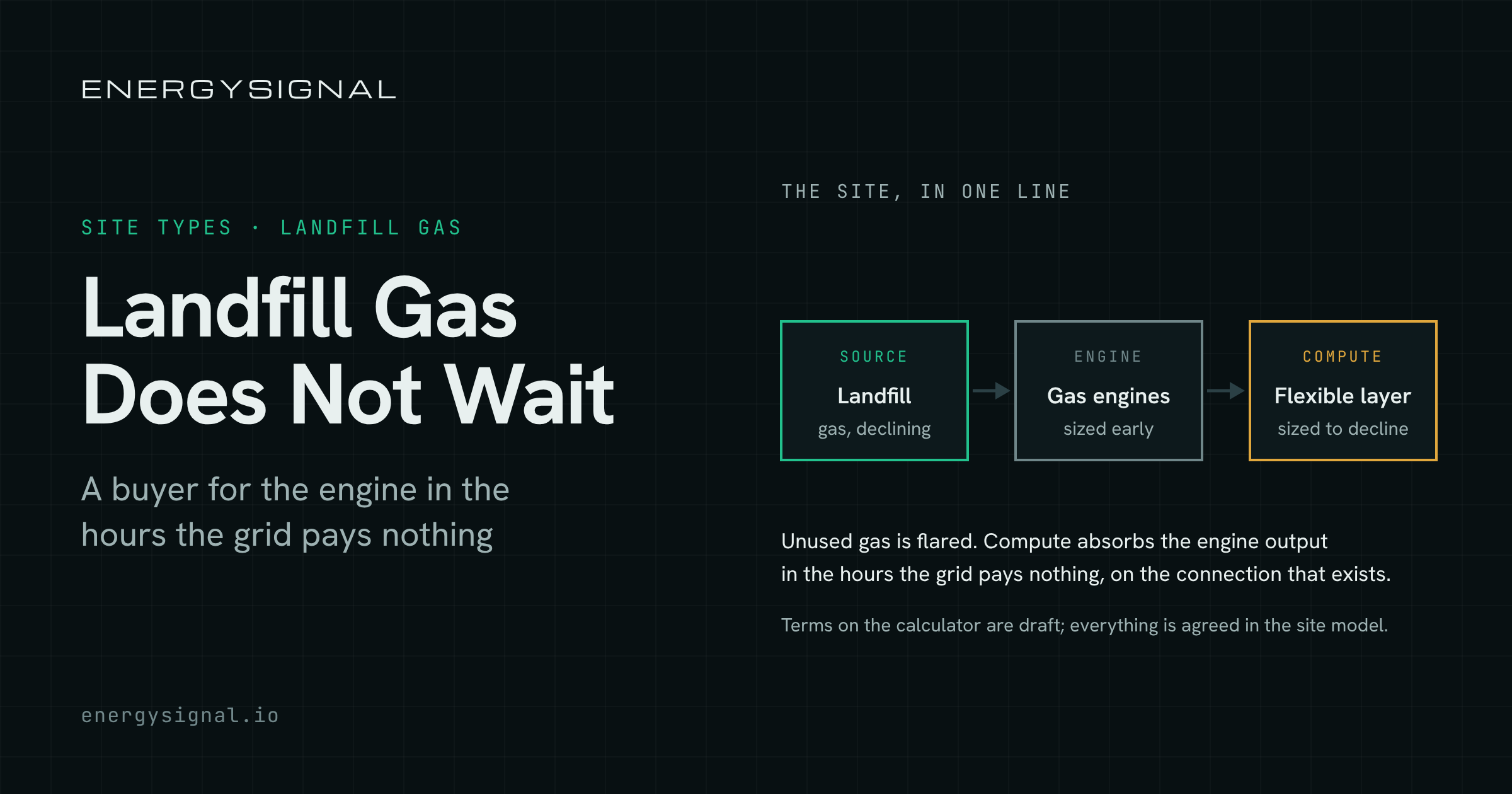
A landfill makes gas whether anyone wants the power or not, and the law says use it or flare it. What follows is why engines and a connection sized for the early years, on a site whose gas declines for decades, suit a flexible load better than almost any other buyer, and what to have ready before you run the numbers.
The EU's Landfill Directive has required since 1999 that "Landfill gas shall be collected from all landfills receiving biodegradable waste and the landfill gas must be treated and used. If the gas collected cannot be used to produce energy, it must be flared." Landfill gas is roughly half methane, and reciprocating engines are the usual way of turning it into power. What that rule has produced is a fleet of small engines on remote sites, each with a grid connection built for the peak gas year.
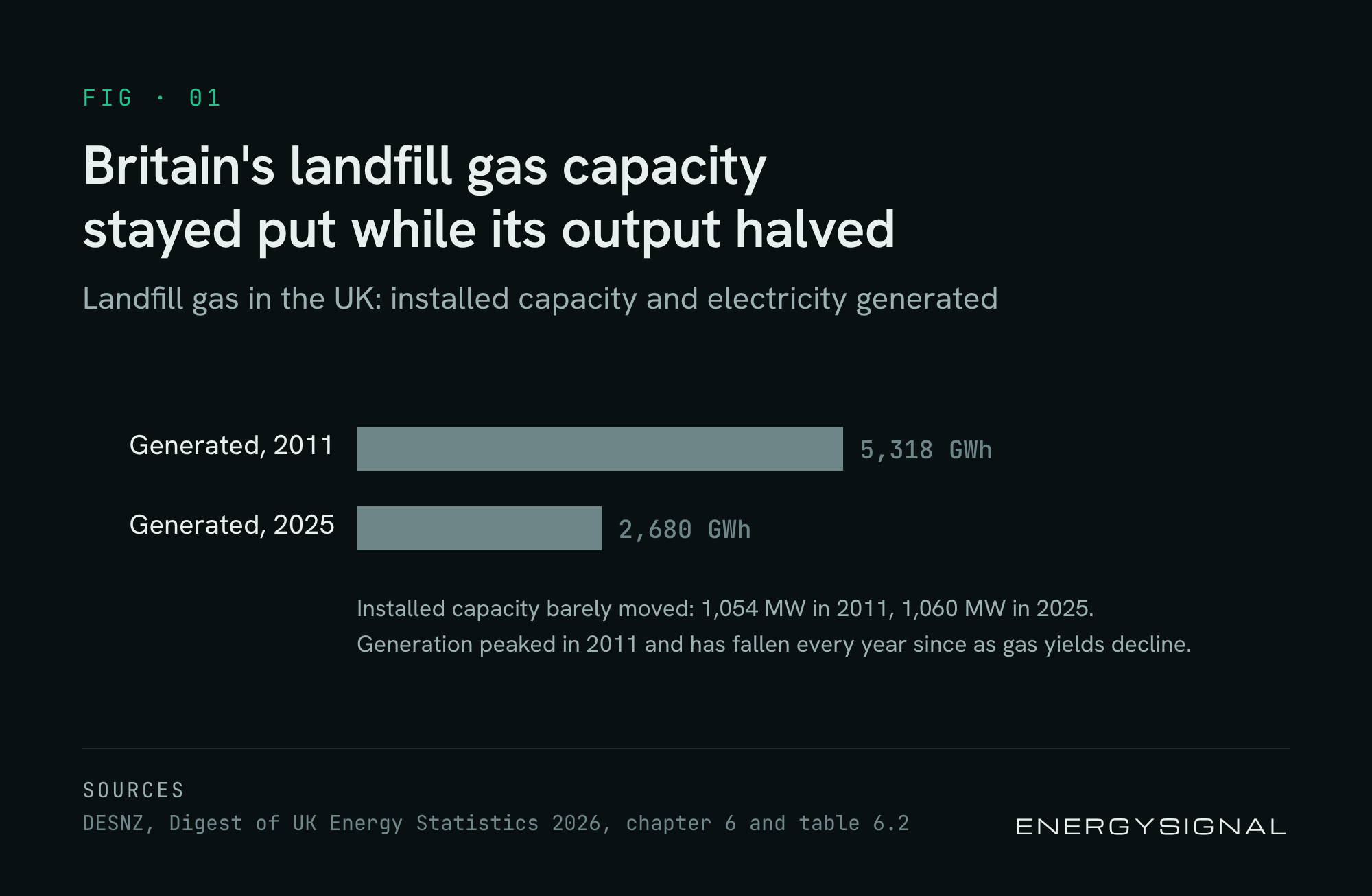
The peak passes. In the United Kingdom, where the statistics are clearest, the Digest of UK Energy Statistics reports that "Generation from landfill gas peaked at 5.3 TWh in 2011 but has fallen in each year since then" and that "The decline in landfill gas generation reflects the continuing reduction in gas yields from landfill sites." Its tables put generation at 5,318 GWh in 2011 and 2,680 GWh in 2025, while installed capacity stayed at about 1,060 MW throughout. In Czechia, landfill gas produced 66.6 GWh in 2025, according to the energy regulator, a small and falling share of the country's biogas, and a ban on landfilling usable waste from 2030 brings the decline forward. So the same engines now run on half the gas, through a connection that is half spare.
Why a landfill gas site suits compute
The gas does not wait. Gas that is not burned in an engine is burned in a flare, and the flare earns nothing. So an engine that runs in the hours the grid pays nothing still beats the flare, and a load that pays for those hours beats both. Compute can be the buyer that keeps the engine running.
The engines and the connection outlast the yield. Both the engines and the export connection were sized for the peak year, and the gas now falls year by year. That leaves spare engine capacity and spare connection capacity, already paid for. A flexible layer can be sized to the decline, with enough compute to absorb the engine's output in the cheap hours now, stepping down as the gas does, and with equipment that can be moved when the site's time is over. The site model carries the yield curve. The web calculator says only that output falls after closure.
The grid pays nothing in the hours that matter. A landfill engine runs around the clock, which means it is running through the spring and summer middays and the windy nights when prices across Europe fall to zero or below. Those are the hours compute buys, on site, at a price above what the market would pay. In the hours that do pay, the export carries on as before.
Heat has few takers, so the case is the power. Landfills are remote, and a neighbour who can use warm water is rare. Leachate treatment and a nearby greenhouse are the realistic uses, and the calculator names both. Where neither exists, the case rests on the power alone, and the calculator says so rather than counting heat that has nowhere to go.
Nothing about the gas collection, the engines, the permits or the flare needs to change, and the flare stays as the backstop. What changes is that the engine has a buyer in every hour.
What the calculator asks, and what to have ready
Our quick check treats landfill gas as a source in its own right, with its own lift and limit lines. It asks for the engine's power band, the spare hours, what the power earns in them today, whether there is spare grid capacity and whether any heat use exists. For a landfill site, it helps to have the following ready:
- The engine capacity in kW and its run hours, and the gas yield curve the operator uses for planning
- The connection: export capacity, and whether import capacity is available on the same connection
- What the power earns today, as a band, and when any support for landfill gas electricity ends
- Any heat use on or next to the site: leachate treatment, a greenhouse, a neighbouring plant
- Space for containers near the engine compound, road access, and the data link, which at a remote site is one of the first things we would check
The calculator shows a return a year as a range, before the operator's own investment, and the terms behind it are draft terms. The site model goes further and works from the yield curve and a year of the engine's metered output. The quick check is at energysignal.io/calculator/gas-engines.
Start light, and let the site run down with a buyer
The arrangement we have in mind puts a core of AI or cloud capacity on firm supply, and next to it a flexible layer of compute that uses surplus or curtailed energy and can step back within minutes when the core or the grid needs the power. The flexible layer can also go in first and earn from the site while firm supply and grid upgrades are built.
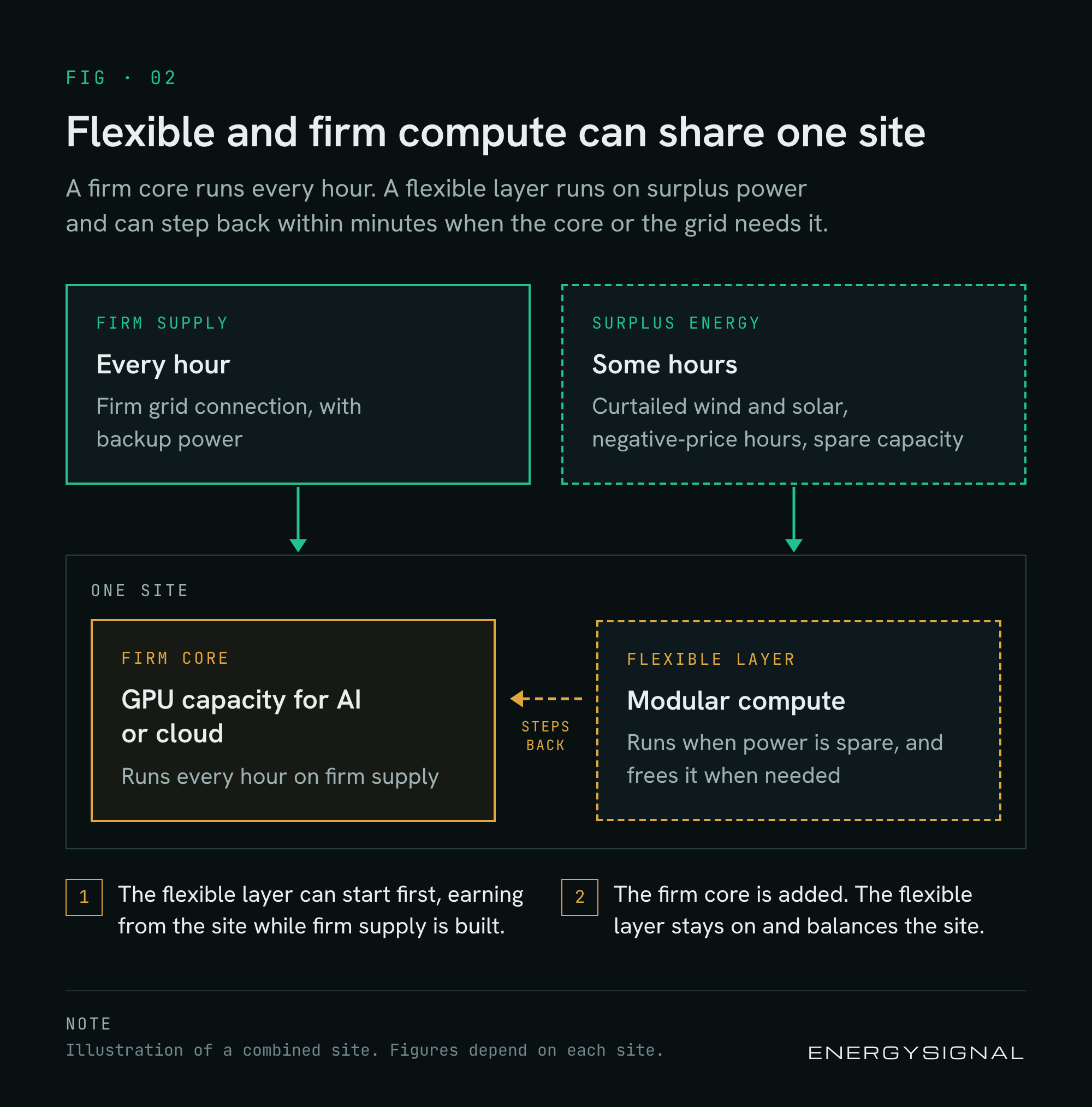
A landfill is about the clearest case of starting light that we can think of. The gas is finite and the engines are already there, so a flexible layer that can be scaled down and moved later matches the site's own curve. And where a landfill sits next to a larger connection or an industrial estate, the flexible layer can be the first step toward a firm core elsewhere on the same connection.
We are here to help hosts work out what their site is worth. The calculators at energysignal.io/calculators are a good first look at what a site could be valuable for, and for a landfill the gas engine calculator is the one to start with: energysignal.io/calculator/gas-engines. If you would rather talk it through, write to us at info@energysignal.io and we can go through your site with you and what it might be worth.
Also in this series
- Biogas After the Tariff: why a biogas plant suits compute when the support ends
- Methane You Drain Is Power You Can Use: coal mine methane, the EU deadline and compute on the surface
Sources
- Council Directive 1999/31/EC on the landfill of waste, Annex I, point 4.2
- US EPA Landfill Methane Outreach Program, Basic Information about Landfill Gas
- Department for Energy Security and Net Zero, Digest of UK Energy Statistics 2026, chapter 6 and table 6.2, July 2026
- Energetický regulační úřad, Roční zpráva o provozu elektrizační soustavy České republiky 2025, 2026
- The source and limit lines for landfill gas, the price bands and the heat wording are those of EnergySignal's site calculators: energysignal.io/calculators
Information only, as of the date shown. Not an offer, and not legal, tax, regulatory or investment advice. Any arrangement is agreed only in signed agreements.