Articles · 02
Beyond the Big Hubs: Europe's Search for Accessible Power
The map is moving
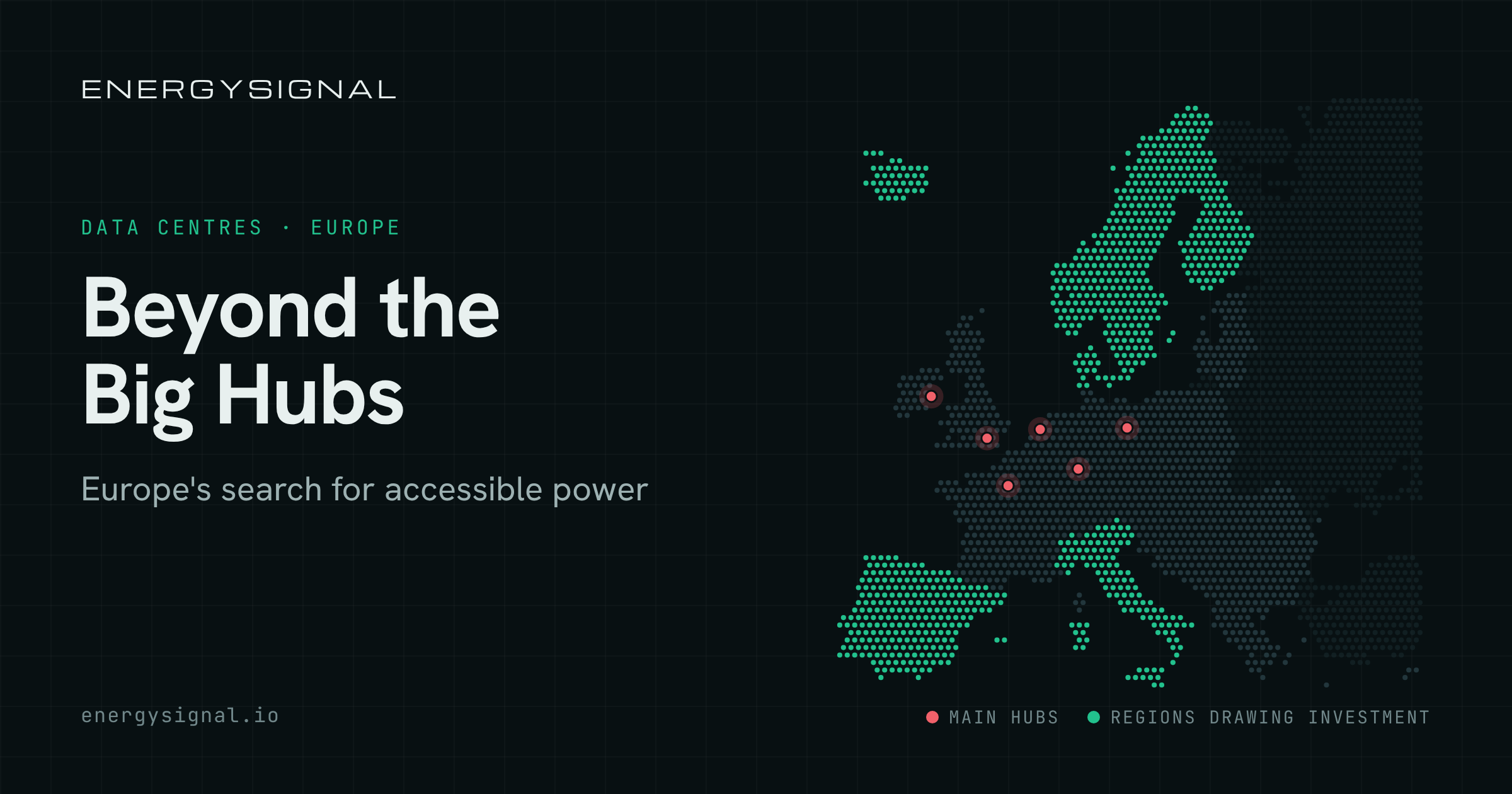
Europe's established data centre hubs are running into the limits of their grids, and new compute is going where power can actually be connected. Dublin is one of Europe's largest hubs, with over 80 data centres, and its growth has slowed because energy supply and grid connections have not kept pace (A&L Goodbody).
Meanwhile, power is going unused elsewhere. In 2025, Sweden's SE2 price zone led Europe for negative electricity prices, because its hydropower could not be sent south to where most people live (oEnergetice). We think the next wave of European compute will follow that energy.
The hubs have hit their limits
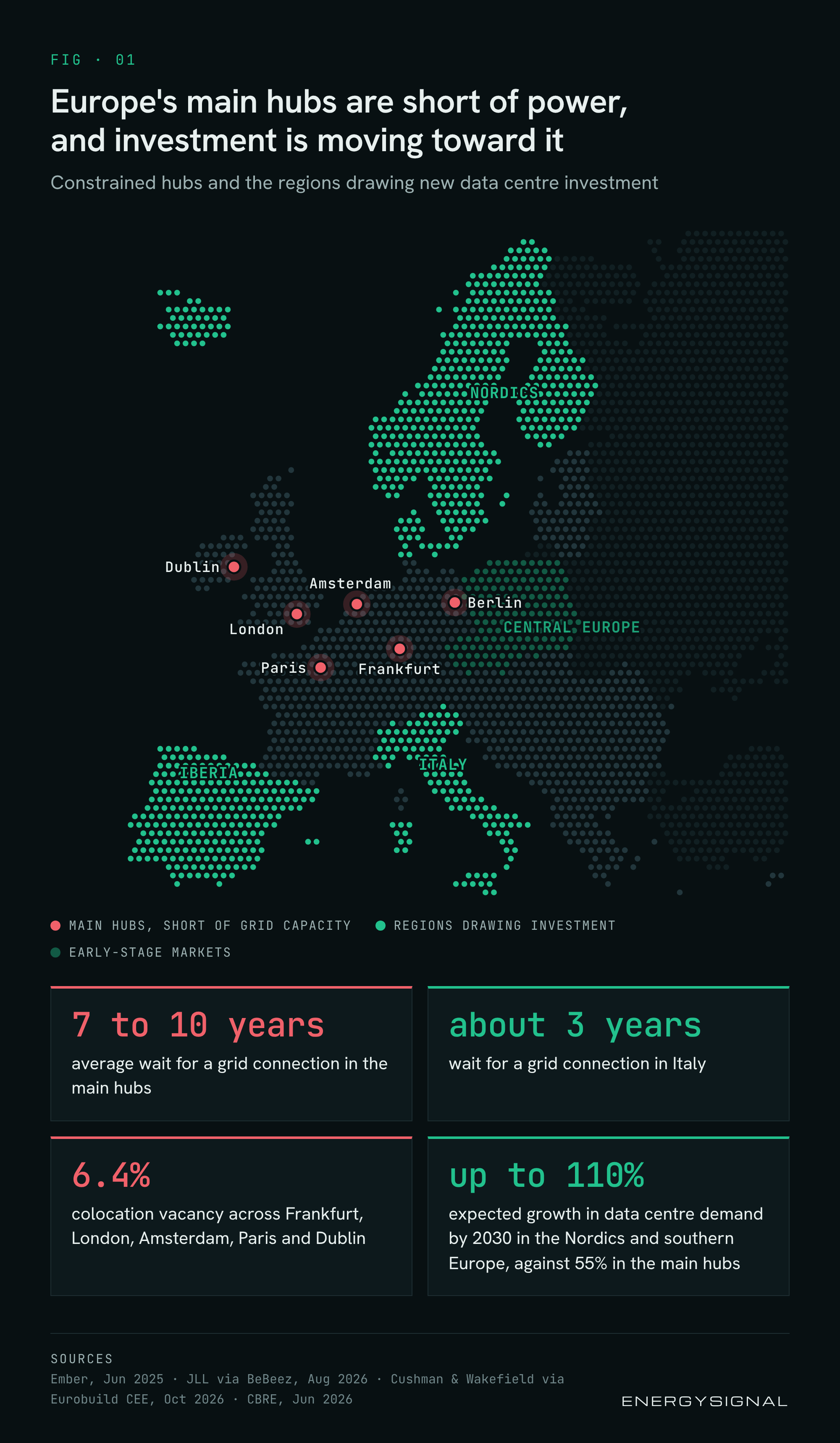
Power that can be connected is the input that matters most, and Europe's five main data centre markets, Frankfurt, London, Amsterdam, Paris and Dublin, are short of it. Colocation vacancy across the five stands at 6.4%. "The determining factor is increasingly where sufficient power can be secured, rather than simply where demand exists," says Assad Noori of JLL (BeBeez, reporting JLL).
A grid connection in these hubs takes 7 to 10 years on average, and up to 13 years for some sites (Ember).
Dublin. Data centres used 23% of Ireland's metered electricity in 2025, which is more than all urban households at 18% (CSO). The Greater Dublin region is now treated as fully constrained for large data centre development (Mason Hayes & Curran).
Frankfurt. Syna, a grid operator in the Rhine-Main region around the city, took in about 800 MW of additional demand for data centre grid capacity in the first half of 2026. Anyone applying now should expect to wait until the early or mid 2030s (ZfK).
Amsterdam. Supply grew more slowly here than in any other core market, held back by "power limitations and restrictions on developments above 70MW", according to CBRE (CBRE).
Berlin. In mid 2025, Stromnetz Berlin had only about 350 MW left for large connections, and data centre projects were asking for around 100 MW each. So it dropped first come, first served and moved to a proportional allocation (ZfK).
London. Three West London boroughs, Ealing, Hillingdon and Hounslow, have had electricity capacity restrictions since summer 2022, and those restrictions have stalled new housing. The transmission upgrades that would fix this are still on their original timelines (Greater London Authority). The UK now gives its AI Growth Zones priority access to whatever grid capacity is available, and offers data centres bill discounts only where they help take pressure off the network (Data Center Dynamics).
Where the search is going
Investment is following the power. Cushman & Wakefield reports that it is "increasingly spreading beyond established hubs such as London, Frankfurt, Amsterdam, Paris and Dublin", and that the Nordics and Southern Europe are drawing developers who have land and a chance of securing power (Eurobuild CEE, reporting Cushman & Wakefield). Around Frankfurt and Paris, CBRE sees development pushing out into the surrounding areas, where land and power are easier to get (CBRE). Ember expects data centre demand in less congested markets such as the Nordics and southern Europe to grow by up to 110% by 2030, against 55% in the established hubs (Ember).
The Nordics. In Sweden, "hydro and onshore wind sit predominantly in the north, the largest industrial and population centres are in the south", and transmission southwards has not kept pace (Nordic Energy Research). So power is plentiful where few people live. In northern Norway, Stargate Norway, a partnership of Nscale, Aker and OpenAI, plans 230 MW of initial capacity near Narvik, running entirely on hydropower (Nscale).
Iberia. In Spain, data centres hold 6,329 MW of the demand access that Red Eléctrica has granted on the transmission grid, 34.2% of the total, but none of it is in service yet (Red Eléctrica). In Portugal, Start Campus plans 1.2 GW of IT load at Sines by the early 2030s. Its first building, of 31 MW, opened in April 2025 (RTP).
Italy connects faster, in about three years (Ember). Even so, its grid operator Terna has had more than 100 GW of data centre connection requests for almost 600 projects (Teleborsa).
Central Europe is at an earlier stage. Czech distribution companies report about 1 GW of data centre connection requests, though some of those requests may overlap, so the real figure could be half. The country has 16 data centres above 500 kW (Forbes Česko). In Warsaw, operational capacity rose by only 2 MW in a year, to 159 MW, and the main obstacle is limited grid capacity around the city (Eurobuild CEE).
The new markets connect faster today, but requests are piling up there too. In our view the advantage is shifting to sites where power is already connected, or already going unused.
The challenges outside the hubs
Moving away from the hubs solves one problem and brings a few others with it.
The queues follow the rush. Speculative requests tie up capacity in the new markets too. The EU's Grids Package, published in December 2025, proposes moving grid access from "first come, first served" to "first ready, first served", so that projects which hold capacity but never get built are cleared out (Herbert Smith Freehills Kramer). Projects that are genuinely ready, with power, land and permits in hand, stand to move ahead.
The rules are tightening. In Ireland, new data centres of 10 MVA or more must bring dispatchable generation or storage on site or nearby that matches their grid import capacity, and must meet 80% of their annual demand from renewable electricity generated in Ireland within six years (A&L Goodbody). In Germany, data centres starting operation from July 2026 must reach a PUE of 1.2 and reuse at least 10% of their energy, rising to 20% for those starting from July 2028 (§ 11 EnEfG). A bill now before the Bundestag would ease these duties, so that heat reuse is required only where a suitable heat network is nearby (Deutscher Bundestag).
Remote sites need more than power. The places with spare energy often lack fibre, or skilled staff, or a nearby use for heat. And workloads that have to sit close to their users, such as some inference, may not suit them at all.
Local acceptance travels with every project. Under its proposed Cloud and AI Development Act, the EU wants to triple its data centre capacity within five to seven years (European Parliament Legislative Observatory). "Tripling our data centre capacity cannot mean tripling the pressure on our grids, our water and our energy bills," says Teresa Ribera, Executive Vice-President of the European Commission (European Commission).
The opportunity in power that is already there
The same constraints open a door for sites that already have energy and cannot use it.
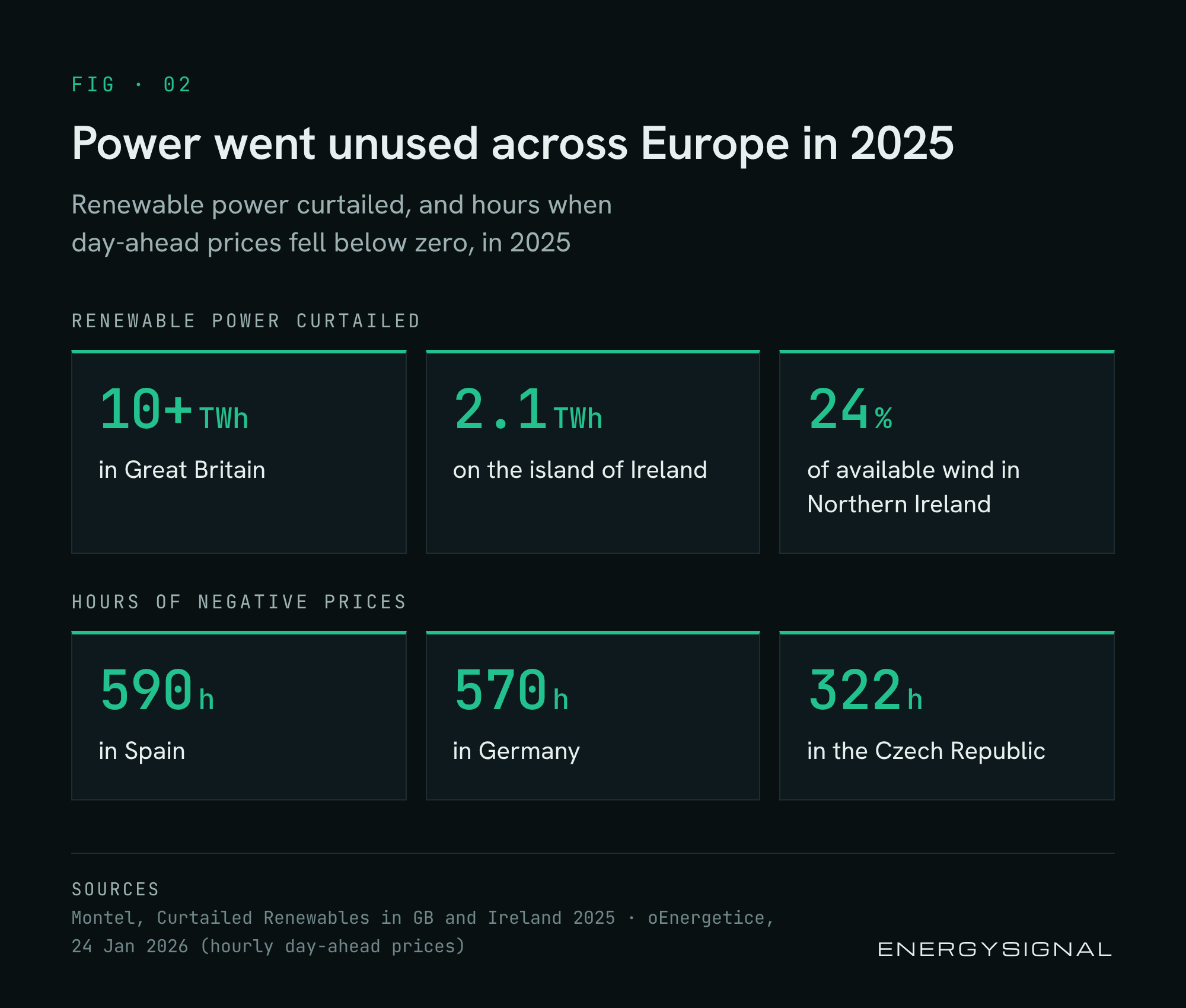
Unused power is large and growing. Great Britain curtailed more than 10 TWh of renewable power in 2025, and the island of Ireland 2.1 TWh (Montel). Aurora Energy Research expects technical curtailment in Great Britain, Spain and Italy alone to reach almost 22 TWh by 2030 (pv magazine). Prices tell the same story. In 2025, day-ahead prices fell below zero for 590 hours in Spain, 570 in Germany and 322 in the Czech Republic (oEnergetice).
Heat is a second source of value. The European Commission says that reusing around half of all waste heat from European data centres would equal the heating demand of 4 million households (European Commission). Heat recovered from Meta's data centre in Odense, Denmark, was set to warm more than 12,000 homes in 2023 (Ramboll). In Finland, heat from Microsoft's data centres is set to cover 40% of Fortum's district heating needs in Espoo and neighbouring cities (Fortum).
Flexibility is starting to earn its place. A 2026 UK trial with National Grid is feeding into rules under which flexible data centres "could qualify for faster and larger connections where they agree to flex on request" (National Grid). Ireland's action plan expects large energy users to accept flexible or non-firm connections (A&L Goodbody). And the EU's proposed rating scheme for data centres above 500 kW will score heat reuse, added clean generation and flexibility, with the first labels expected in 2027 (European Commission).
Industrial sites have an advantage of their own. Some already have a grid connection, land and a use for heat. For a site like that, compute can start on capacity that exists today rather than waiting years for a new place in the queue. Those are the sites we look at first.
Where EnergySignal fits
Europe's next wave of compute will grow where power is available, flexible and welcome. EnergySignal connects owners of curtailed or stranded power with operators of flexible, modular compute, and we model the economics for both sides before anyone commits.
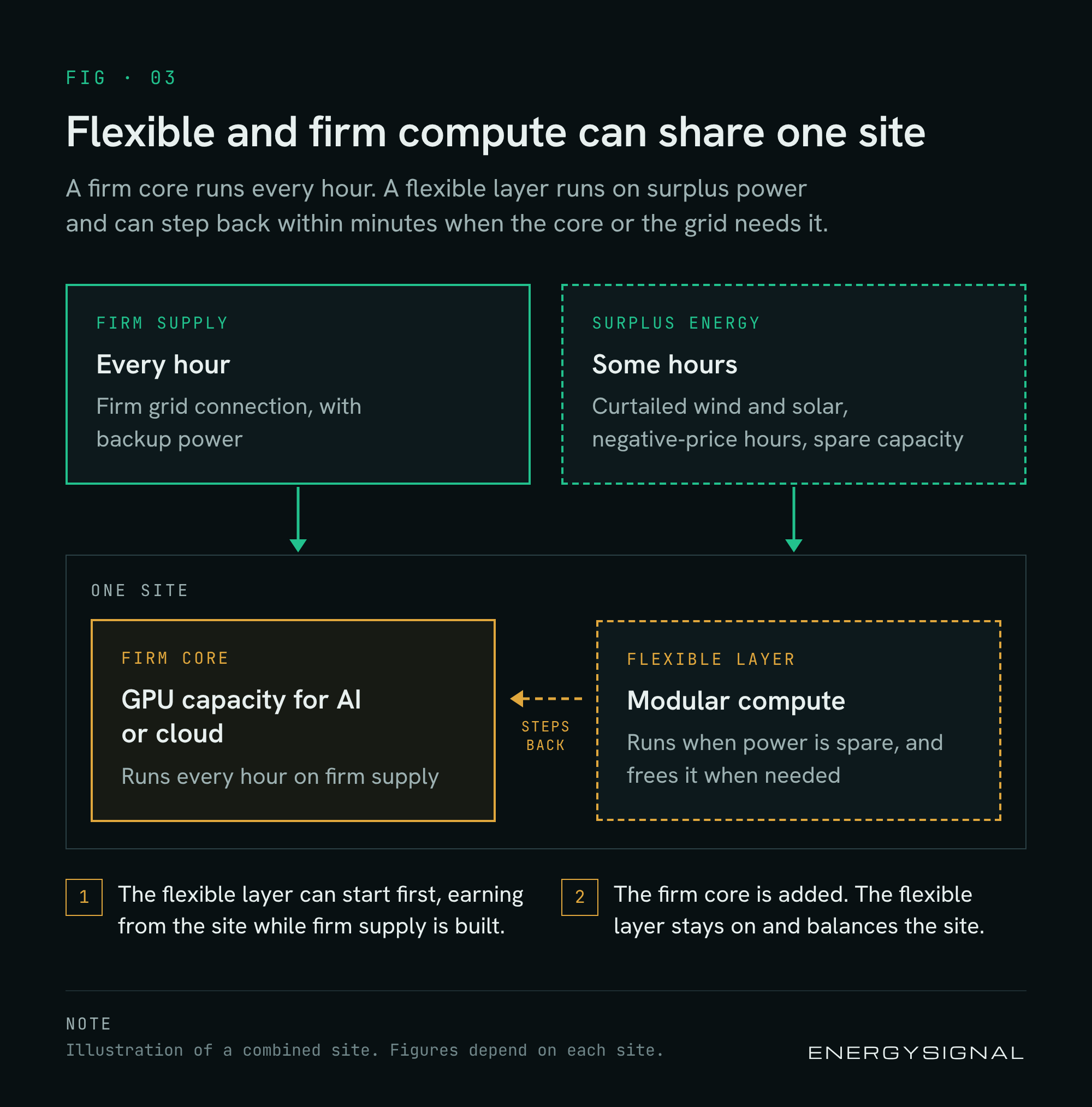
Flexible compute and the large projects that need stable, round-the-clock power can share a site, and the flexible part can make the large project easier to build and to pay for.
The firm core, AI or cloud capacity, runs on firm supply. The flexible layer takes surplus or curtailed energy and can step back within minutes when the core or the grid needs the power. And the flexible layer can go in first, earning from the site while the firm supply and the grid upgrades are still being built.
If you are a compute operator or an investor looking for powered, flexible sites, you can reach us at info@energysignal.io.
If you own a site, we would like to help you see what it is worth. It might be a wind or solar farm that is being curtailed, or an industrial site with spare grid capacity or a demand for heat. You can test your site, and what it could be valuable for, with our calculators at energysignal.io/calculators. Or just write to us at info@energysignal.io and we can go through it with you and help you understand its potential.
Also in this series
- Why Central Europe: industrial power, district heat and room to grow
- First Ready, First Served: Europe's grid queues are being re-ranked by readiness and flexibility
- Not All Megawatts Are Equal: flexible energy, the firm power GPUs need, and how to sequence a project
Sources
- A&L Goodbody: Data centres and the grid, how recent Irish policy will shape the sector (15 Apr 2026)
- oEnergetice: 2025 marked by negative electricity prices, new records set in Czechia and beyond (24 Jan 2026)
- BeBeez, reporting JLL: FLAPD on track for record data center growth year (6 Aug 2026)
- Ember: Grids set to block or unlock economic opportunities in Europe's AI race (19 Jun 2025)
- CSO: Data Centres Metered Electricity Consumption 2025 (7 Jul 2026)
- Mason Hayes & Curran: New data centre connection rules (11 Jun 2026)
- ZfK: Vorerst kein Anschluss, Syna ist bei Rechenzentren ausgebucht (20 Oct 2026)
- CBRE: European data centre supply surges as growth expands beyond core markets (22 Jun 2026)
- ZfK: Wie Stromnetz Berlin mit einer Flut an Rechenzentren umgeht (26 Jun 2025)
- Greater London Authority: West London electricity capacity constraints
- Data Center Dynamics: UK plans AI Growth Zone in North Wales
- Eurobuild CEE, reporting Cushman & Wakefield: EMEA data centre capacity exceeds 12.1 GW (21 Oct 2026)
- Nordic Energy Research: Energy security in the Nordics, Sweden (2026)
- Nscale: Stargate Norway (14 Aug 2025)
- Red Eléctrica: Mapa de capacidades de demanda tipo consumo (1 Oct 2026)
- RTP: Start Campus avança com segundo edifício em Sines (13 Jan 2026)
- Teleborsa: Terna, oltre 100 GW di richieste di connessione per data center (14 Oct 2026)
- Forbes Česko: Datacentra místo oceláren (16 Sep 2026)
- Herbert Smith Freehills Kramer: The EU Grids Package (16 Dec 2025)
- Gesetze im Internet: § 11 Energieeffizienzgesetz
- Deutscher Bundestag: hearing on the Energy Efficiency Directive bill (5 Oct 2026)
- European Parliament Legislative Observatory: Cloud and AI Development Act (Jun 2026)
- European Commission: Commission enhances energy efficiency and sustainability of data centres in the EU (21 Sep 2026)
- Montel: Curtailed renewables in GB and Ireland 2025
- pv magazine: Over 1 TW of renewables awaiting approval in Europe (9 Jan 2026)
- Ramboll: Meta, surplus heat to district heating
- Fortum: Microsoft x Fortum (7 Mar 2024)
- National Grid: UK-first trial of AI grid technology (2 Mar 2026)
Information only, as of the date shown. Not an offer, and not legal, tax, regulatory or investment advice. Any arrangement is agreed only in signed agreements.