Articles · 09
Curtailment Is a Revenue Problem: What a Flexible Load Next to a Wind or Solar Farm Can Earn
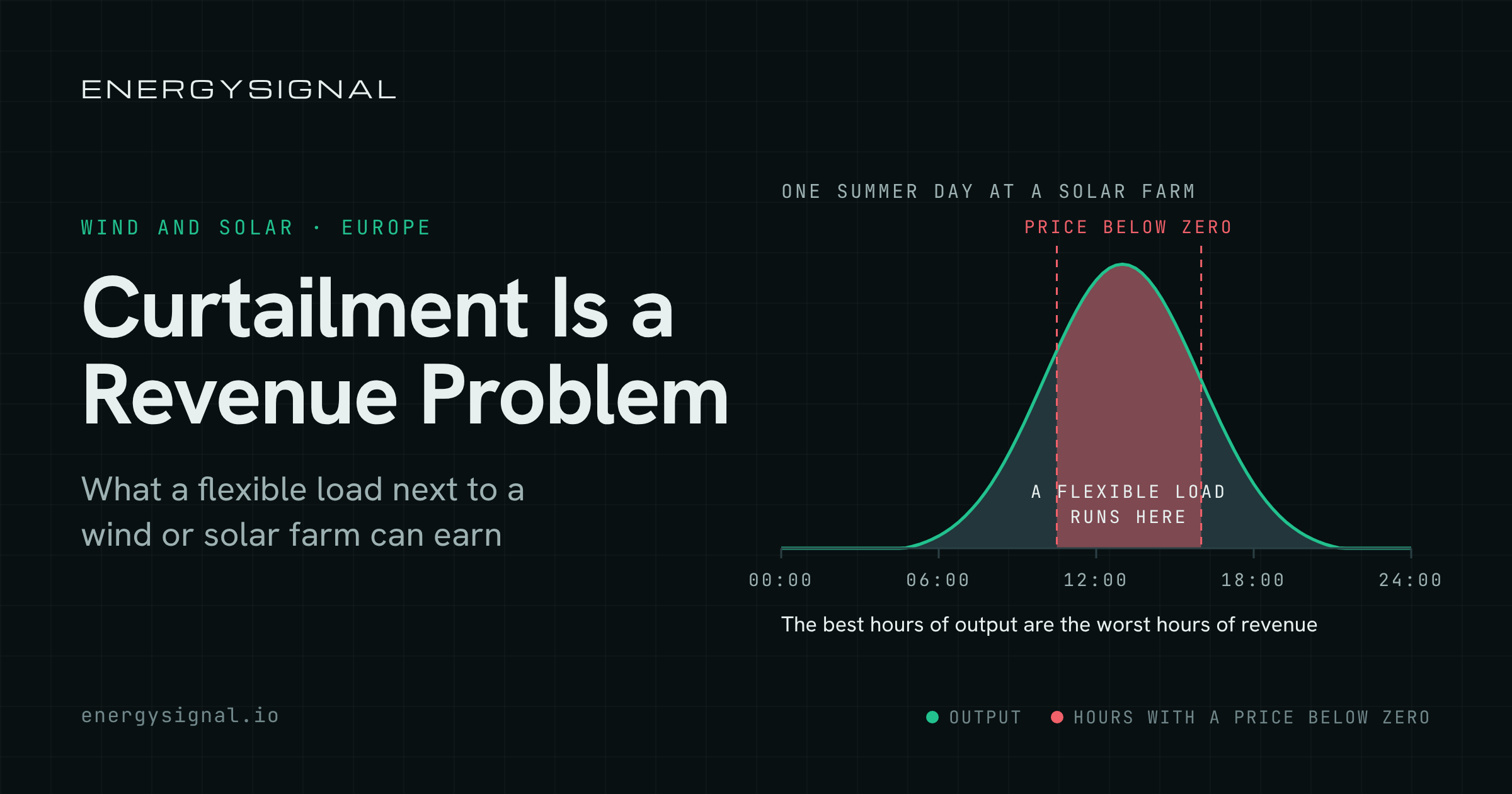
A wind or solar farm now gets paid nothing, or gets paid to stop, in a growing share of the hours it produces most. This piece is about how big those hours have become, why things are getting worse for the owner, and what a flexible load next to the farm is worth in them.
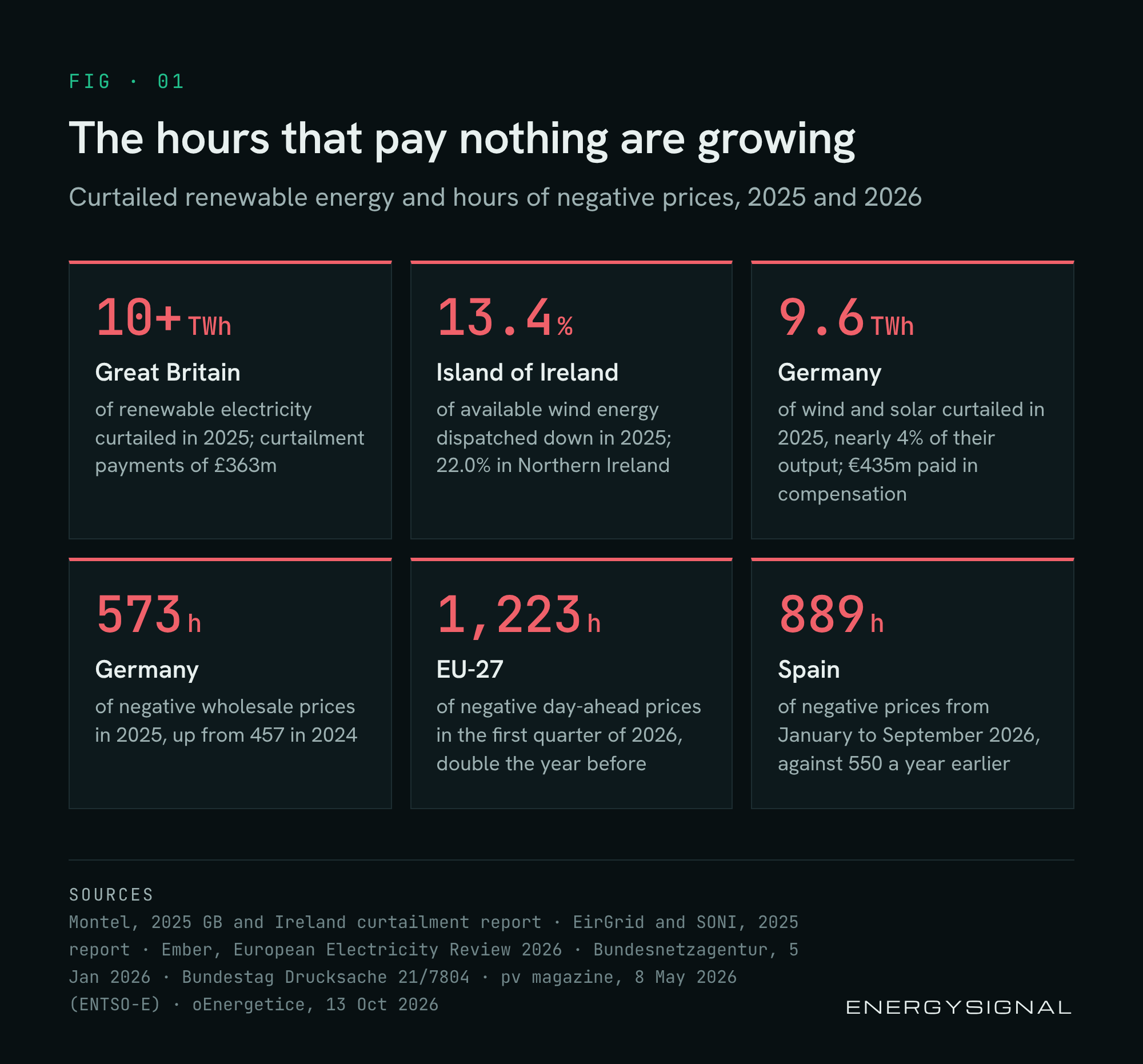
For the first two decades of the renewables build-out the owner's problem was volume. Build the turbines, get the connection and sell every MWh at the tariff. That problem has changed. In Great Britain more than 10 TWh of renewable electricity was curtailed in 2025. On the island of Ireland 13.4% of the available wind energy was dispatched down. In Germany wholesale prices were negative in 573 hours of the year, and new plants are no longer paid in those hours. Spain's day-ahead price was below zero for 889 hours in the first nine months of 2026, against 550 a year earlier.
To be fair, the farms have done nothing wrong here. This is what happens when generation that costs nothing to run meets a grid that cannot move it and a market with nobody to buy it. The owner's options so far have been to accept the curtailment, build a battery or wait for the grid. We think there is a fourth. Put a load next to the farm that uses the power in exactly the hours the grid will not take it, pays for it, and steps back the moment the grid can take it again.
The scale, in 2025 and 2026
Great Britain. Montel's curtailment report for 2025 finds that "Over 10TWh of renewable electricity was curtailed in GB" and that "The total cost of curtailment payments was £363m, representing a 10% decrease year-on-year". NESO's balancing costs for the financial year 2025/26, which include constraint management, "came to £3.125 billion", according to NESO.
Ireland. EirGrid and SONI report that in 2025 "the total wind energy generated in Ireland and Northern Ireland was 13,675 GWh" and that "2,139 GWh of wind energy was dispatched down", which is 13.4% of the available wind. In Northern Ireland the figure was 663 GWh, "equivalent to 22.0% of total available wind energy in that jurisdiction". Most of that was constraint, meaning local grid limits, rather than system-wide curtailment.
Germany. The Bundesnetzagentur reports that in 2025 "Negative Großhandelspreise traten in 573 von 8.760 Stunden auf", up from 457 hours in 2024. The federal government told the Bundestag in August 2026 that congestion management cost €3,076 million in 2025, and that €435 million of it was compensation to renewable plants that were curtailed. Ember estimates that "Germany curtailed an estimated 9.6 TWh of wind and solar generation in 2025, nearly 4%" of their output, with solar curtailment up from 1.9% to 3.1% in a single year.
Europe. The Commission's quarterly market report for Q4 2025 says that over the year "negative prices occurred in around 3% of all hours", that "June 2025 set a record with 2,656 hours of negative prices across the selected European markets", and that northern Sweden, the Netherlands, Germany, Spain and Belgium saw negative prices in roughly 6% to 8% of intervals. Then the first quarter of 2026 doubled the year before. pv magazine, working from ENTSO-E data, counts "1,223 hours below zero in Q1 2026" across the EU-27 day-ahead markets, against 593 in Q1 2025, and Spain alone accounts for 347 of them. By the end of September 2026 the count from oEnergetice stood at 889 negative hours in Spain, 471 in Germany and 278 in Czechia.
The pattern is the same wherever you look. The hours cluster around spring and summer middays and on windy nights, which is exactly when a farm's output is highest, and they are growing faster than the grid and the storage that would absorb them.
Why it is getting worse for the owner
Three things used to protect a farm's revenue in these hours. Each of them is going.
The subsidy no longer pays in negative hours. Germany's Solar Peak Act of February 2025 rewrote section 51 of the EEG, which now reads: "Für Zeiträume, in denen der Spotmarktpreis negativ ist, verringert sich der anzulegende Wert auf null." For periods in which the spot price is negative, the payment falls to zero, from the first such hour, for new plants above 100 kW. Smaller plants follow once they have a smart meter. A farm that used to be paid in every hour is now paid in fewer of them each year.
Constraint payments are under political pressure. In Great Britain the cost of paying wind farms to turn down, and gas plants to turn up somewhere else, turns into a public argument every winter, and the system operator's answer is to move demand to where the wind is rather than keep paying. Regulators are trying to bring the compensation bill down, so it is not a revenue line we would plan a farm around.
Export capacity is in the same queue as everyone else. A farm that wants a larger export connection, or a battery that wants one, waits behind the hundreds of gigawatts we described in our article on grid queues (energysignal.io/insights/first-ready-first-served). The grid will arrive. But what does the farm earn in the years before it does?
Put the three together and the farm's hours of highest output become its hours of lowest, or negative, revenue, with no subsidy to cover them and no grid coming soon to carry the power away.
What a flexible load next door changes
A flexible layer of modular compute, in containers at the farm's substation or behind its own connection, does four things that a battery, a grid upgrade or a hedge do not.
It uses the hours nobody wants. The load runs when the farm would otherwise be curtailed or paid nothing, and it pays for the power. Because it consumes the energy where it is made, it does not need the grid to carry anything away. So the farm's spare hours, which are also its best hours for output, become its best-paid hours.
It steps back when the grid wants the power. When the price is high and the grid can take the output, the compute steps back within minutes and the farm exports as before. The compute is sized to the surplus rather than to the whole farm, so it does not compete with the export.
It does not wait for the connection. It sits behind the meter, inside the capacity the farm already has, so it typically needs no place in the queue. It can start in the years before the upgrade and stay on afterwards to take the hours the upgrade still cannot.
It can be scaled, moved and stopped. Containers can be added as the data supports it, and withdrawn if the farm's position changes. The commitment is to a first term rather than to a plant.
What it pays depends on the hours and on what the farm earns in them today. Where the farm earns nothing in those hours, or pays to offload, everything the compute pays is gain. Where the farm still earns a support payment, the gain is the difference. Our spare-power calculator asks for the site's hours and the band the power earns in today, and shows the range. The exact terms are agreed in the site model. The calculator is at energysignal.io/calculator/power.
Two things it does not do. It does not replace export in the hours when export pays. It is there for the hours when export does not. And it is a different thing from a battery, because a battery moves energy to a later hour while a flexible load consumes it now. Many sites can use both, with the compute taking the hours in which the battery is already full.
What the system operators say
The operators who pick up the curtailment bill have arrived at the same conclusion from the other side.
In Great Britain, NESO's chief executive argued in May 2026 that growing demand in Scotland could lower long-term bills, because "Creating more demand closer to where renewable power is generated could reduce the need for both actions", meaning the turn-down of wind and the turn-up of gas elsewhere. NESO's own analysis finds that "locating an additional 5GW of flexible demand behind transmission bottlenecks" in Scotland "could save consumers up to £5 billion", and that up to a fifth of future data centre demand could be located there.
In Germany, the Bundesnetzagentur's "Nutzen statt Abregeln 2.0", which translates as use instead of curtail, sits under section 13k of the energy act and creates an incentive for additional, switchable consumption in congested regions. The idea is that renewable power which would otherwise be curtailed goes to loads that can be switched on when the grid needs them to be. The Commission's July 2026 proposal on electricity bills would let regulators give priority to grid users with flexible consumption patterns, and would require tariffs that enable flexible connections.
It is the same logic we have been describing since the start of this series. The cheapest grid upgrade is a load that wants the power where and when it is spare, and steps back when it is not.
How to assess a wind or solar site
We assess a wind or solar site the way we assess any site, with the hours doing most of the work.
- The hourly profile. A year of metered output, hour by hour, and the hours in which the farm was curtailed, constrained or paid a negative or zero price. The flexible layer is sized from these hours rather than from the installed capacity.
- What those hours earn today. Nothing, a payment to offload, or a support payment that still applies. The gain from compute is measured against this, so the band matters more than the tariff in the other hours.
- The connection terms. The export capacity, the import capacity if any, and whether the load can sit behind the farm's meter inside the existing capacity. In practice a load behind the meter is the simplest case, and a load that needs an import connection is a different project.
- The curtailment signal. How the farm is told to turn down, and how fast. The compute steps back on the same signal, so the control arrangement is part of the site model.
- Space and data. A yard for containers near the substation, road access, and a data link. Wind farms usually have the first two, and the third is one of the first things we check.
- Heat. Most farms have no heat user, and the case then rests on the power alone. Where a greenhouse, a digester, a dairy or a village network is nearby, the heat account adds a second line and the site model counts it.
A site with a few thousand curtailed or zero-price hours a year and no better use for them is exactly the case our spare-power calculator was built for. A site with fewer hours is still worth a conversation, because the hours are growing.
Start light, and let the surplus pay
The arrangement we have in mind puts a core of AI or cloud capacity on firm supply, with a flexible layer next to it that uses surplus or curtailed energy and can step back within minutes when the core or the grid needs the power. The flexible layer can also start first, and earn from the site while firm supply and grid upgrades are still being built.
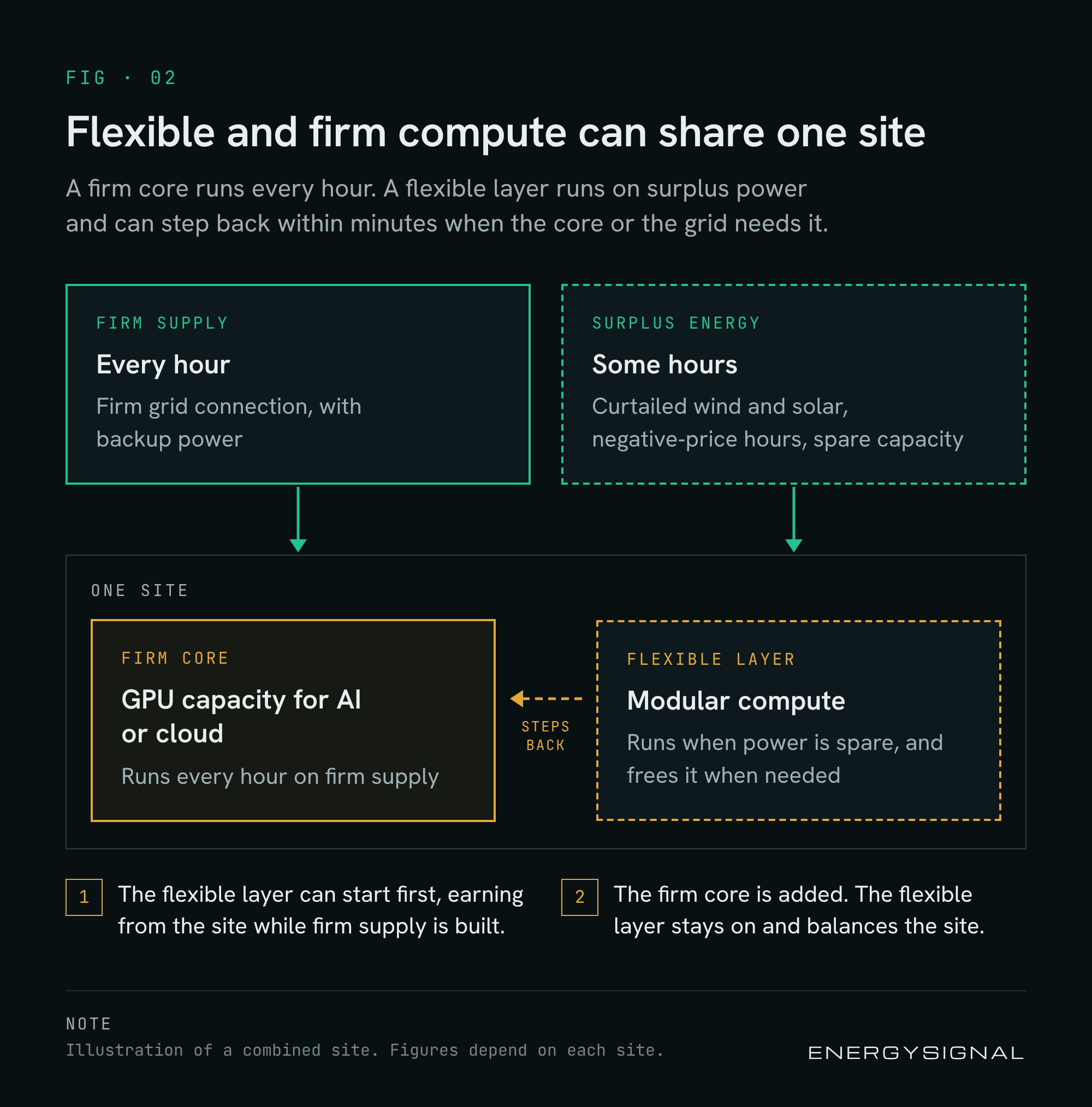
For a wind or solar owner the flexible layer is the whole of the first step. It is a buyer for the hours the grid will not take, on the connection the farm already has, and it steps back when the grid will take them. If the farm later gains a firm supply, whether through storage, a grid upgrade or a nearby plant, a firm core can be added alongside, and the flexible layer stays on to take the surplus the core does not need.
If you own or operate a wind or solar farm and want to know what its curtailed hours could be worth, we would like to help you find out. Our calculators at energysignal.io/calculators will give you a first reading, and for a farm the spare power calculator is the one to start with: energysignal.io/calculator/power. Or drop us a line at info@energysignal.io and we can go through your site with you and what it might be worth.
Also in this series
- Pricing Flexibility: what a load that can step back is worth
- Not All Megawatts Are Equal: flexible energy, the firm power GPUs need, and how to sequence a project
- First Ready, First Served: Europe's grid queues are being re-ranked by readiness and flexibility
Sources
- Montel, Curtailed Renewables in GB and Ireland 2025
- NESO, Growing energy demand in Scotland could help lower long term bills, says NESO chief executive, 13 May 2026
- EirGrid and SONI, Annual Renewable Energy Constraint and Curtailment Report 2025, 2026
- Bundesnetzagentur, Bundesnetzagentur veröffentlicht Daten zum Strommarkt 2025, 5 January 2026
- Deutscher Bundestag, Drucksache 21/7804, Antwort der Bundesregierung, 31 August 2026
- Ember, European Electricity Review 2026: early signs of the impact of batteries, January 2026
- European Commission, Quarterly report on European electricity markets, volume 18, issue 4 (Q4 2025), 2026
- pv magazine, Europe's negative electricity price hours double in Q1 amid renewables surpluses, market imbalances, 8 May 2026
- oEnergetice.cz, Negative prices are less frequent in Czechia this year, but the trend varies across Europe, 13 October 2026
- Section 51 of the Erneuerbare-Energien-Gesetz, as amended by the Solarspitzengesetz of February 2025
- Bundesnetzagentur, "Nutzen statt Abregeln 2.0" durch zuschaltbaren Stromverbrauch
- European Commission, Proposal for a Regulation as regards future-proofing electricity bills in the Union, COM(2026) 600, 17 July 2026
Information only, as of the date shown. Not an offer, and not legal, tax, regulatory or investment advice. Any arrangement is agreed only in signed agreements.