Articles · 18
The Price of a GPU-Hour Went Up, Not Down: H100 Rent Is 47% Above Its December Low
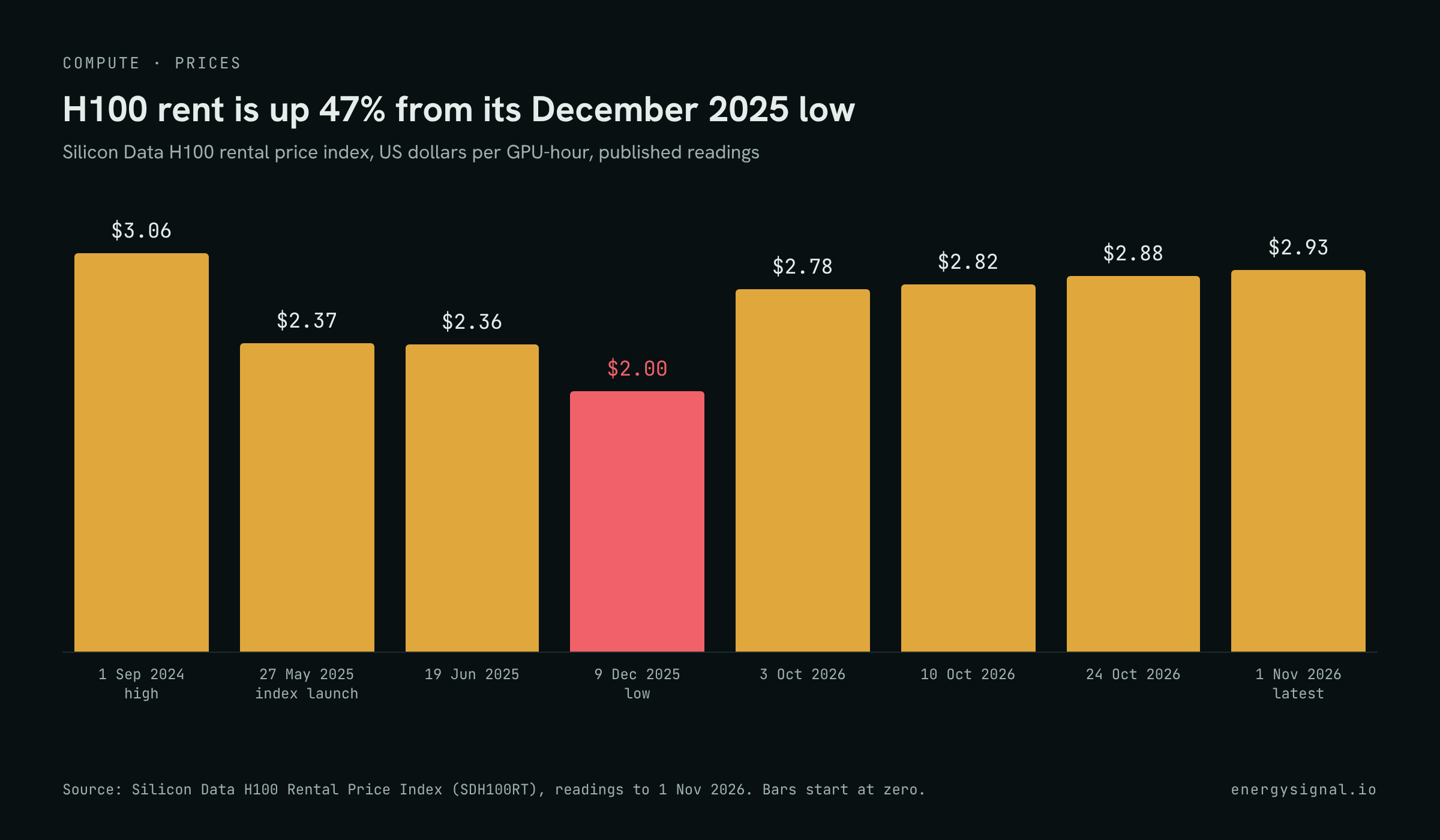
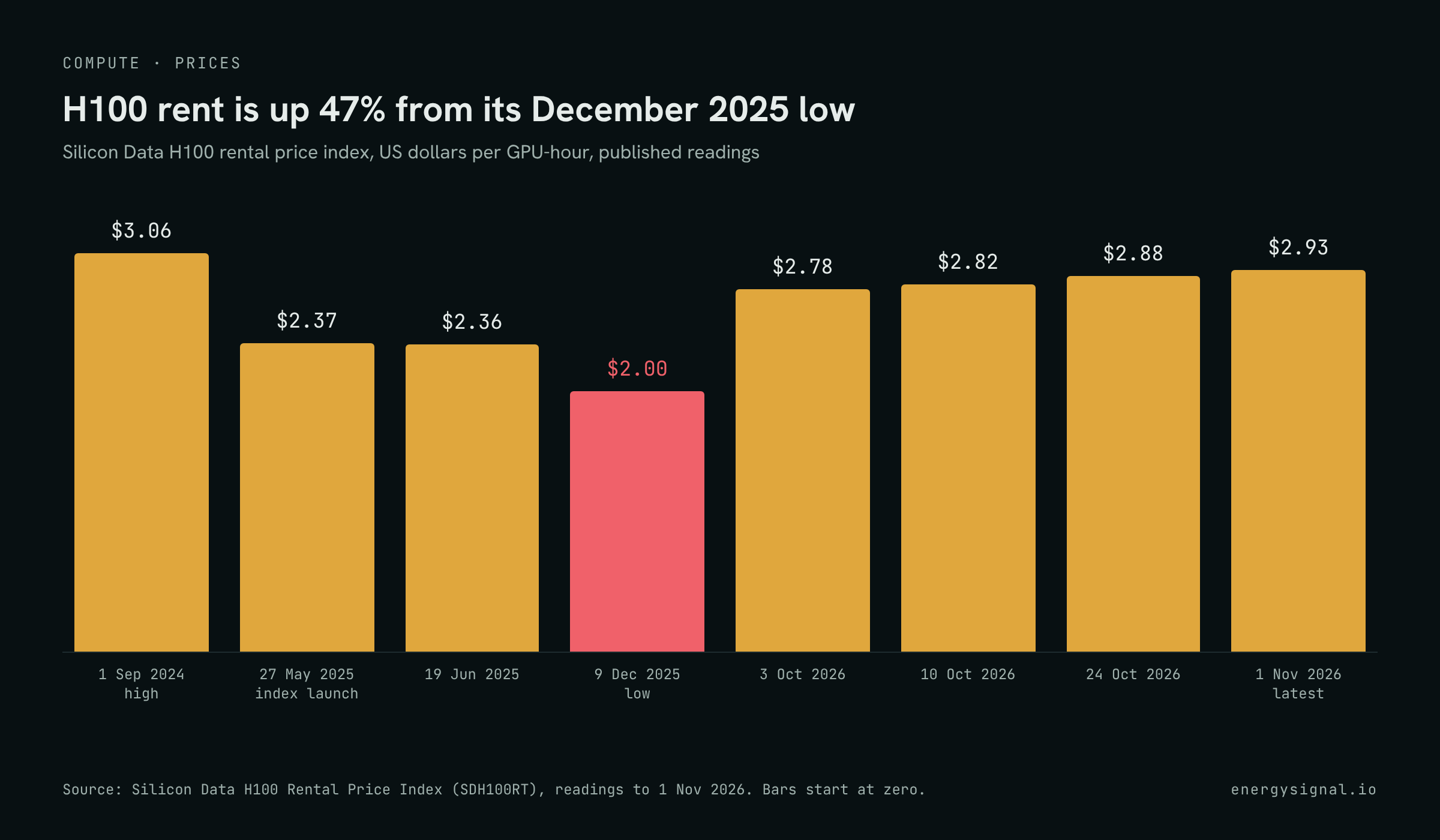
Renting one Nvidia H100 costs $2.93 per GPU-hour on the Silicon Data H100 index, 1 Nov 2026. That is up about 47% from the $2.00 low of 9 Dec 2025. Everyone expected the older chips to get cheaper once the new generation shipped. Instead, every GPU generation rose in price through 2026, which tells you demand is still absorbing new supply faster than it arrives.
What the index measures
The Silicon Data H100 Rental Price Index (ticker SDH100RT) is a daily benchmark for the cost of renting one H100 for one hour. It launched in May 2025 and is published on Bloomberg terminals. Each reading is standardised for machine specification, rental term, interconnect and location, with outliers removed, so a day's number can be compared with any other day's. Sister indexes cover the H200, A100, B200, B300 and MI300X.
It matters beyond price watching. Lenders use it to underwrite debt secured on GPUs, and CME Group announced H100 and B200 futures for 5 Oct 2026, pending CFTC review. Compute is starting to trade the way power and gas do, with a daily print and a forward curve.
The turn in the price
The index fell through 2025 as the 2023 shortage eased, bottomed at $2.00 on 9 Dec 2025, then reversed. By 3 Oct 2026 it was back at $2.78, and it has climbed on every published reading since.
The newer chips are dearer and have risen too. On the Silicon Data indexes of 10 Oct 2026, an H200 rented for $3.43 per GPU-hour, a B200 for $5.93 and a B300 for $6.71. A B300 earns about 2.3 times an H100 while drawing about 1.4 times the power, so each new generation earns more per watt. We will come back to what that means for a megawatt in a separate piece.
Why other benchmarks show a different number
You will see H100 prices quoted anywhere from $3 to $8. They are not contradicting each other; they measure different things.
| Benchmark | What it measures | H100, $ per GPU-hour |
|---|---|---|
| Silicon Data SDH100RT | Blended neocloud rate: on-demand, spot and reserved | 2.93 (1 Nov 2026) |
| Ornn OCPI | Executed trades | 3.00 (31 Oct 2026) |
| GetDeploying | Median on-demand list price, 39 GPU clouds | 3.84 (Oct 2026) |
| GetDeploying | Median on-demand list price, hyperscalers | 7.89 (Oct 2026) |
We quote Silicon Data because it is daily, standardised and used by lenders. List prices run higher because they are asking prices for short, uncommitted use.
What the price says about power
Electricity is a small part of what a GPU-hour rents for. At an industrial power price of $80 per MWh, power is roughly 3% to 5% of the rent. Most of the rest pays for the chips, their financing and their depreciation. Turn it round and each megawatt-hour that goes through the meter earns the operator about $1,770 to $2,850 in GPU rent, depending on the generation, which is 22 to 36 times the cost of the power. That is revenue to the compute operator, not profit, and it is not income to the site that hosts the load.
It does explain the operator's behaviour. A few euros per MWh on the power price barely moves the margin. A cluster that sits waiting for a grid connection earns nothing while its loans keep running. So what a compute operator pays for is energised capacity it can use soon, and a rising index makes every month of waiting more expensive.
The risk runs the other way too. If rental prices fall when new capacity lands in 2027 and 2028, the operators carrying the most debt get squeezed first. A site owner choosing a compute partner should look at the strength of its contracts and its backing, not only at the price it offers.
What this means for energy owners
A rising GPU index is a signal that the compute side is short of something, and it is not chips. It is powered sites that can take load within months rather than years. If your site has a connection with spare hours, surplus generation that is sold cheaply or curtailed, or heat demand next to a yard with room for containers, that is the asset the index is pricing. EnergySignal sits between energy that is stranded, curtailed or underused and the compute operators who need power fast, and the first conversation starts with your site's numbers, not theirs.
FAQ
What does an H100 cost to rent per hour? On the Silicon Data H100 Rental Price Index, one H100 rented for $2.93 per GPU-hour on 1 Nov 2026. The index is a blended rate across on-demand, spot and reserved contracts at neocloud providers.
Why did GPU rental prices rise in 2026? The index fell through 2025 as the 2023 shortage eased, then rose from $2.00 in December 2025 to $2.93 by 1 Nov 2026. Demand for compute has absorbed new supply faster than it has arrived, and newer generations rose alongside the older ones.
How much of a GPU-hour's price is electricity? At $80 per MWh, power is about 3% to 5% of what an H100 rents for. The bottleneck for compute operators is access to powered sites, not the price per megawatt-hour.
Also in this series
- Not All Megawatts Are Equal: flexible energy, the firm power GPUs need, and how to sequence a project
- Pricing Flexibility: what a load that can step back is worth
- First Ready, First Served: Europe's grid queues are being re-ranked by readiness and flexibility
Sources
- Silicon Data, H100 Rental Price Index and the Silicon Index family and methodology
- Silicon Data, launch announcement of the daily GPU rental index
- Price of Compute, comparing GPU indexes
- Ornn, Compute Price Index
- GetDeploying, GPU price trends
- Explainx, H100 rental price since December 2025
- NVIDIA DGX system power specifications, summary; power per GPU is the system maximum divided by eight, with cooling and losses added at a PUE of 1.3; $80 per MWh is an illustrative industrial price, not a quote
Information only, as of the date shown. Not an offer, and not legal, tax, regulatory or investment advice. Any arrangement is agreed only in signed agreements.