Articles · 15
Methane You Drain Is Power You Can Use: Coal Mine Methane, the EU Deadline, and Compute on the Surface
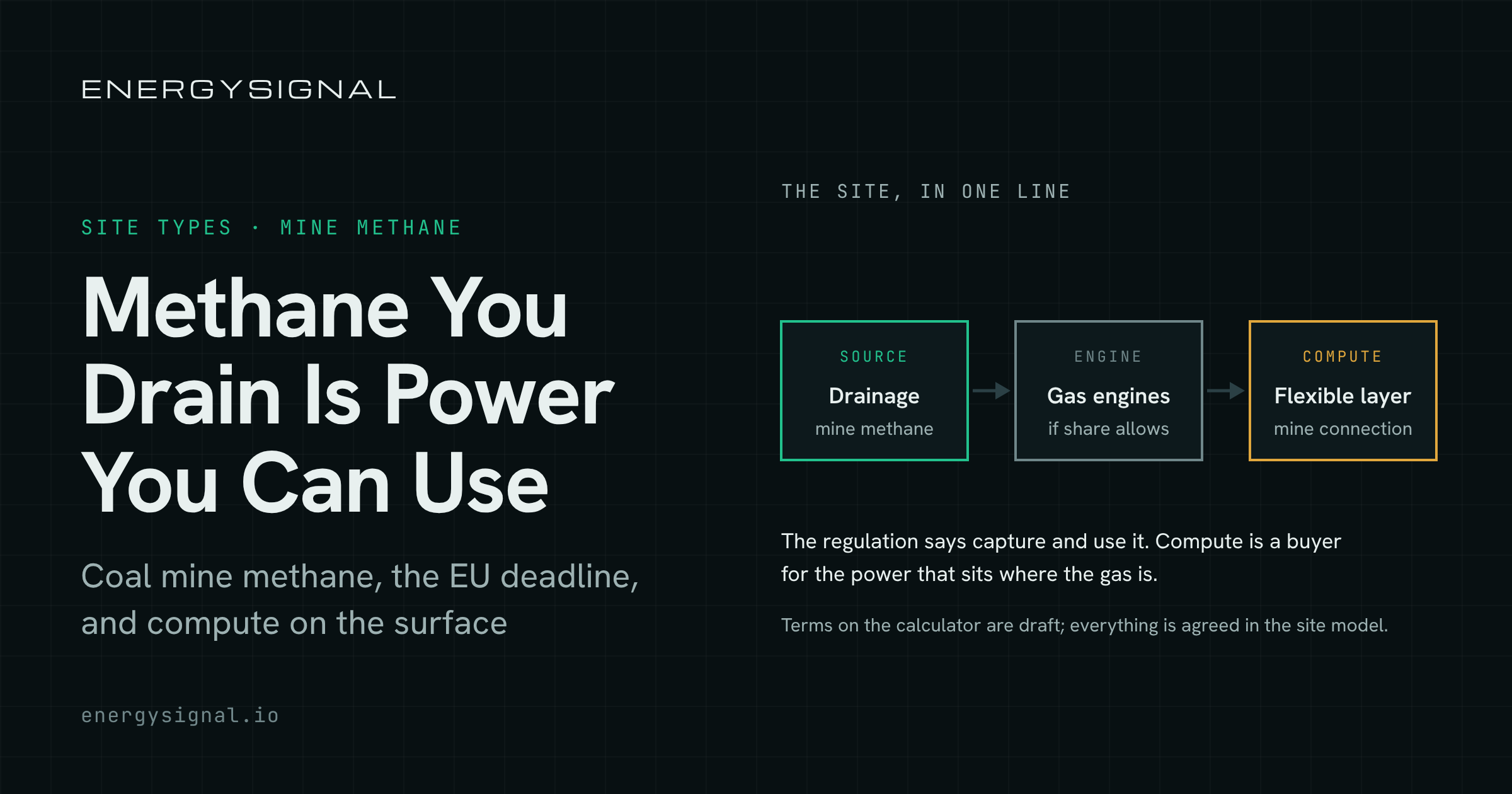
Coal mines, working and closed, give off methane that the EU now requires them to capture and use rather than vent, and most of it is still vented. What follows is the regulation's timetable, why a mine's surface site suits a flexible layer of compute, and what to have ready if you want to run your own numbers.
Methane is a far stronger greenhouse gas than carbon dioxide over the decades that matter, and coal mines are one of Europe's largest sources of it. Poland has most of the EU's remaining deep mines, and its hard coal industry released 752 million cubic metres of methane in 2023. Drainage systems captured 283 million cubic metres of that, 37.7%, and 201 million cubic metres of the drained gas, 70.9%, was put to use, according to figures from the state mining authority presented at a Silesian University of Technology conference. That left 551 million cubic metres going to the atmosphere, 85% of it through ventilation shafts.
The EU Methane Regulation, Regulation (EU) 2024/1787, in force since 4 August 2024, changes that arithmetic. It bans venting from drainage systems, puts limits on venting through shafts from 2027 and 2031, and from 2030 bans venting and flaring at closed and abandoned mines unless using the gas is not feasible. So where does the drained gas go? The regulation's own logic says capture more of it and use what you capture, and in practice that means the engine room.
The rules, step by step
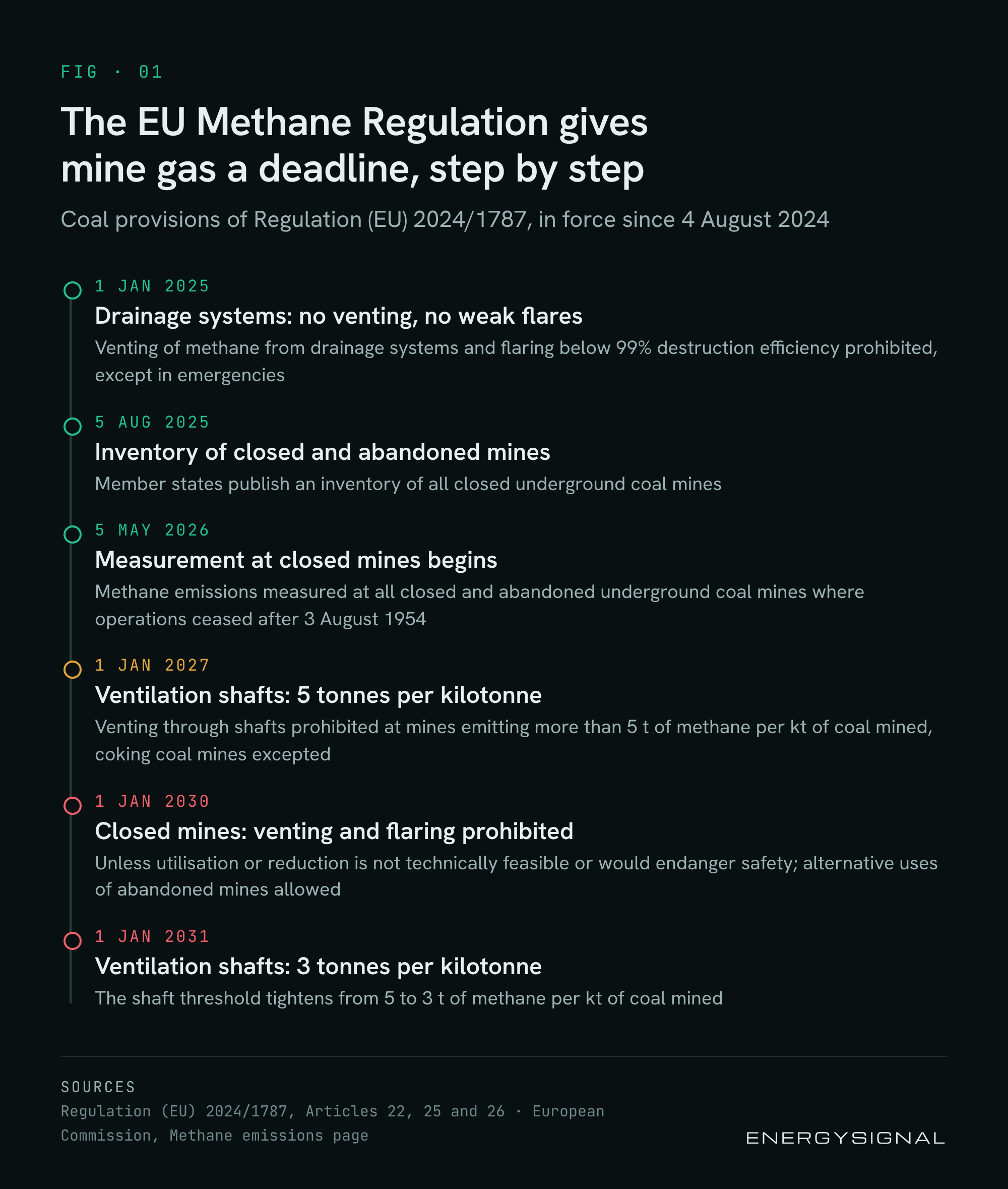
The coal provisions come in a sequence, and each step makes doing nothing with the gas more expensive.
- 1 January 2025. Article 22(1): "Flaring with a destruction and removal efficiency by design level below 99 % and venting of methane from drainage systems shall be prohibited from 1 January 2025, except in the case of an emergency or a malfunction, or where unavoidable and strictly necessary for maintenance". Since then, drained gas can no longer be released as a matter of course.
- 5 August 2025 and 5 May 2026. Member states were to publish an inventory of every closed and abandoned underground coal mine by the first date, and from May 2026 methane emissions are measured at all of them where operations ceased after 3 August 1954.
- 1 January 2027. Article 22(2): venting through ventilation shafts is prohibited at mines "emitting more than 5 tonnes of methane per kilotonne of coal mined, other than coking coal mines", except in an emergency.
- 1 January 2030. Article 26(2): at closed and abandoned mines, venting and flaring from the listed equipment "shall be prohibited from 1 January 2030, unless utilisation of methane or reduction of methane emissions is not technically feasible" or would endanger safety. Article 26(3) adds that "Alternative use of abandoned underground coal mines shall be allowed" under an adapted permitting procedure.
- 1 January 2031. The shaft threshold tightens to 3 tonnes of methane per kilotonne of coal mined.
For a working mine, the route to compliance is the one the industry itself describes, which is to raise the capture rate and use everything that is captured. For a closed mine the gas keeps coming for decades after the last shift, and from 2030 it has to be used or destroyed. That use happens on the surface site, which still has the connection, the roads and the land the mine left behind.
Germany already shows what this looks like at scale. According to EURACOAL, "Germany has over one hundred CMM plants with a total capacity of around 136 MW", most of them built between 2001 and 2004 on mine gas from the Ruhr and Saar, running engines of 1 to 2 MW of the kind the landfill gas industry uses. Closer to home, in the Czech Ostrava-Karviná basin, where deep mining ended in January 2026, mine gas from closed mines is already drained and burned in cogeneration units through a dedicated local network.
Why a mine suits compute
The gas is where the connection is. A mine, working or closed, has a high-voltage connection that was built for winding gear, pumps and ventilation, and a surface site with roads, hardstanding and security already in place. Burn the drained methane in gas engines on that site and you make power at the point where the connection, the land and the gas all sit together. We struggle to think of a better place to put a load.
The engines often exist already. Many mines, to be fair, already run drainage gas in engines and sell the power or use it on site. What the regulation changes is the volume. More gas gets captured, so the engines run more hours, and more of that power lands in the hours the grid pays least for it. A flexible layer takes the power in those hours and lets the engines run flat out. Where the gas already runs engines, our calculator counts only the uplift, and where the gas is vented or flared today it counts the whole of the power.
Closed mines keep gassing. Abandoned workings go on releasing methane for decades, at rates that fall but stay steady, and the regulation's 2030 deadline applies to them too. A flexible layer sized to the drainage rate, in containers on the surface, scales down as the gas does and typically needs no new building.
The methane share decides the engine. Drainage gas above about 30% methane runs in standard gas engines. Between 20 and 30% it needs lean-burn engines, and below that, or for ventilation air, it needs enrichment, blending or an oxidiser rather than engines. Whichever band the gas falls in, the compute can still run on the mine's connection, and the gas analysis and the engine quote replace the calculator's figures in the site model.
The drainage system, the safety regime, the mine's permits and its closure plan all stay as they are. The difference is that the gas the regulation says must be captured has a buyer for its power in every hour.
What the calculator asks, and what to have ready
Our mine methane calculator asks where the mine is, whether it is active or closed, how much methane is drained in cubic metres per hour, the methane share of the gas, and whether the gas is vented, flared or already used in engines today. From those it sizes the engines and the compute in kW or MW and gives a return a year as a range. If you are going to run it for a mine, it helps to have ready:
- A year's drainage log, with gas flow and methane concentration hour by hour where that exists
- Whether the gas is vented, flared or used today, and what any power made from it earns
- The engines on site, if there are any, with their capacity and run hours
- The connection at the surface site, its capacity and voltage, and what the mine's own load now takes
- The surface land available for containers and engines, and the data link
- For a closed mine, the closure plan and who holds responsibility for the gas after closure
The terms on the page are draft terms, and the calculator says so. In the site model, the gas analysis, the engine quote and the shaft-emission accounting replace its figures. The calculator is at energysignal.io/calculator/mine-methane.
Start light, on the surface
The arrangement we have in mind puts a core of AI or cloud capacity on firm supply, with a flexible layer beside it that uses surplus or curtailed energy and can step back within minutes when the core or the grid needs the power. The flexible layer does not have to wait for the core. It can start first and earn from the site while firm supply and grid upgrades are built.
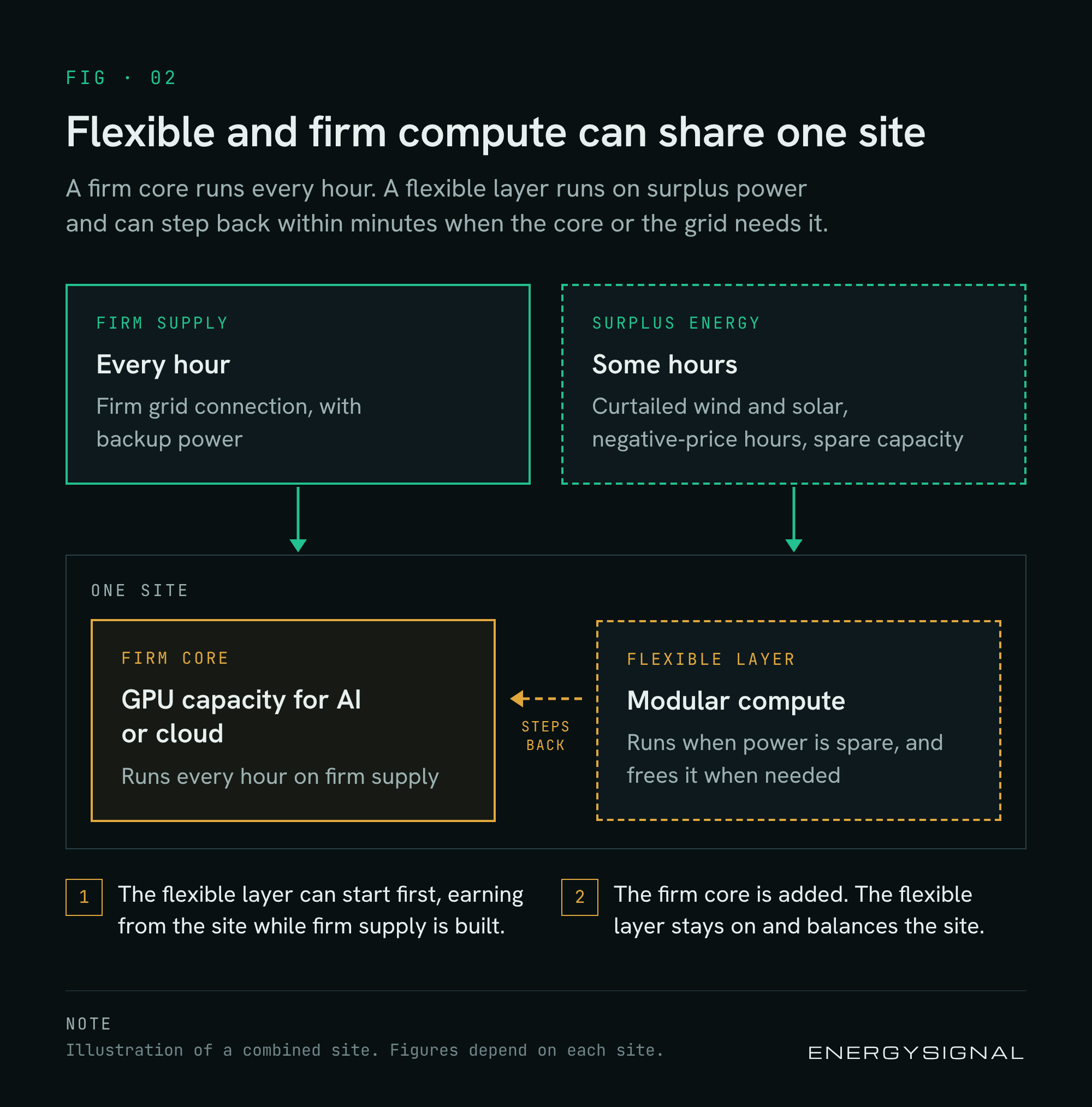
At a mine the flexible layer runs on the gas engines and the connection the mine already has, starting with the gas the regulation says must be captured anyway. Where the surface site holds a large firm connection, which the surface sites of closed mines often do, a firm core can follow on the same connection once the flexible layer has shown that the hours and the operating arrangements work.
If you run a mine, working or closed, and want to know what the gas and the connection could be worth, we would like to help you find out. The mine methane calculator at energysignal.io/calculator/mine-methane is the place to start, and the rest of our calculators are at energysignal.io/calculators if your site has other things going for it. Or just write to us at info@energysignal.io with what you know about the drainage and the connection, and we can talk your site through with you.
Sources
- Regulation (EU) 2024/1787 on the reduction of methane emissions in the energy sector, Articles 22, 25 and 26
- European Commission, Methane emissions
- Dariusz Katan, Podstawowe dane dotyczące kształtowania się zagrożenia metanowego oraz wskaźników dotyczących odmetanowania w kopalniach węgla kamiennego w 2023 roku, conference presentation, Silesian University of Technology, June 2024, citing the State Mining Authority (WUG)
- EURACOAL, Paper on incentives (and penalties) under the EU Methane Regulation, November 2024
- Green Gas DPB, Důlní plyn, on mine gas from closed mines in the Ostrava-Karviná basin
- The methane share bands, engine sizing and price treatment are those of EnergySignal's mine methane calculator and site model; terms are draft: energysignal.io/calculators
Information only, as of the date shown. Not an offer, and not legal, tax, regulatory or investment advice. Any arrangement is agreed only in signed agreements.