Articles · 13
Biogas After the Tariff: Why a Biogas Plant Suits Compute When the Support Ends
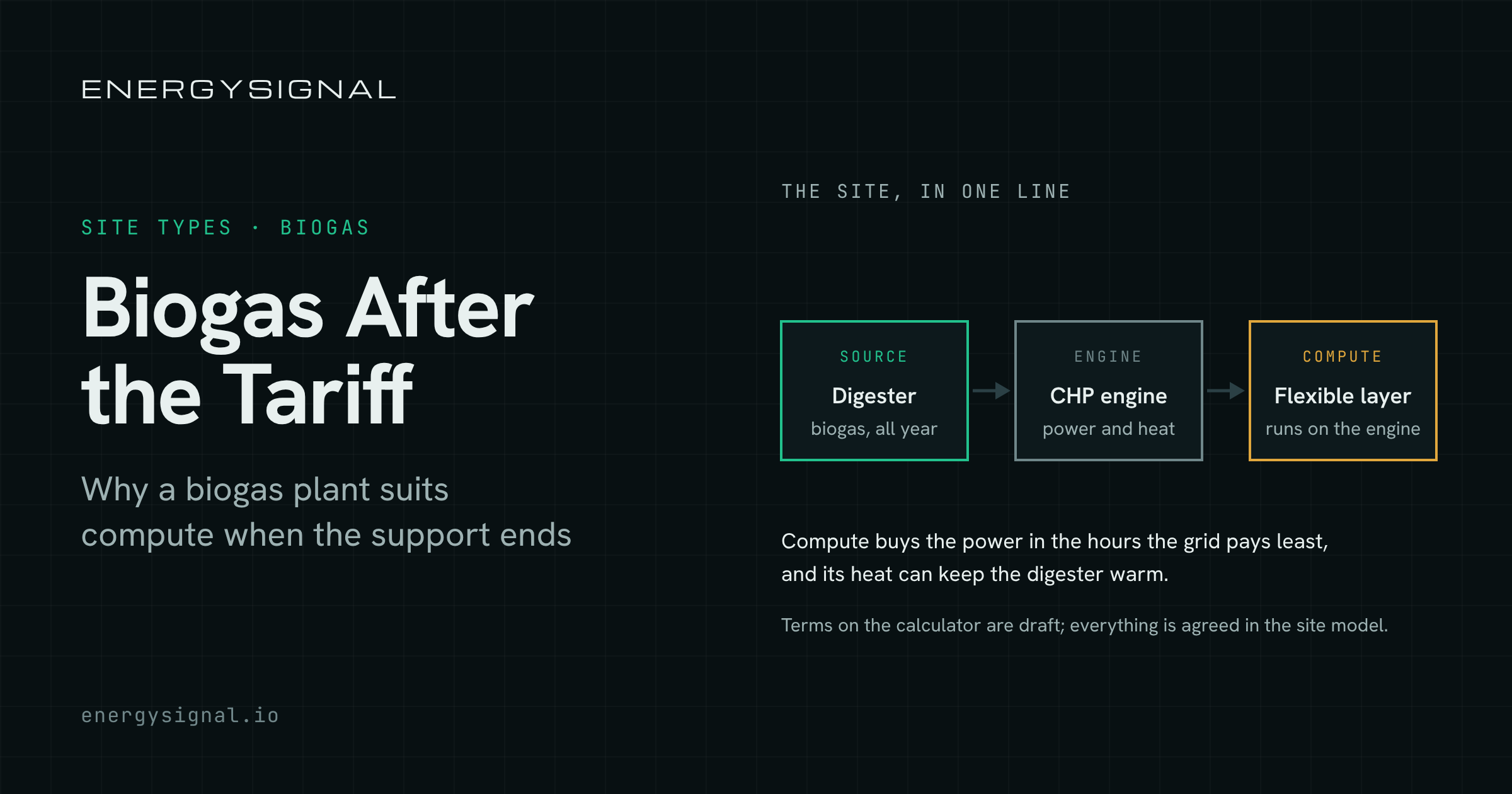
Thousands of European biogas plants are coming off the 20-year tariffs they were built on, and the engine keeps running all year whether the support is there or not. Below is our view on what the power can earn once the tariff ends, and why a flexible layer of compute next to the engine suits a plant in that position.
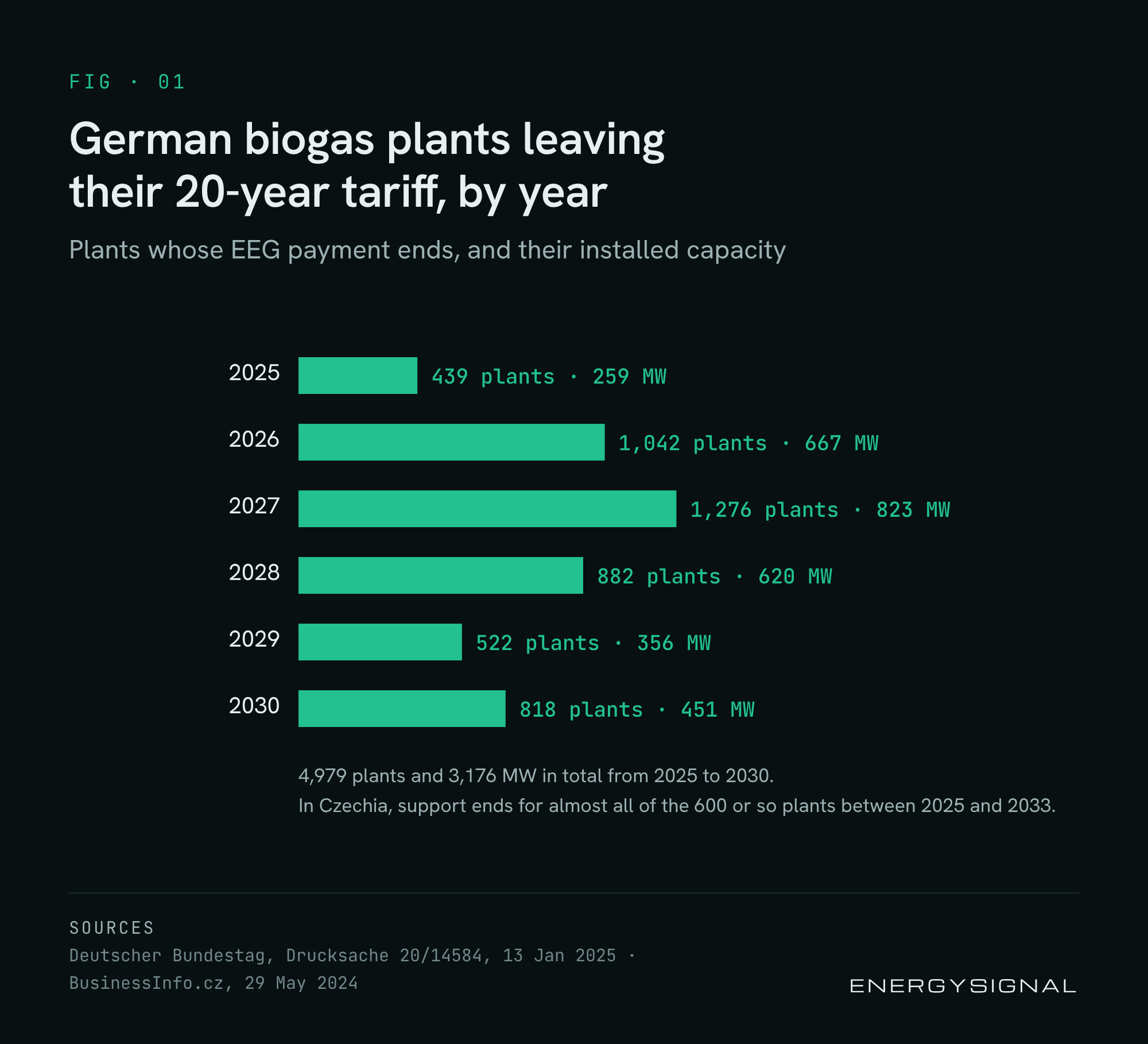
In Germany, the federal government's answer to the Bundestag in January 2025 lists the plants whose 20-year EEG payment ends year by year: 439 plants and 259 MW in 2025, 1,042 plants and 667 MW in 2026, 1,276 plants and 823 MW in 2027, and 4,979 plants with 3,176 MW in total from 2025 to 2030. In Czechia, BusinessInfo counts "přes 600 bioplynek", over 600 biogas plants, and reports that their operating support ends gradually, "u prvních z nich už na konci roku 2025", for the first at the end of 2025, for 171 plants by 2027, for 386 by 2031 and for all by 2033. Europe as a whole produced 22 bcm of biogas and biomethane in 2024, according to the European Biogas Association.
A plant that loses its tariff still has its gas. The digester keeps producing and the engine keeps running, but the power now sells at the market price, and the market price is lowest in exactly the hours a steady engine cannot avoid. Converting to biomethane is one answer, for plants near a gas pipeline. For the rest, the practical question is what the power earns in the hours the market pays least. Compute is a buyer for exactly those hours.
Why a biogas plant suits compute
The engine runs all year. A biogas CHP engine runs steadily, often 7,000 hours a year or more, because the digester does not stop. That is the profile a flexible layer wants, predictable power every day at a known capacity. The compute is sized to the engine, in kW or MW, and runs in the hours the plant chooses.
The market pays least when the engine runs. After the tariff, the plant sells at the hourly price. In spring and summer middays, and on windy nights, that price is low or negative across most of Europe. Compute buys those hours on site, at a price above what the market would pay the plant for them, and the plant goes on exporting in the hours that do pay. The gain is the difference, hour by hour, and it is largest in exactly the hours where a post-tariff plant is weakest.
The heat fits. Per MW of connection, the compute returns about 0.8 MW of heat at about 55 °C. A mesophilic digester runs near 40 °C and today it is heated from the engine's jacket. When the engine runs less, or when that heat is wanted elsewhere, the compute's loop can carry the digester's heat, and the plant's buildings and neighbours can take the rest. The calculators word this conditionally, and we would too. The heat may suit digester heating when the engine runs less.
The connection exists. A biogas plant already has a grid connection sized for its engine's export, usually at medium voltage and often with import capacity to spare. A flexible layer behind that connection typically needs no new application and no place in the queue. And if the plant wants to grow later, whether with a larger engine, a biomethane upgrade or a second load, it does so from a site that has already proven its hours.
None of this touches the gas, the digester, the permits or the engine. The only thing that changes is who buys the power in the hours nobody else wants it.
What the calculator asks, and what to have ready
Our quick check asks for the plant's power band, confirms that biogas is the source, and then wants to know how many hours a year the power is spare or sells cheaply, what it earns in those hours today, and whether there is a use for heat. For a biogas plant the answers are usually already to hand:
- The engine's electrical capacity in kW, and its run hours a year
- The date the tariff or green bonus ends, and what the power is expected to earn after it, as a band: nothing or a payment to offload, under €20, €20 to €40, €40 to €80, or over €80 per MWh
- The heat the plant uses today, for the digester and the buildings, and any neighbour who could take more
- The connection, its capacity for export and import, and the voltage
- Space for containers near the engine house, and a data link
The calculator shows a return a year, as a range, before the plant's own investment. The terms on the page are draft terms. The site model then takes a year of the engine's metered output and turns it into the plant's own numbers. The gas engine calculator is at energysignal.io/calculator/gas-engines.
Start light, and let the engine keep running
The arrangement we have in mind is a firm core of AI or cloud capacity running on firm supply, with a flexible layer beside it that uses surplus or curtailed energy and can step back within minutes when the core or the grid needs the power. The flexible layer does not have to wait for the core. It can start first and earn from the site while firm supply and grid upgrades are built.
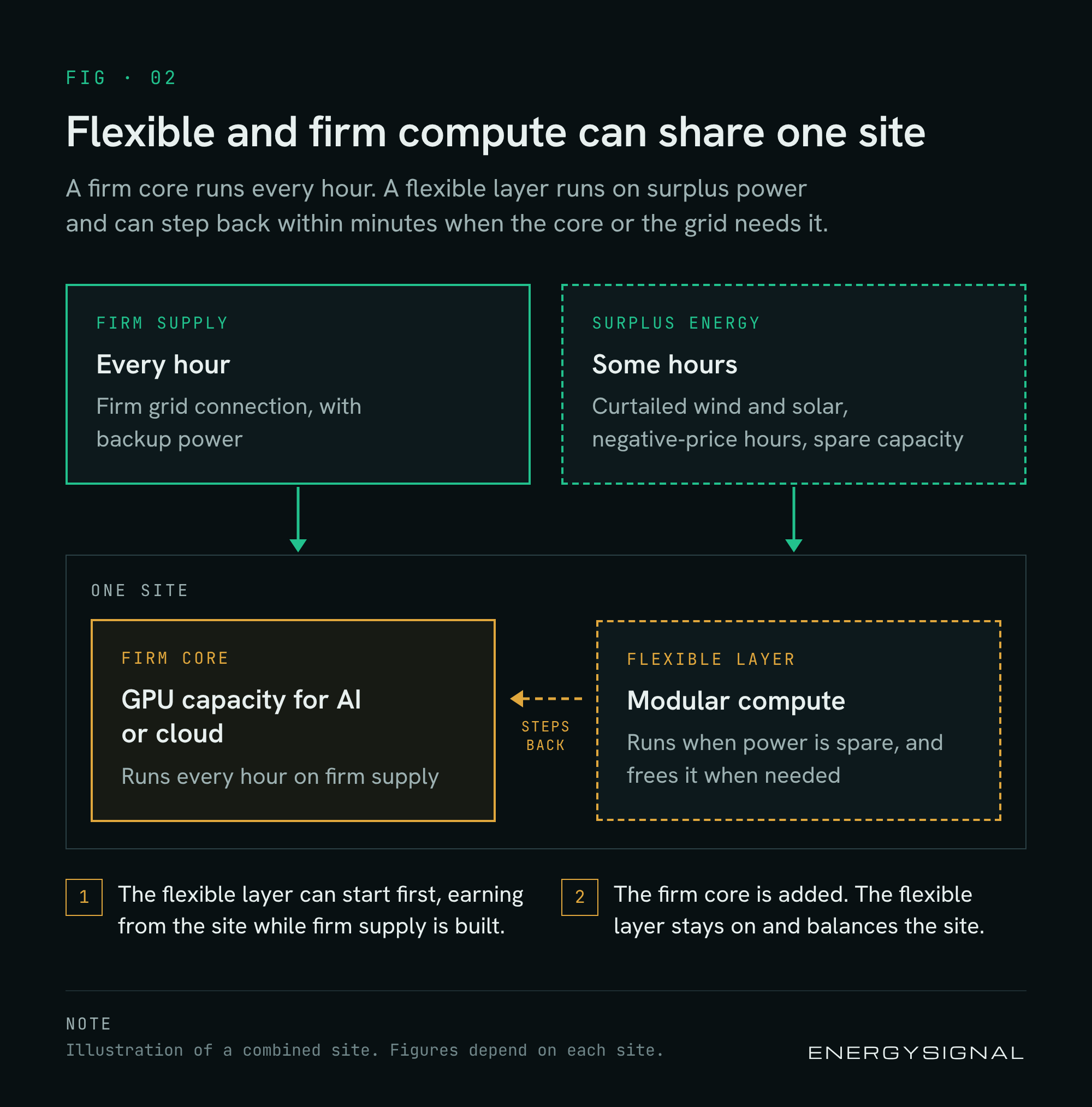
For most biogas plants the flexible layer is the whole case, and in our view it is enough. It gives the engine a buyer for its output in the hours the market pays least, on the connection the plant already has. For the larger plants, and for clusters of plants that share a connection, a steady engine is also a firm supply, so a firm core can follow once the flexible layer has shown the hours.
If you run a biogas plant and the end of the tariff is in sight, we would like to help you work out what the site is worth. Our calculators are at energysignal.io/calculators, and for a biogas plant the gas engine calculator is the place to start, at energysignal.io/calculator/gas-engines. Or write to us at info@energysignal.io and we can go through the site with you and what it could earn.
Sources
- Deutscher Bundestag, Drucksache 20/14584, Antwort der Bundesregierung: Perspektiven der Energieerzeugung aus Biogas, 13 January 2025
- BusinessInfo.cz, Konec podpory pro bioplynky se blíží, je vhodné zvážit přechod na biometan, 29 May 2024
- European Biogas Association, 15th Statistical Report, 10 December 2025
- The compute draw and heat return figures, the price bands and the conditional heat wording are those of EnergySignal's site calculators and site model: energysignal.io/calculators
Information only, as of the date shown. Not an offer, and not legal, tax, regulatory or investment advice. Any arrangement is agreed only in signed agreements.