Articles · 04
Energy Costs Are Squeezing European Industry. Compute Can Help Carry Them
The bill that will not come down
For many European manufacturers, energy has become the cost that decides whether a plant stays open. Prices have come down from the peaks of 2022, but they have settled well above what competitors in the United States and Asia pay, and that gap now shapes where companies invest, where they cut and where they close.
The usual answers are running out. Most of the efficiency gains have been taken. Hedging smooths the price without lowering it, and relief from governments is partial and slow. What is left is a harder question. Can a site turn its energy position, meaning the connection it holds, the heat it rejects and the hours when power is cheap, into income rather than cost?
For a growing number of sites, the answer is a compute partner. We want to set out how that works, what it can and cannot do, and why we think pairing flexible compute with a firm GPU core is the version most likely to keep a site in the game.
The squeeze in numbers
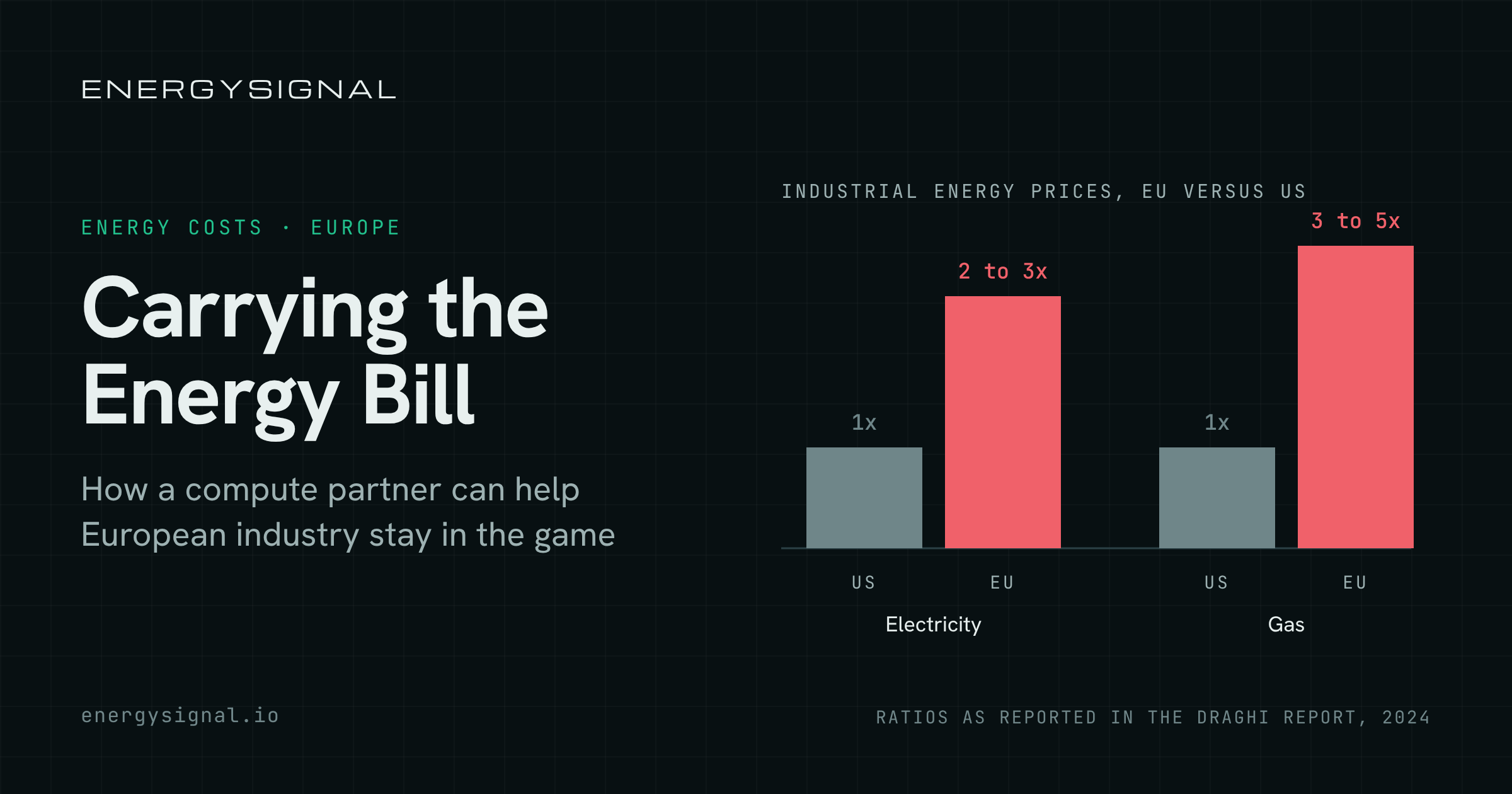
The gap is wide and it is not closing. In 2024 the Draghi report found that EU companies face electricity prices two to three times those in the US, and gas prices three to five times higher (DLA Piper, on the Draghi report). A BloombergNEF analysis reported in October 2026 put 2025 business electricity prices at 110 dollars per MWh in the US and 89 dollars in China, against 226 dollars in Germany and as much as 327 dollars in Britain (oEnergetice, reporting BloombergNEF).
Prices have eased from their peak, but not by much. Eurostat puts the EU average non-household electricity price at 0.1837 EUR per kWh in the second half of 2025, down 5.4% on a year earlier, with Ireland the most expensive at 0.2552 EUR and Finland the cheapest at 0.0748 EUR (Eurostat).
The effect on output is already showing. Production in Germany's energy-intensive industries fell 15.2% between February 2022 and March 2026, against 9.5% for industry as a whole (Clean Energy Wire, on Destatis data). In the DIHK's June 2026 survey of around 3,100 German companies, about 60% of large industrial firms said they were considering or carrying out relocation or production cuts because of energy costs, and about a third of those were already relocating (DIHK).
And plants are closing. In July 2025 Dow announced it would shut an ethylene cracker in Böhlen and chlor-alkali and vinyl assets in Schkopau, both in Germany, with around 800 job cuts and shutdowns beginning in mid 2026 (Reuters via Yahoo Finance). In September 2026 INEOS mothballed its three acetyls plants in Hull, described as the last remaining acetyls units in Europe, saying European gas prices had reached twelve times US levels (chemeurope).
Why the usual responses are not enough
Each of the standard responses helps a bit. None of them closes the gap.
Efficiency has largely been done. European industry has, to be fair, spent two decades squeezing energy out of its processes, and what is left to find is small and expensive.
Hedging fixes the price for a period and protects against spikes. But it does nothing to the level, and when the hedge rolls over the new price carries the same structural gap.
Relief from governments is partial and usually temporary. It also tends to reach the largest consumers first, which leaves mid-sized sites to manage on their own.
Relocation is the response nobody wants, and some are choosing it anyway. It gives up the site, the workforce and the local supply chain in exchange for a lower bill somewhere else.
There is a fifth option that most sites have not looked at. It leaves the price of the power a site buys where it is, and works on what the site's energy position is worth instead.
The site as an energy asset
An industrial site is more than a consumer of power. It usually holds a grid connection sized for its busiest day. It rejects heat it paid to make. And it has hours, overnight or at weekends, when its own demand falls and power is cheapest. Each of these is worth something to a compute operator and almost nothing to anyone else.
Compute is the one industrial load that can be built in months and placed almost anywhere with power and fibre, and in its flexible form it can be switched off when the site needs the capacity back. That makes it the ideal counterparty for a site with energy value it cannot otherwise sell.
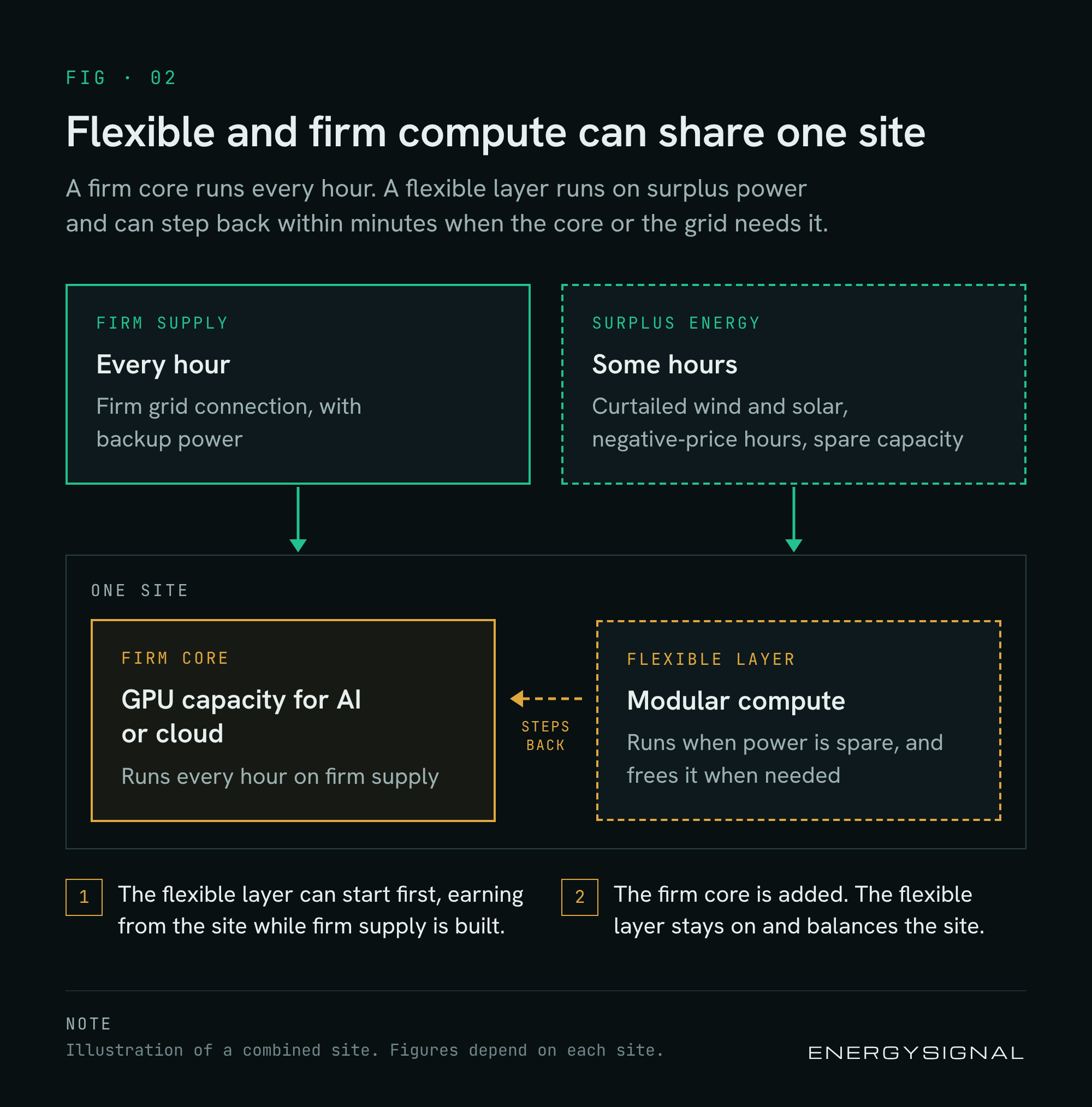
The arrangement is simple at its core. The compute partner brings the demand for power. The site brings the connection, the space and, where it has one, a use for the heat. Who supplies what, and on which terms, gets agreed in the site model. The site is paid for what it provides, and that income goes against the energy bill. In the best cases it can do more than offset it.
The site still buys its electricity at the going price. The gain comes from the parts of its energy position that currently earn nothing.
Three ways a compute partner can lower the bill
The figures below are illustrations rather than quotes. Every site is different, and the site model is where the real numbers get agreed.
1. Selling hours the site does not use. A plant with a 10 MW connection that runs one shift uses a fraction of its capacity overnight and at weekends. A flexible compute load can draw, say, 5 MW in those hours and step back when the plant ramps up. Over a year that can add up to several thousand hours of power sold through a connection the site already holds, with no new grid application to make.
2. Getting paid for heat the site throws away. Compute turns almost all of its electricity into heat. Where a site has a steady use for warm water or low-grade process heat, a temperature lift stage can raise the compute's output into the band the site needs. The site then buys less gas for the same heat, and the saving lands straight on the bottom line.
3. Earning from flexibility itself. Grids pay for load that can step back on request, and a site with a flexible compute layer has that ability built in. In the UK, flexible data centres "could qualify for faster and larger connections where they agree to flex on request", according to National Grid (National Grid). Ireland's action plan expects large energy users to operate flexibly and to cut demand when the grid is constrained (A&L Goodbody).
In practice a site can stack all three, with the compute partner buying the spare hours, the heat replacing gas and the flexibility earning from the grid. The more of them a site can offer, the stronger its position when the site model is drawn up.
Why combining flexible and GPU compute is what keeps a site in the game
Flexible compute and GPU compute are different businesses, and a site does best when it hosts both.
Flexible compute is the easy first step. It runs on the hours a site does not need, it needs no data hall, and it can be switched off when the plant ramps up. It earns from the site's spare capacity and heat. But it earns only in the hours it runs, and the price it pays for power is modest.
GPU compute for AI is the larger prize. It needs firm power every hour, at steady quality, and it pays for that reliability. A site that can offer a firm connection, fibre and a long contract becomes a candidate for an AI or cloud tenant, and that tenant pays far more per megawatt hour than a flexible load does. The catch is that GPU capacity is expensive to build and cannot tolerate interruption, which means it cannot just be plugged into a plant's spare hours.
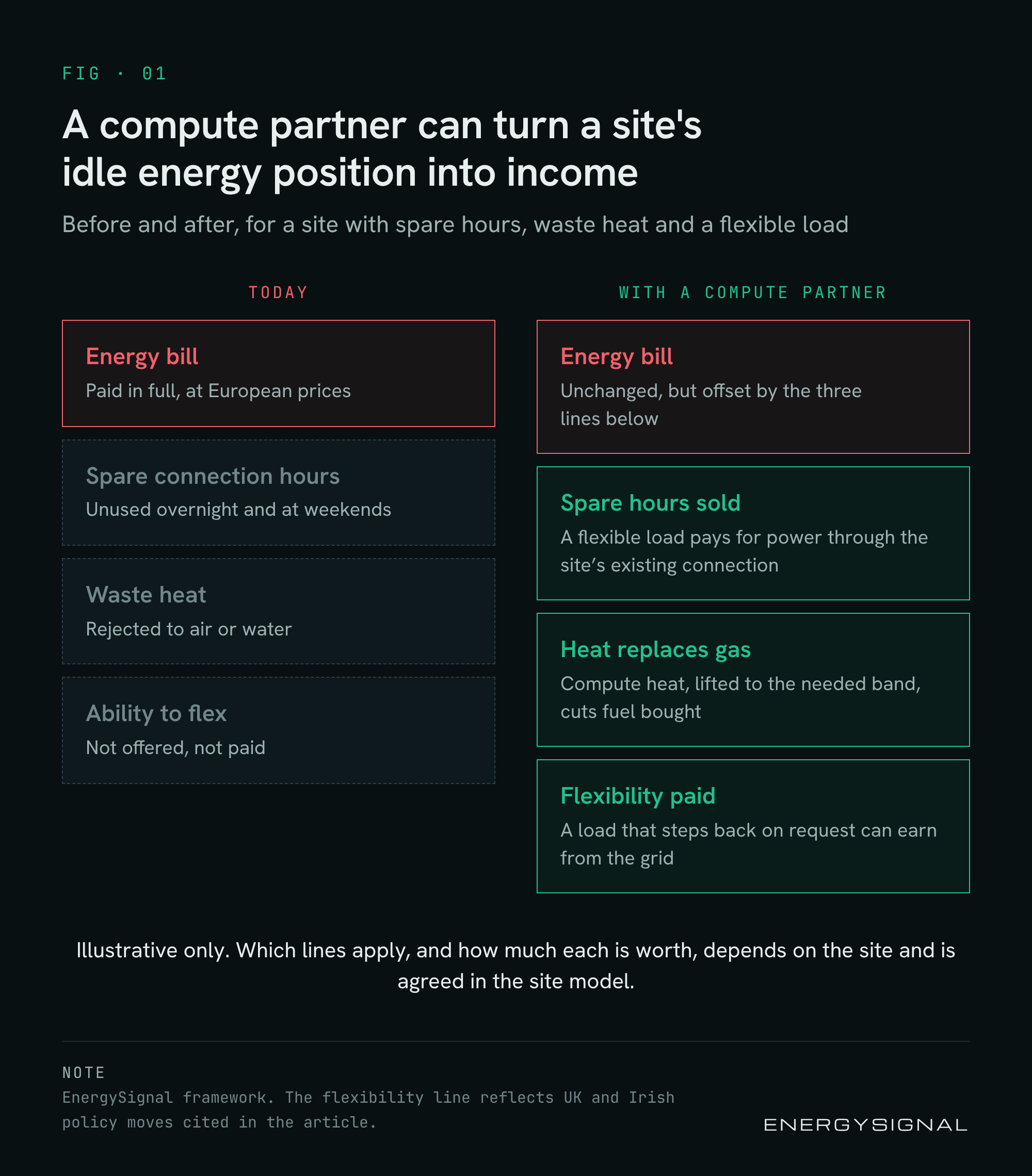
Hosting both resolves this. The firm GPU core runs on the site's firm supply every hour, and a flexible layer sits beside it on the surplus hours and the heat, able to step back within minutes when the core, the plant or the grid needs the power. The flexible layer can also go first and earn from the site while the firm core is arranged and built.
For a site under pressure from energy costs, this is the version that changes the picture. The flexible layer gets income started early and keeps the commitment small. When the firm core arrives, the site stops being only an energy consumer and becomes an energy host, with a tenant whose business depends on the site's power and who pays accordingly.
What a site needs, and what to ask
Not every site is a candidate, and the ones that are should go in with their eyes open. These are the questions we think a site owner should be able to answer before signing anything.
- How much of our connection do we actually use, hour by hour? A year of hourly data is the single most useful thing a site can bring to the table. It shows how many hours are spare, and when.
- Is our connection firm, and could it be upgraded? Firm capacity is what a GPU tenant needs. If an upgrade is years away, the flexible layer is the realistic first step.
- Do we have a use for heat, and at what temperature? A site that can take warm water or low-grade heat can replace gas with it. One with no heat use earns from power alone.
- Is there fibre, and how much? Flexible compute can live with modest connectivity. A GPU tenant cannot.
- What are the noise and planning constraints? Compute equipment makes noise, so neighbours and permits should be checked before anything arrives on site.
- What does the contract let us do if conditions change? A site should be able to resize or end the flexible layer without penalty, and it should know exactly what it is committing to before a firm core is added.
- Who carries which risk? Power price, uptime, equipment and permits each sit with someone, and the site model should say who.
A good compute partner will welcome these questions. And a site that cannot answer the first one yet is still a candidate. Measuring is the first step, and it costs almost nothing.
Start light, and keep the site in the game
A site under cost pressure does not need a large commitment to begin. A measurement, a small flexible installation on its spare hours and the evidence that comes from running it are enough to start with. If the numbers hold, the site can scale the flexible layer, add heat reuse and in time offer its firm capacity to a GPU tenant. If they do not, the equipment can be resized or removed and the site has lost little.
Flexible compute sits alongside large projects that need stable, round-the-clock power rather than competing with them, and it can make those projects easier to build and to pay for. A single site can host both.
The shape we keep coming back to is a firm core of AI or cloud capacity on firm supply, with a flexible layer of modular compute beside it that runs on surplus or curtailed energy and can step back within minutes whenever the core or the grid needs the power. And the flexible layer can start first, earning from the site while firm supply and grid upgrades are built.
EnergySignal connects industrial sites and energy owners with operators of flexible, modular compute, and we model the economics for both sides before anyone commits. If you are a compute operator or an investor looking for powered, flexible sites, you can reach us at info@energysignal.io.
We are here to help hosts see what their site is worth, whether that is a plant with a connection it does not fully use, a site with spare heat demand, or a wind or solar farm facing curtailment.
The calculators at energysignal.io/calculators are a good place to put your own numbers in and see what comes out. Or write to us at info@energysignal.io and we can go through your site with you and what it could be worth.
Also in this series
- Heat as a Second Income: what compute heat is worth to a site
- What Is Your Site's Energy Worth?: four things that set a site's value, and how to prepare the first conversation
- Anatomy of a Site: an industrial plant with its own power station, and where its value sits
Sources
- DLA Piper: Draghi report on the future of European competitiveness, implications for the energy sector (25 Sep 2024)
- oEnergetice, reporting BloombergNEF: European industry pays several times as much for electricity as its US and Chinese competitors (18 Oct 2026)
- Eurostat: Electricity price statistics (data extracted April 2026)
- Clean Energy Wire: Energy-intensive industries in Germany see 15 percent production fall since start of Ukraine war (15 May 2026)
- DIHK: Energiekosten, jedes dritte große Industrieunternehmen verlagert bereits Produktion ins Ausland (27 Jul 2026)
- Reuters via Yahoo Finance: Dow to close three European chemical plants, cut 800 jobs (7 Jul 2025)
- chemeurope: Europe's last acetyls site halts production (23 Sep 2026)
- National Grid: UK-first trial of AI grid technology (2 Mar 2026)
- A&L Goodbody: Data centres and the grid, how recent Irish policy will shape the sector (15 Apr 2026)
Information only, as of the date shown. Not an offer, and not legal, tax, regulatory or investment advice. Any arrangement is agreed only in signed agreements.