Articles · 06
First Ready, First Served: Why a Site That Is Ready Now Is Worth More
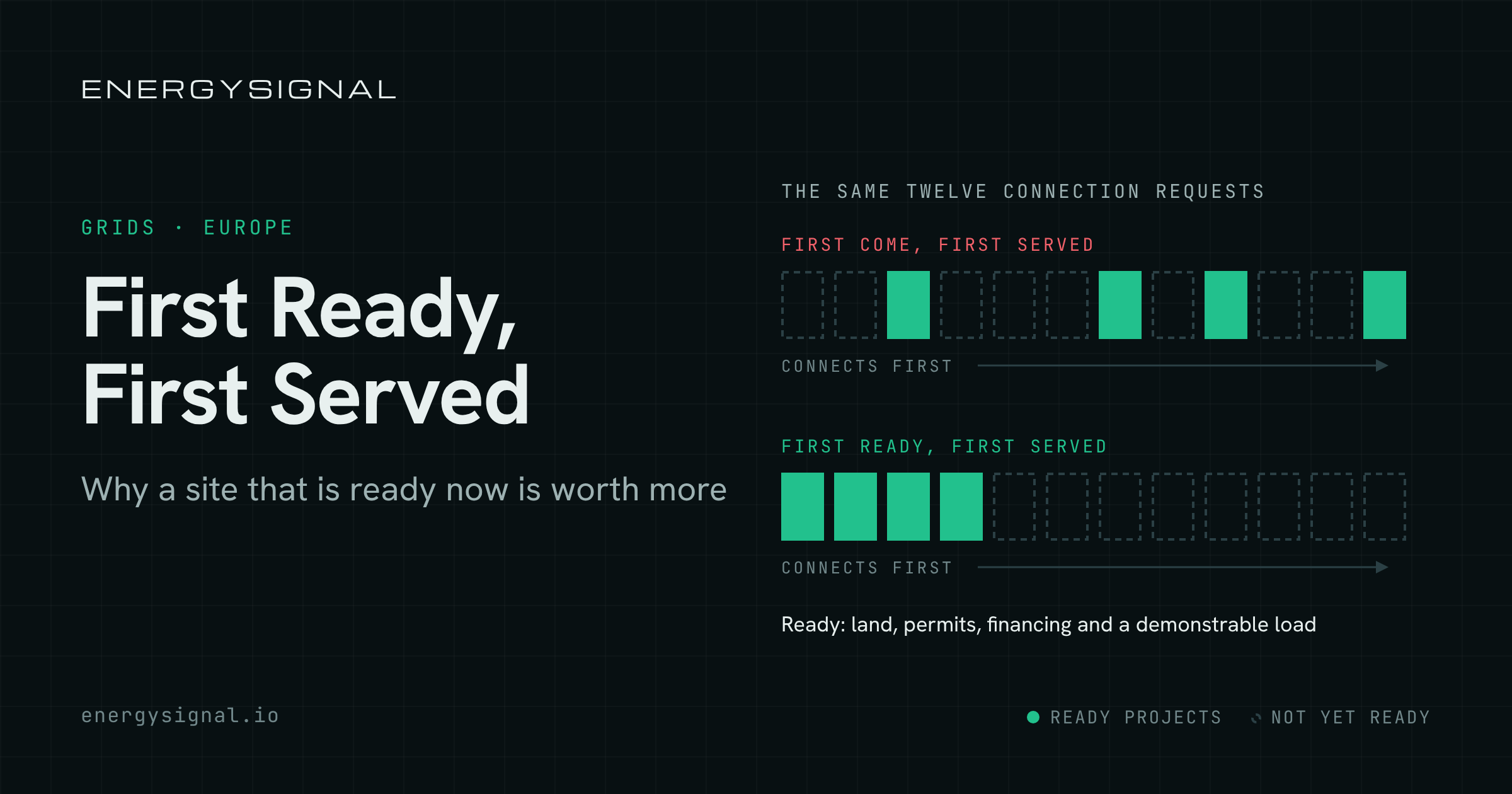
Europe's grid queues hold far more projects than will ever be built, and the rules are being rewritten to put the ready ones first. For anyone who owns a site with a connection already in hand, that shift changes what the site is worth, and we want to explain why.
For most of the last decade, a grid connection in Europe went to whoever asked first. It was simple, and fair in a narrow sense, but it filled the queues with applications that had no land, no permits and no financing, sitting ahead of projects that had all three. So a developer who wanted to be sure of capacity applied early and applied often. The queues grew, waiting times grew with them, and capacity that was reserved on paper was not available to anyone who could actually use it.
That is now being unwound. The European Commission's guidance of December 2025 points out that EU law never required the queue to work this way, and invites member states to rank requests by how ready they are. Great Britain has already rebuilt its queue on that basis, and Germany's cabinet approved a grid package in July 2026 that moves the same way. For anyone who owns a site with a connection, metered hours and a heat user, the direction is the same in every country, and readiness is becoming the thing the system pays for.
The queue in numbers
The system operators themselves now publish the scale of the problem, and their numbers bear little relation to what will ever be built.
In Great Britain, NESO says the old queue for grid access "grew tenfold in five years, reaching over 700 GW", which is around four times what the country is projected to need by 2030. The rebuilt pipeline, published in December 2025, holds 283 GW of generation and storage and 99 GW of transmission-connected demand. In Italy, Terna's chief executive said on 14 October 2026 that data centre connection requests had reached "oltre 100 GW di richieste di connessione, per quasi 600 iniziative", more than 100 GW for almost 600 projects, and that, as with renewables before them, "le richieste di connessione superano ampiamente la reale capacità di realizzazione dei progetti", the requests far exceeding what can actually be built (Teleborsa).
In Spain, Red Eléctrica's map of demand access, published on 1 October 2026, shows 18,521 MW of access granted on the transmission grid, of which 11,046 MW is not yet in service. Data centres hold the largest share, 6,329 MW or 34.2%, "pero ninguno aún puesto en servicio", none of it yet in service (Energías Renovables). The Spanish government's own August 2026 statement puts the data centre demand its AI strategy actually needs at 3.5 to 4 GW, against "más de 12 GW de derechos de acceso y conexión" already granted since 2021.
In the Netherlands, Netbeheer Nederland counted 15,498 businesses waiting for a consumption connection halfway through 2026, representing 9,986 MW, and a further 8,558 waiting to feed in. In Denmark, according to Ember, Energinet paused new grid connections in March 2026 after a surge of requests from data centres, batteries and power-to-X plants. Ember's figure is that "More than 60 GW of new consumption is currently queued", in a country whose peak demand in 2024 was 7.3 GW. Across the eight European countries that report their queues, Ember finds "Almost 700 GW of renewables are stuck in the grid connection queue".
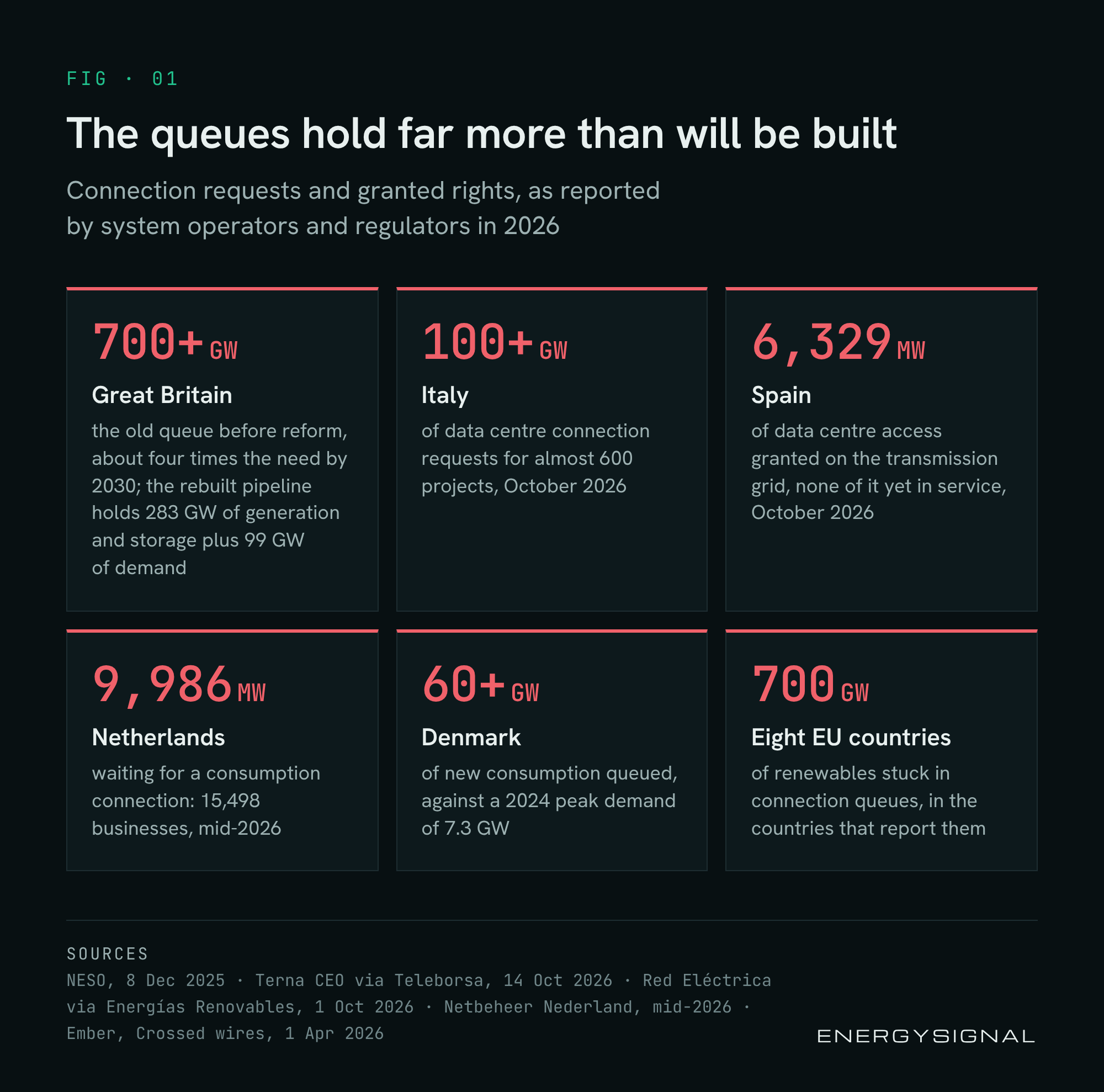
These figures count applications, most of them filed to hold a place in the line, and they say very little about real demand. So operators and regulators have stopped treating the date of the application as the thing that matters.
What the European Grids Package changes
The Commission presented the European Grids Package on 10 December 2025. The part that matters for queues is the Commission Notice it published alongside the legislative proposals, the Guidance on efficient and timely grid connections. Three points in it stand out for us.
First come, first served was never a requirement. The guidance states that "the Electricity Directive does not prescribe the application of the 'first come, first served' principle". Member states and regulators are encouraged to consider "a first-ready, first-served system, which takes into account the maturity of grid connection request". It adds that "Maturity criteria have significant potential to disincentivise immature projects from applying."
Queues can be ranked by what a project offers the grid. Where member states set prioritisation rules, the guidance lists criteria they may use, including "grid friendly uses (e.g. storage, non-fossil flexibility), climate friendly uses, social value", and prioritisation tied to "policy objectives, such as electrification of transport, industry or the deployment of data centres". It also recommends reservation fees "proportionate to project size" and milestone-based queues on the "use it or lose it" principle, so that capacity reserved on paper goes back into the pool if a project does not progress.
Large loads need more than a procedure. The guidance is candid that for large consumers such as data centres, changing the connection procedure alone will not be enough, because the grid usually needs reinforcing as well. It asks system operators to engage with heavy grid users early so that their needs are reflected in grid planning, and it encourages direct lines where they relieve the main grid.
The guidance is not binding. But the Commission's own count is that "at least 16 Member States face grid connection queues as of mid-2025", and it says regulators and system operators can act on the guidance relatively fast without waiting for the legislative proposals to pass. The proposals themselves, which amend the Electricity Directive and the Renewable Energy Directive among others, are still with the European Parliament and the Council.
A second proposal followed on 17 July 2026. COM(2026) 600, on "future-proofing electricity bills in the Union", would amend the Electricity Regulation so that, where capacity is scarce, "regulatory authorities should be allowed to approve measures to deter speculative requests for connection to the grid", and could "prioritise users within the same category with flexible consumption patterns" or those "contributing to on-site storage and on-site generation of additional clean energy". Its recitals say of data centres that "their optimal location, time-of-use and consumption profile can support their efficient connection", and network tariffs would have to "enable the use of flexible connections, while ensuring this does not delay needed network reinforcements". If that is adopted, flexibility becomes a criterion that moves a project up the queue rather than a courtesy it offers the grid.
National moves already under way
Several countries had already started down this road before the Commission wrote its guidance.
Great Britain rebuilt its queue. Ofgem's connections reform set out to "end the first-come, first-served system" and fast-track projects that are ready and needed. Every project in the old queue was reassessed against readiness and need, and the pipeline that came out of it in December 2025 is the 283 GW and 99 GW above. By 1 October 2026, NESO's director of connections reported that "more than 75% of the offers needed to support the 2030 energy system have been issued", and added a caution that applies everywhere: "An offer is an important milestone, not a finished project."
Spain auctions scarce capacity on merit. Where demand requests exceed the capacity of a transmission node, MITECO now runs demand access tenders, awarded on three criteria rather than on order of arrival: avoided greenhouse gas emissions, the volume of investment, and the date consumption starts. The first awards, in February 2026, gave 928 MW to large industrial projects in five nodes, tied to €3,105 million of investment. Several applicants withdrew along the way, which freed capacity for others without a contest. A decree announced in August 2026 would make data centres show they meet requirements, including additional renewable supply, before access rights are granted, with rising penalties and ultimately loss of the right for those that do not.
Ireland asks new data centres to bring their own power. The CRU's decision of 12 December 2025 requires new data centres "to provide generation and/or storage capacity, either onsite or local in proximity to match the requested data centre maximum import demand capacity", and to meet at least 80% of their annual demand with additional renewable projects in Ireland. System operators also have to look at whether a requested connection sits in a constrained or unconstrained location. Data centres took 22% of Irish electricity demand in 2024 and are expected to reach 31% by 2034.
The Netherlands ranks by social function and sells the off-peak hours. ACM's prioritisation framework decides how operators allocate scarce transport capacity, and social functions come first. TenneT, for its part, offers time-dependent transport rights to customers on the waiting list. Up to 9.1 GW is available at off-peak times, flexible users "can save up to 65% on grid tariffs", and TenneT may limit them for the remaining 15% of the time.
Germany and Italy are following. According to CMS, Germany's cabinet approved a grid package on 29 July 2026 that gives the transmission operators' maturity assessment, in use since 1 April 2026, a legal basis, and allows connections to be made conditional on a flexible connection agreement where capacity is constrained. The bill is still before parliament. Terna's answer to its 100 GW of requests is the same principle put in engineering terms: build the infrastructure "in funzione della concreta maturazione delle iniziative", according to how far each project has actually matured.
What ready means for a site
Every version of the new rules, the Commission's, Britain's and Germany's, ranks projects on evidence rather than on the date they applied. For a site owner, the evidence is a short list.
- A connection that exists. A connection agreement with reserved capacity for import and export, at a stated voltage, is the single most valuable document a site holds. A plant that can host a load behind its own meter, inside the capacity it already has, needs no place in the queue at all.
- Twelve months of metered hours. A system operator can plan around spare capacity that is shown hour by hour. It cannot do much with capacity that is only asserted.
- Flexibility that can be demonstrated. A load that steps back when the grid is tight is the kind of user the July 2026 proposal would move up the queue, and the kind a flexible connection agreement is written for.
- A heat user. Heat reuse adds a second income to the site and counts in the EU's reporting on data centres. A plant or a network that can take the heat makes the site worth more than the connection alone would.
- Land with permits. An industrial site with an existing electrical installation, road access and a permitted use is years ahead of a field.
- A data link. Fibre at the site, or a route to it, decides whether firm compute can ever follow the flexible layer.
Most of this is in the owner's files already. Our host guide, "What Is Your Site's Energy Worth?", lists what to gather and where it usually is: energysignal.io/insights/what-is-your-site-worth.
What it means for investors
The market already prices readiness. JLL's EMEA data centre mid-year 2026 report puts prime powered land in the five main hubs at about €2.26 million per MW, up 82% since 2021 from €1.24 million, with primary markets carrying a 2.3 times premium over secondary locations and four times over tertiary ones. The same report finds that hyperscale sites in the 2026 to 2028 pipeline sit on average 175 km from a hub city, up from 46 km, and that greenfield sites have risen from 8% to 39% of that pipeline. Power is being bought wherever it exists, and the premium goes to the sites that have it now.
For anyone holding or financing a site, we think three things follow.
Secured power is the asset, and it can earn before the firm tenant arrives. A site with a connection and spare hours does not have to wait for the AI operator before it is worth something. A flexible load can use those hours from the first year, on the existing connection, while the firm case is put together, which turns a holding cost into an income.
Readiness is about to compound. If connection queues are re-ranked by maturity and flexibility, the sites that can show both move up, and their upgrades arrive sooner. With every rule that is adopted, the gap between a ready site and an option on one gets wider.
The rules are not law yet. The Grids Package proposals and the July 2026 regulation are with the Parliament and the Council, the Commission's guidance is advisory, and national rules differ. A connection agreement may carry curtailment conditions, and, to be fair, a flexible connection is flexible for the operator as well as the site. The value of readiness is real. But the detail of how each country rewards it is still being written, and it is worth checking site by site.
Start light, and let readiness pay
The arrangement we have in mind has two parts. A firm core of AI or cloud capacity runs on firm supply, and a flexible layer of modular compute uses surplus or curtailed energy and can step back within minutes when the core or the grid needs the power. The flexible layer does not have to wait for the core, either. It can start first and earn from the site while firm supply and grid upgrades are being built.
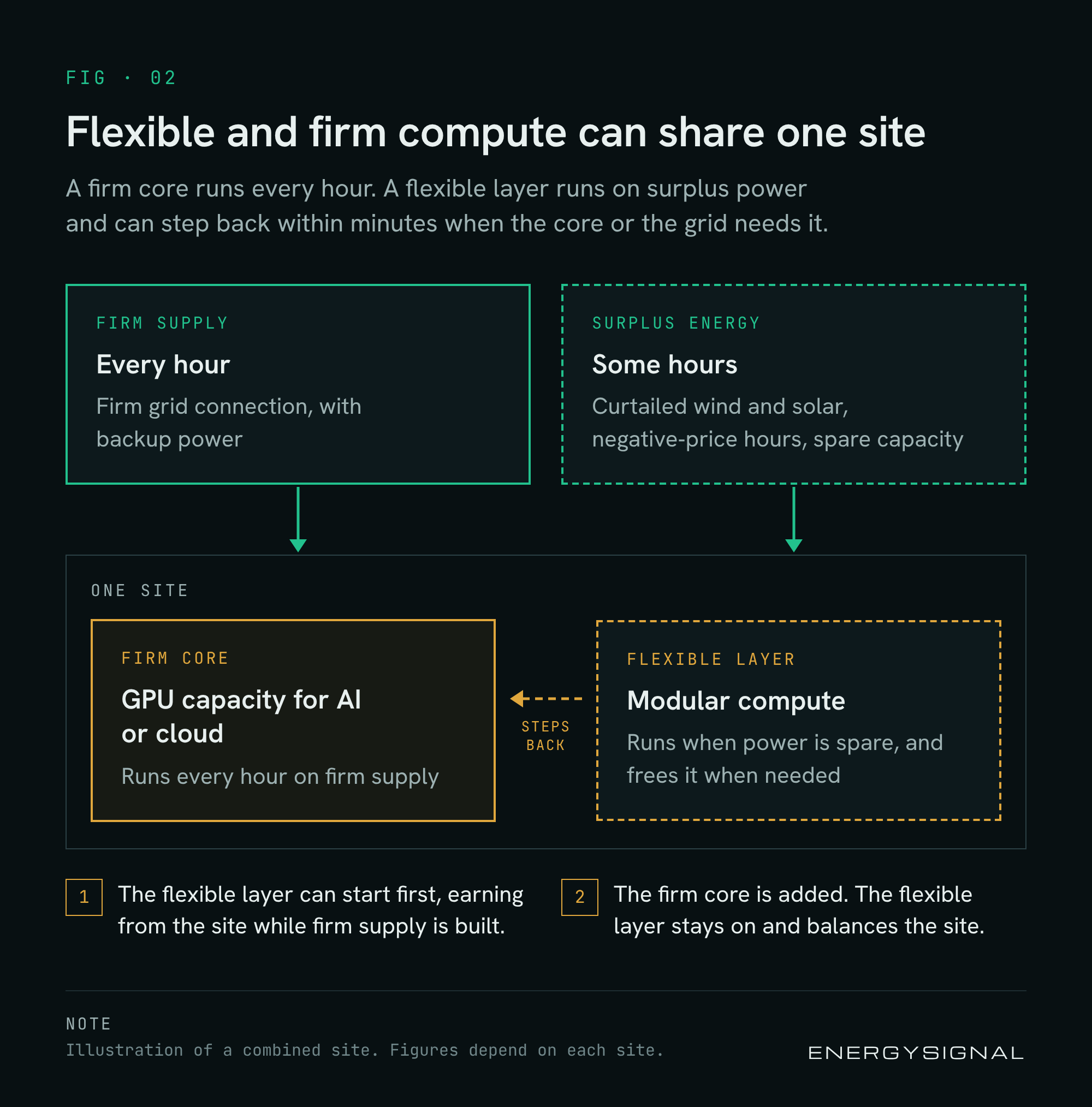
A site that hosts a flexible layer today is doing two things at once. It is earning from hours that would otherwise go unused, on a connection it already has, and it is building exactly the evidence the new queue rules reward, in the form of metered flexibility, a working heat loop and an operating record. When the upgrade or the firm connection comes through, the firm core can be added alongside, and the site walks into that conversation as a proven host rather than as one more application.
If you own a site like this, we would like to help you work out what it is worth. Our calculators at energysignal.io/calculators are a good place to start with your own numbers. And if you would rather talk it through, write to us at info@energysignal.io and we can go through your site with you.
Also in this series
- Pricing Flexibility: what a load that can step back is worth
- What Is Your Site's Energy Worth?: four things that set a site's value, and how to prepare the first conversation
Sources
- European Commission, Commission Notice: Guidance on efficient and timely grid connections, C(2025) 8473, 10 December 2025
- European Commission, European grids (the Grids Package page, with links to the legislative proposals)
- European Commission, Proposal for a Regulation amending Regulation (EU) 2019/943 as regards future-proofing electricity bills in the Union, COM(2026) 600, 17 July 2026
- A&O Shearman, The European Grids Package: Policy Reforms to Accelerate Europe's Energy Transition, 11 December 2025
- Arthur Cox, EU proposes reforms to electricity network tariffs, smart metering and grid access, 2026
- NESO, Unveiling the new project pipeline to deliver Clean Power by 2030, 8 December 2025, and What industry needs next from connections reform, 1 October 2026
- Ofgem, Clean power by 2030 one step closer as proposed new, fast-track grid connections system is unveiled, 14 February 2025
- Teleborsa, Terna, Monti: oltre 100 GW di richieste di connessione per data center, 14 October 2026
- Energías Renovables, Este es el mapa REE de capacidades de acceso de la demanda por tipo de consumo, 1 October 2026, reporting Red Eléctrica's map
- MITECO, El Gobierno plantea impulsar los centros de datos sostenibles, eficientes y soberanos, 27 August 2026, and El MITECO adjudica 928 MW de acceso a la red eléctrica a grandes proyectos industriales, 25 February 2026
- Netbeheer Nederland, Feiten en cijfers, mid-2026
- TenneT, TenneT provides 9 gigawatts of capacity on the high-voltage grid for customers on the waiting list, 7 April 2025
- Ember, Crossed wires: Grid capacity could block EU energy security, 1 April 2026
- CRU, The CRU publishes its decision on new electricity connection policy for data centres, 12 December 2025
- CMS, Grid Package 2026: New framework for grid connections proposed, 31 July 2026 (Germany)
- JLL, EMEA data centre mid-year 2026 report, 3 August 2026
Information only, as of the date shown. Not an offer, and not legal, tax, regulatory or investment advice. Any arrangement is agreed only in signed agreements.