Articles · 16
The Connection That Stays: Post-Coal Sites, Land, Grid Capacity and a Heat Duty to Meet
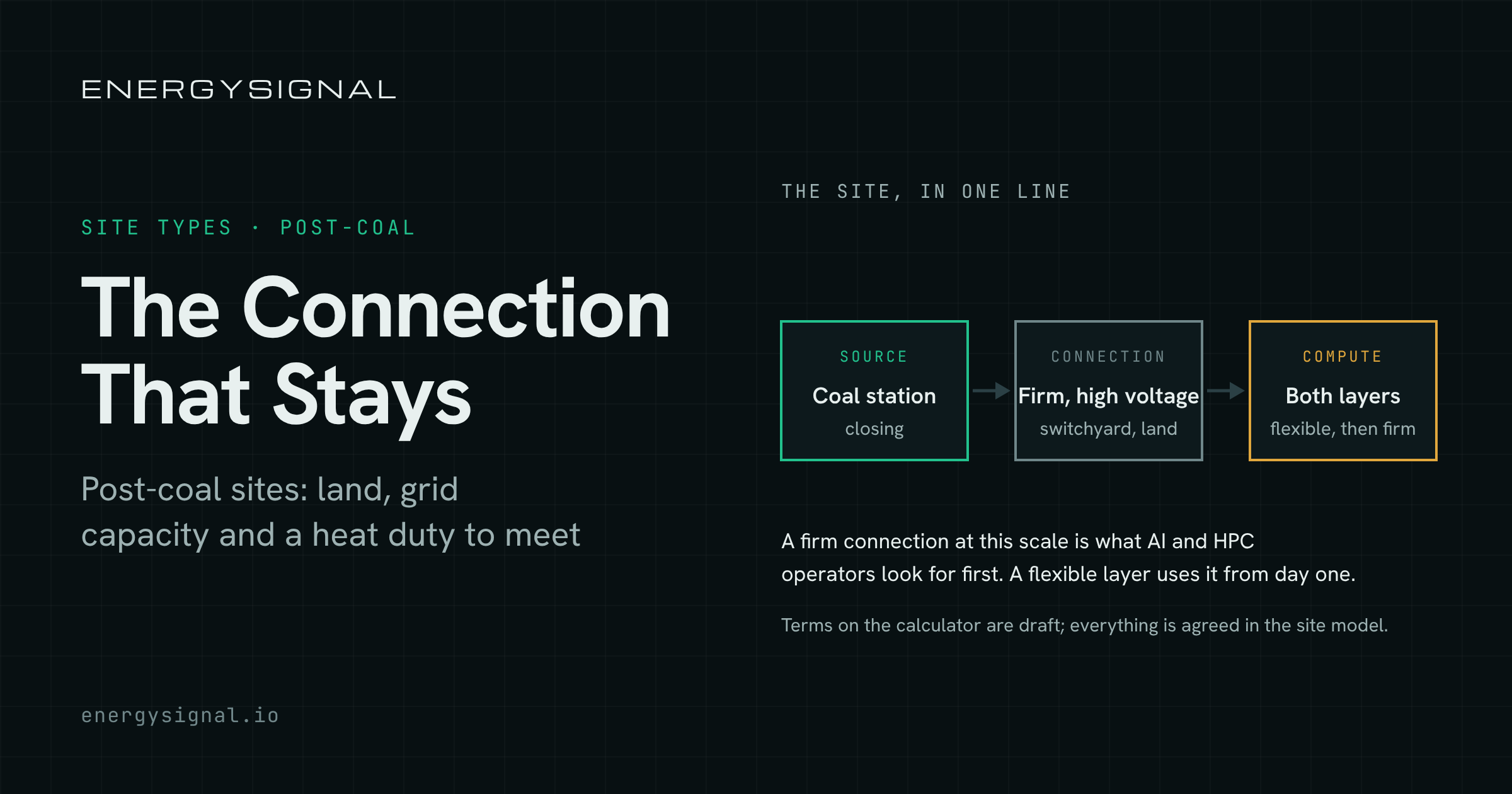
When a coal station closes, three things stay behind after the boilers go cold: the grid connection, the land, and often a duty to keep the town warm. This is about what those three are worth to a compute project, and what to have ready before you run the numbers.
In Central Europe the coal exit already has dates attached. Czechia's government programme set the conditions for a coal exit by 2033, Poland has agreed with its unions to end hard coal mining by 2049, and the Czech Ostrava-Karviná basin stopped deep mining in January 2026. The stations that burned the coal were built where the coal was, and they came with transmission connections sized for hundreds of megawatts, switchyards, cooling water, rail sidings and, in many cases, a heat network the town depends on. The licence to burn coal ends, and the licence to supply heat carries on.
Those sites, and what they are worth, are the subject here: how big they are, what transition money sits behind their regions, why their shape suits compute better than almost any other kind of site, and what our post-coal calculator asks for.
The sites, and the money
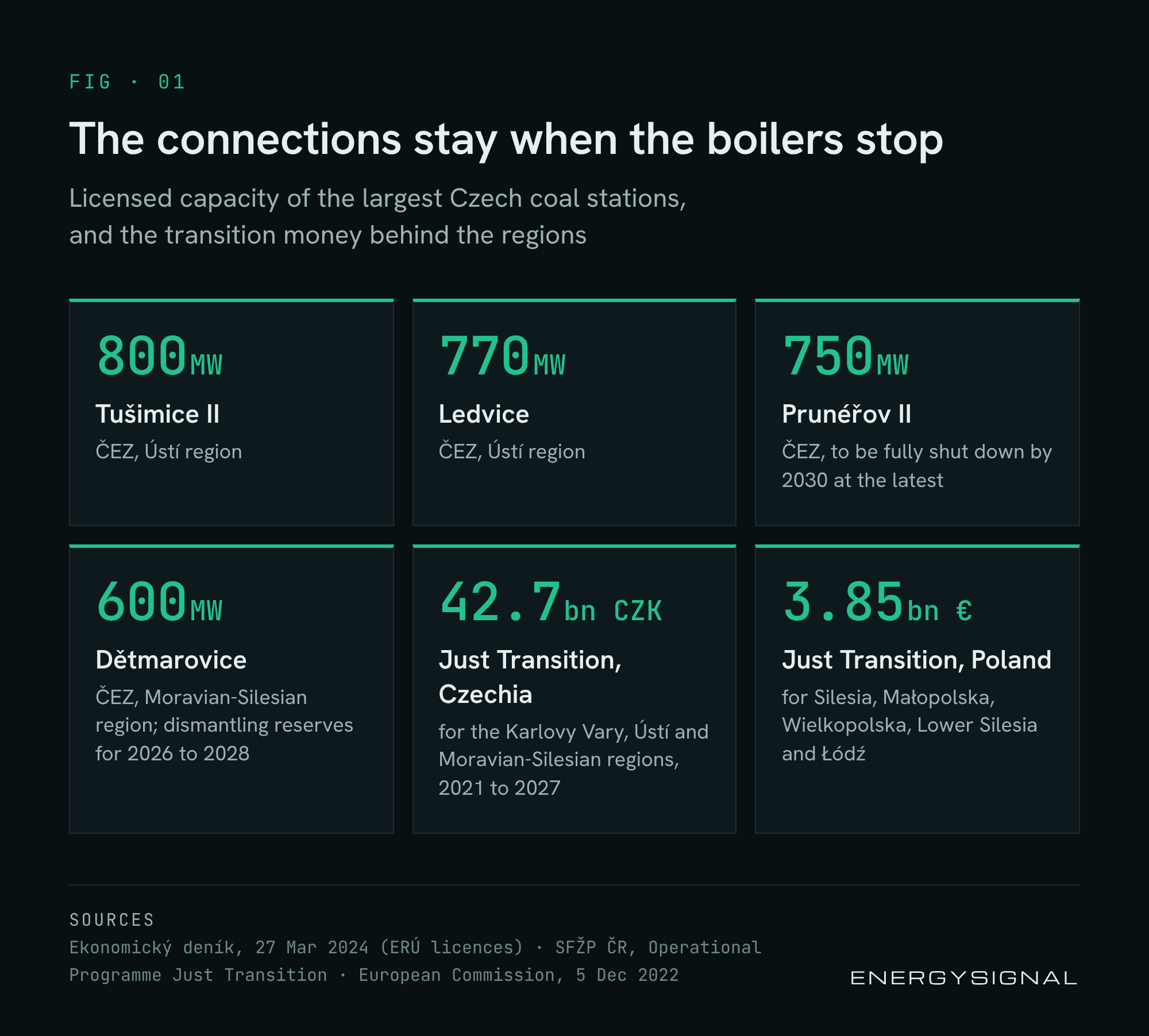
Start with the size of the stations. The licensed capacities of the largest Czech coal plants, all owned by ČEZ and listed by Ekonomický deník from the regulator's licences, run from 800 MW at Tušimice II and 770 MW at Ledvice to 750 MW at Prunéřov II, 600 MW at Dětmarovice and 460 MW at Mělník. ČEZ has set aside reserves for dismantling at Dětmarovice in 2026 to 2028. Prunéřov is to be fully shut down by 2030 at the latest. And the old coal plant at Mělník is to be replaced by a gas plant of up to 1,000 MW, which tells you how much the owner thinks the connection at a coal site is worth. In Poland the stations are larger still, and the regions around them, Silesia above all, hold the country's industry and its district heating.
The transition money is already committed, which matters. The Czech Operational Programme Just Transition has CZK 42.7 billion from the EU Just Transition Fund for 2021 to 2027, shared between the Karlovy Vary, Ústí nad Labem and Moravian-Silesian regions, and it pays for jobs for workers leaving coal, clean energy, energy savings and the regeneration of underused sites. Poland's five coal regions, Silesia, Małopolska, Wielkopolska, Lower Silesia and Łódź, have more than €3.85 billion from the same fund under plans the Commission approved in December 2022. Across the EU the fund is €19.7 billion, and the Commission expects it to mobilise about €27 billion once national co-financing is added.
A data centre is more or less the project those programmes were written to attract. It brings capital investment to a brownfield and skilled jobs with it, and it gives the connection a use that keeps the town's heat supply running on something other than coal.
Why a post-coal site suits compute
A firm connection at scale. A coal station's transmission connection is firm, high voltage and large, and it is the one thing the grid queues cannot supply quickly. A connection that stays firm at this scale is what AI and HPC operators look for first. In the site model we compare a long lease of the connection and land against an annual fee, and the calculator shows how that fee is built, as a term tied to the energy that flows through the connection point.
Land that is already industrial. A station site comes with hardstanding, roads, rail, water, fencing and a permitted industrial use, which is the kind of thing a developer elsewhere spends years assembling. Our calculator counts about 10 MW of containerised compute per hectare, spacing and transformers included, and tells you which of the two, the connection or the land, is the limit on the project.
A heat duty to meet. Many stations supply a town's heat, and that duty outlives the coal. Per MW of connection, compute returns about 0.8 MW of heat at about 55 °C, and a temperature lift stage raises it into the 60 to 95 °C band most networks run at. In a seasonal network the compute's heat counts for up to a share of the year's demand, and the rest stays on the plant's other source. The heat is a second income for the site and a problem solved for the town.
Two layers, in the right order. A flexible layer can use the connection from the day the boilers stop, in containers on the hardstanding, earning from the hours the grid pays least and proving the heat tie-in while it does so. A firm core follows once an operator, a data link and a long term are in place. Nothing about the site forces the larger project to go first, and having to go first is the usual reason such projects stall.
The ownership of the site, its remediation obligations and its heat contract all stay as they are. The difference is that the connection earns before the next plant is built, and keeps earning after it is.
What the calculator asks, and what to have ready
Our post-coal calculator asks for the connection that stays, in MW, from 5 MW to 1,000 MW, then the land available for compute in hectares, the heat duty in MWh a year with the network's temperature band, and how long the duty runs. It shows how much compute the site can take, which limit binds, the heat the compute can return, and a return a year as a range, with the firm-tier term shown as a proposal. For a station site, it helps to have ready:
- The connection agreement after closure: reserved capacity, voltage, and whether it is firm
- The site plan: hectares free of plant, the remediation status, and the distance to the switchyard
- The heat contract: volumes by month, supply and return temperatures, term and penalties
- What generation stays or is planned on the site, and how it uses the connection
- The fibre routes to the site, and the operators already looking at the region
The terms on the page are draft terms, and the firm-tier term is marked as a proposal. In the site model, the connection study, the heat contract and the site plan replace the calculator's figures. The calculator is at energysignal.io/calculator/post-coal.
Start light, on the hardstanding
The pattern we keep coming back to is a firm core of AI or cloud capacity running on firm supply, with a flexible layer of modular compute beside it that uses surplus or curtailed energy and can step back within minutes when the core or the grid needs the power. And the flexible layer does not have to wait for the core. It can start first and earn from the site while the firm supply and grid upgrades are built.
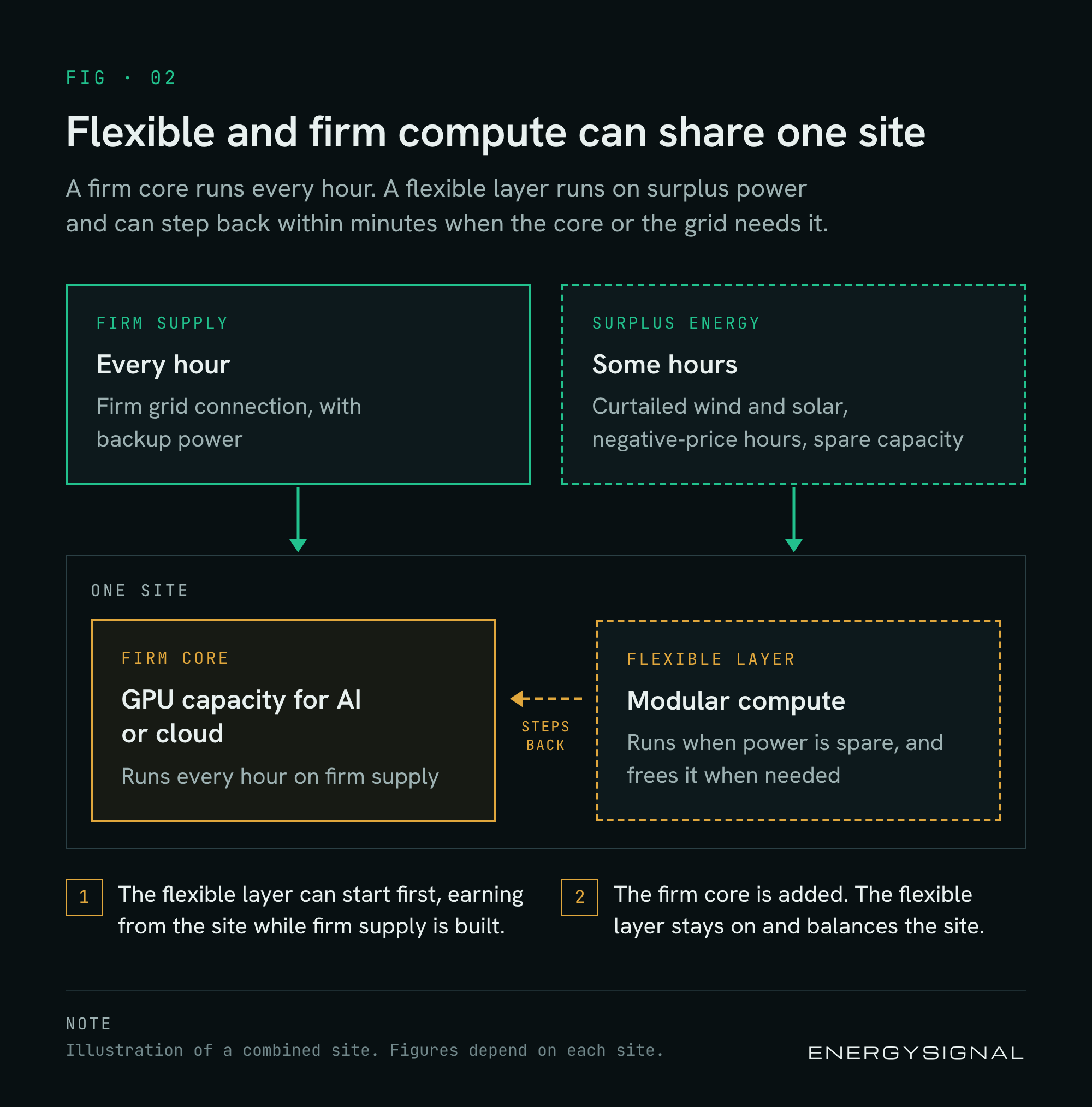
A post-coal site is where that order matters most. The firm core is the prize, but landing it takes an operator, a long term and a large investment, and those take time. The flexible layer can go ahead without them. It uses the connection and the land that are already there, earns from the first year, keeps the heat network supplied and gives the region something to point to. By the time the firm core arrives, it arrives at a site that is already working.
If you own or manage a station site like this, we would like to help you see what it is worth. Our calculators are at energysignal.io/calculators, and for a coal station the post-coal calculator at energysignal.io/calculator/post-coal is the one to open first. Or write to us at info@energysignal.io and we can go through the site with you, the connection, the land and the heat contract, and tell you what we think it could do.
Also in this series
- Methane You Drain Is Power You Can Use: coal mine methane, the EU deadline and compute on the surface
Sources
- Ekonomický deník, Rychle a zběsile. ČEZ nejspíš zavře uhelné elektrárny a doly již v tomto desetiletí, 27 March 2024, listing licensed capacities from the Energy Regulatory Office
- Úřad vlády ČR, Programové prohlášení vlády (coal exit by 2033)
- SFŽP ČR, Operational Programme Just Transition
- European Commission, EU Cohesion Policy: €3.85 billion for a just transition in five Polish regions, 5 December 2022
- European Commission, The Just Transition Mechanism: making sure no one is left behind
- The land rule, the heat treatment and the connection-and-land fee basis are those of EnergySignal's post-coal calculator and site model; terms are draft and the firm-tier term is a proposal: energysignal.io/calculators
Information only, as of the date shown. Not an offer, and not legal, tax, regulatory or investment advice. Any arrangement is agreed only in signed agreements.