Articles · 08
Why Central Europe: Industrial Power, District Heat and Room to Grow
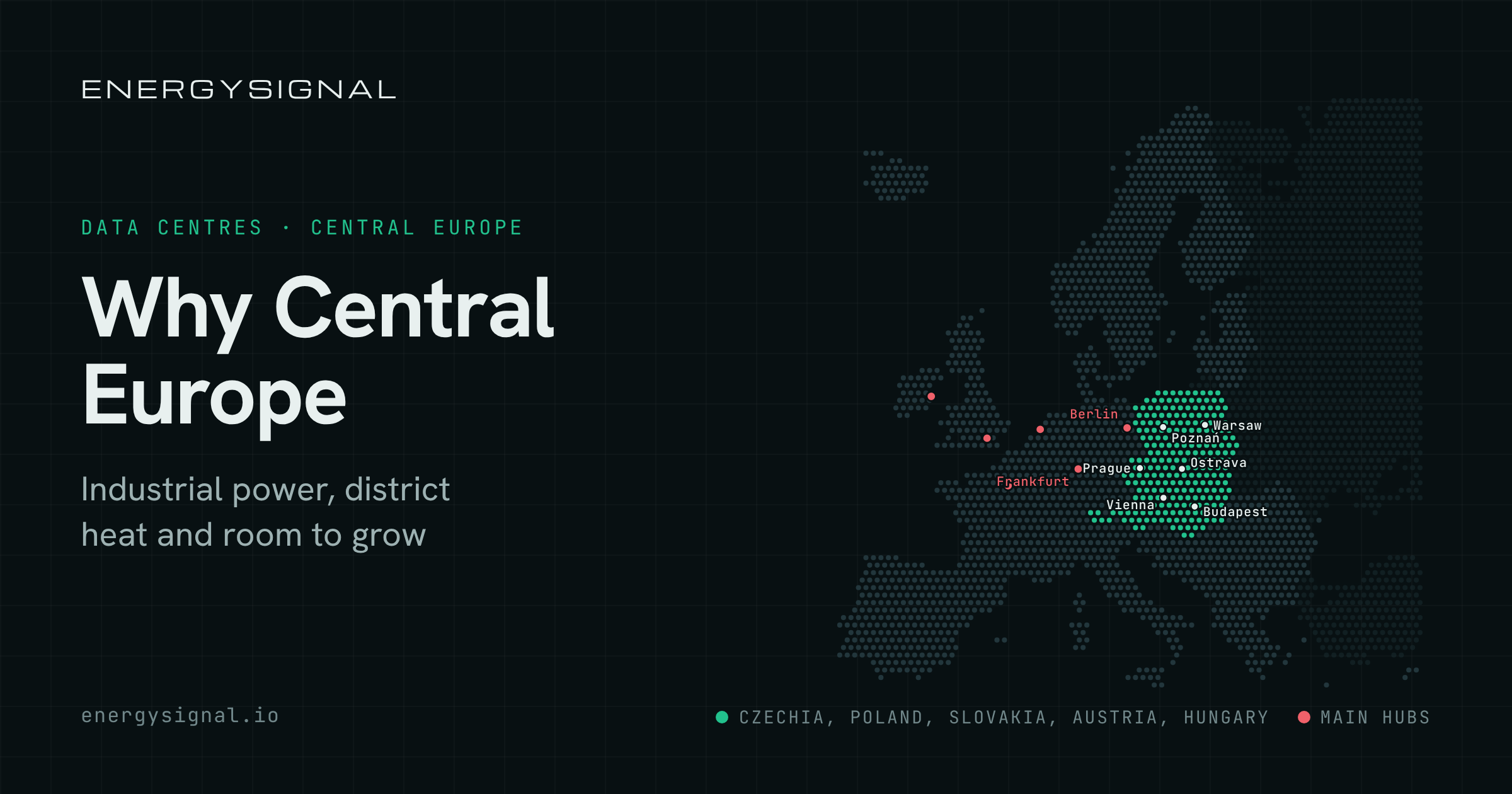
Central Europe is not where you go for Europe's cheapest grid power, and we would rather say that at the start. This article is about what the region does have, which is industrial sites with their own generation and connections, the densest district heating networks in the EU after the Nordics, coal sites with grid capacity coming free, and a data centre market still early enough to have room.
The main hubs are full. Dublin, London, Amsterdam, Frankfurt and Berlin all have queues for power, and JLL's mid-year report found that new hyperscale sites now sit on average 175 km from a hub city. So the search is moving outward, and the question for an operator or an investor is where it should go. Czechia, Poland, Slovakia, Austria and Hungary are an answer that most of the industry has not priced yet.
The usual case for a secondary market is cheap power, and we would not make it here. Czech industrial electricity costs more than German. The case we would make is that the region's industrial base, built on its own power stations and its own heat networks, holds the three things a compute project needs first, which are a connection that already exists, hours in which the power is spare, and a use for the heat. Below we go through the market as it stands, the prices as they are, and where we think the case really sits.
The market today
Czechia is a small market that has suddenly found itself in demand. According to the industry ministry, quoted by Forbes in September 2026, the country has "celkem šestnáct datacenter o celkovém příkonu nad pět set kilowattů", sixteen data centres above 500 kW. The three distribution operators have registered connection requests of "kolem jednoho gigawattu", around one gigawatt, and the ministry says individual projects now run "přibližně od padesáti do dvou set megawattů", roughly 50 to 200 MW each. The consultancy EGÚ expects data centres to use about 1.8 TWh a year by 2030. The government approved the AI Gigafactory CZ project in November 2025, and the EuroHPC Joint Undertaking selected the Czech AI Factory, built around the KarolAIna supercomputer at IT4Innovations in Ostrava, in October 2025.
Poland is the region's largest market and its fastest growing. The Polish data centre association's 2025 report puts live capacity at 180 MW, with a compound growth rate of 19.8% since 2020, and projects 500 MW by 2030 and 1,200 MW by 2034. The transmission operator PSE "allocated capacity for 1200MW of data centre development by 2034". The queue looks much as it does everywhere else. PSE had issued connection conditions for data centres totalling more than 6 GW by August 2026, after applications that had reached 150 to 200 GW before new financial requirements were introduced, and the genuine applicants, as Gramwzielone puts it, number "kilkanaście, nie setki", a dozen or so, not hundreds.
Austria, Slovakia and Hungary are earlier still. Vienna's total IT capacity exceeds 300 MW, but roughly two-thirds of it is in the early-stage category, according to DC Byte. Google announced its first Austrian data centre, at Kronstorf, in April 2026, saying it would reuse the site's waste heat. In Hungary, a 96 MW AI data centre near the Paks nuclear plant was announced by letter of intent in 2025. Slovakia's national supercomputer Perun was integrated in 2026. None of these countries is a hub, and for our purposes that is the attraction. The competition for power and land there is between a handful of projects, not hundreds.
What ties the region together is an industrial base that was built on its own energy. The region is dense with vehicle plants that have combined heat and power stations, chemical and steel sites with high-voltage connections, breweries and dairies with heat networks, and biogas plants with engines. Those are the sites our calculators are built for.
Power: what grid electricity costs here
Industrial electricity in Central Europe is not cheap, and Czechia is the clearest case of that. Eurostat's price for non-household consumers in the 20,000 to 70,000 MWh band, excluding taxes and levies, was €0.1498 per kWh in Czechia in the second half of 2025, against €0.1363 in Germany, €0.1134 in the Netherlands and an EU average of €0.1178. Poland, at €0.1058, is the one exception below the average. So a compute project buying grid power at a tariff pays more in Czechia than it would in Germany, and any pitch that tells you otherwise should be read with care.
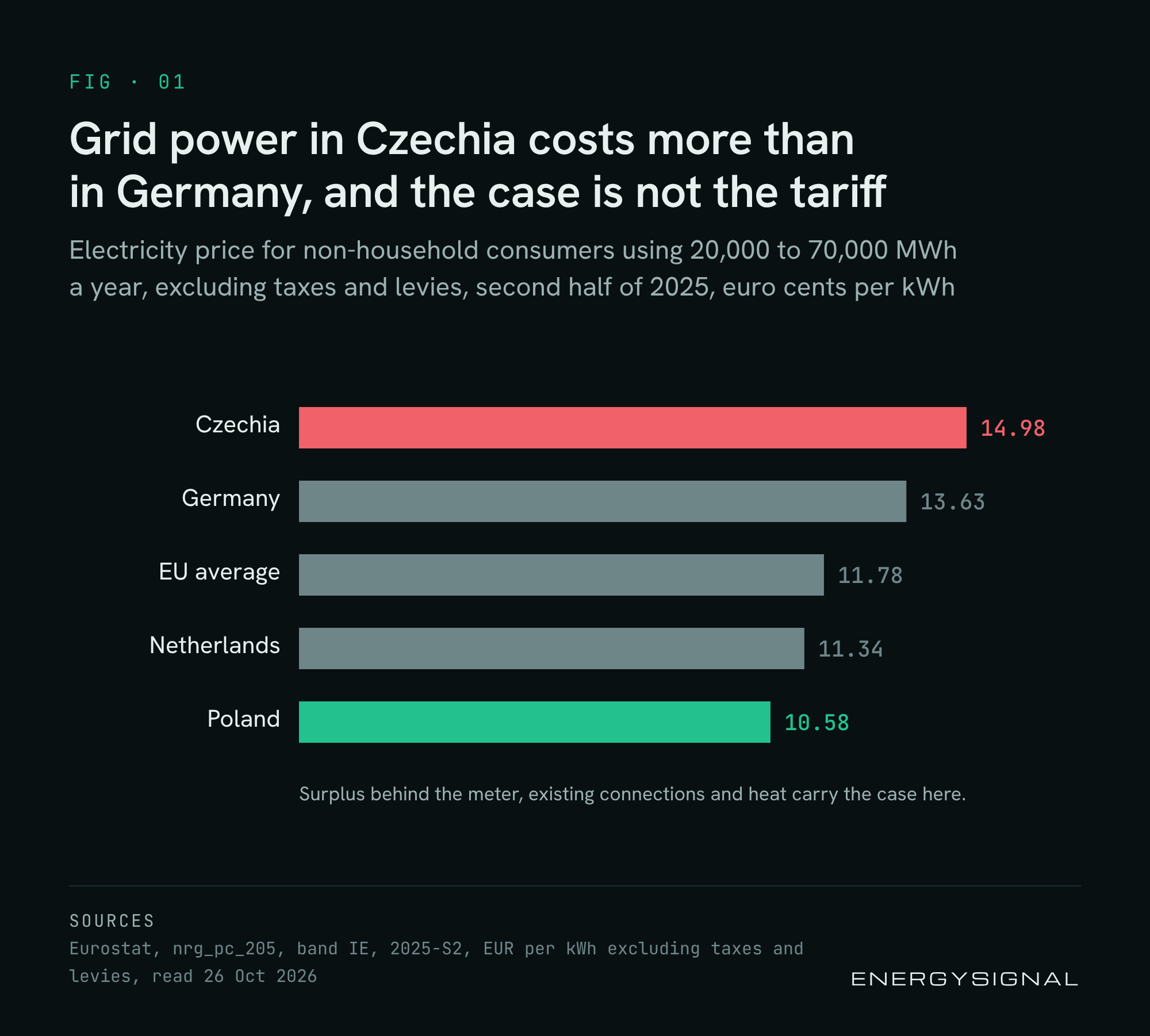
So the case for this region rests on the three things the main hubs are short of, and none of them is the tariff.
- Surplus behind the meter. A plant with its own CHP exports its weekend and overnight surplus at whatever the market pays, which in those hours is not much. A flexible layer that uses that surplus on site pays the plant more than the export earns, and the tariff never comes into it.
- Connections that exist. Industrial sites hold high-voltage connections sized for full production and used for two shifts. The spare capacity is already paid for, and a firm block of compute can take a reserved share of it without joining any queue.
- Heat with a buyer. Where a plant or a network takes the compute's heat, the heat account can carry a project that the power account alone would not. The next section says how much of the region that covers.
On those three, Central Europe can stand next to any region in Europe, and is ahead of most, because its industry grew up around its own energy rather than around the grid.
Heat: the networks are here, and they are leaving coal
District heating is, in our view, the single strongest argument for the region. In Czechia the networks supply 1.7 million households, 38% of the population, according to the district heating association. Coal still provided 47.6% of that heat in 2025, down from more than half, and the networks are replacing it. In Poland, system heat reaches about 52% of households through 22,700 km of networks, according to Forum Energii. Slovakia's networks serve over 761,000 households, 42% of the population (TASR), and 28.9% of Austrian main residences are on district heat (Statistik Austria). Across the EU as a whole, derived heat covered 10.4% of household space heating in 2024 (Eurostat), and the Nordic countries and Central Europe are where the networks are densest.
A network that is replacing coal is a network looking for a new source, and compute heat is one of the few that arrives with its own customer. Per MW of connection, the modular compute in our site model returns about 0.8 MW of heat to a water loop at about 55 °C. A temperature lift stage raises that into the 60 to 95 °C band most networks run at, or the return line of a network can take it directly. The EU's new data centre label states whether a site is waste heat reuse ready, and the Energy Efficiency Directive requires data centres above 1 MW to use their waste heat unless it is not feasible. A site next to a Czech or Polish network is about the easiest place there is to satisfy that.
Industry adds a second set of heat users. Vehicle plants, breweries, dairies, paper mills and chemical sites run processes on warm water and have networks of their own, and many of the region's largest plants already run their own heat and power stations, which is the plant shape our calculators start from.
Post-coal sites, and the money behind them
The region's coal exit is freeing up large, firm grid connections with land around them, which is the one thing every data centre developer is short of. Czechia's government programme set the conditions for a coal exit by 2033, and Poland's agreement with its mining unions runs to 2049. The biggest coal stations in Czechia are owned by ČEZ, and the licensed capacities listed by Ekonomický deník give a sense of the scale: Tušimice II 800 MW, Ledvice 770 MW, Prunéřov II 750 MW, Dětmarovice 600 MW, Mělník 460 MW. ČEZ has set aside reserves for dismantling at Dětmarovice in 2026 to 2028, Prunéřov is to be fully shut down by 2030 at the latest, and the old coal plant at Mělník is to be replaced by a gas plant of up to 1,000 MW. Each of those sites keeps a transmission connection, a switchyard, cooling water, rail and road access and, in several cases, a heat supply duty to a town.
The transition is funded. The Czech Operational Programme Just Transition has CZK 42.7 billion from the EU Just Transition Fund for 2021 to 2027, shared by the Karlovy Vary, Ústí nad Labem and Moravian-Silesian regions, for jobs for workers leaving coal, clean energy and the regeneration of underused sites. Poland's five coal regions have more than €3.85 billion from the same fund. Across the EU the fund is €19.7 billion, and it is expected to mobilise about €27 billion with national co-financing, according to the Commission.
Our post-coal site calculator is built for exactly this shape, which means a connection that stays, land for compute and a heat duty that has to be met from something other than coal. A firm connection at this scale is what AI and HPC operators look for first. And a flexible layer can use it from the day the boilers stop.
Fibre, latency and the AI factories
For most workloads the region is close enough. Frankfurt is one of the continent's main interconnection points, and Prague, Vienna and Poznań all sit within a few hundred kilometres of it on the main fibre routes between Western Europe and the east. One Poznań operator, Beyond.pl, advertises a round trip to Frankfurt of 11 milliseconds, which is a useful order of magnitude. Training and batch workloads do not notice a delay of that size, and most inference does not either. A site still needs a fibre route out to those main routes, and that is one of the first things our site model checks.
Public compute is already landing in the region. The EuroHPC Joint Undertaking's AI Factories include the Czech AI Factory at IT4Innovations in Ostrava, around the KarolAIna system, and the Piast AI Factory at the Poznań Supercomputing and Networking Center, which received €50 million from the Commission. Hungary's Levente supercomputer in Budapest and Slovakia's Perun complete the set. The Czech AI Gigafactory, approved by the government in 2025, is planned to begin construction in 2026. Public anchors of that kind draw in the fibre, the skills and the suppliers that private projects then use.
The challenges
An early-stage market is early for reasons. There are four we would put in front of anyone looking at the region.
The grid queue has arrived here too. A gigawatt of requests at three Czech distributors and 6 GW of connection conditions in Poland look small next to Italy's 100 GW, but they are large next to the systems that have to absorb them. Projects that need a new connection will wait, and the new rules that rank requests by readiness apply here as everywhere. The way around the queue is a site that already has its connection.
Prices. As the numbers above show, grid power in Czechia is dearer than in Germany. A project whose case rests on buying power at a tariff should look elsewhere. One whose case rests on surplus, heat and a firm connection is the kind we think belongs here.
Permits and planning. Industrial sites usually carry the permits a new electrical installation needs, but a hall, a substation or a heat tie-in can need more, and timelines vary from one municipality to the next. Starting with modular compute on an existing connection keeps the first step inside what the site is already permitted to do.
Depth of the market. There are fewer operators, fewer specialist contractors and fewer precedents than in Frankfurt or Amsterdam. That is a cost for the first projects and an advantage for the ones that follow. The sites that can prove themselves with a flexible layer now are, as far as we can tell, the ones the larger projects will come to.
Start light, and let the region prove itself
The shape we keep coming back to is a core of AI or cloud capacity on firm supply, with a flexible layer next to it that uses surplus or curtailed energy and can step back within minutes when the core or the grid needs the power. The flexible layer does not have to wait for the core. It can start first and earn from the site while firm supply and grid upgrades are built.
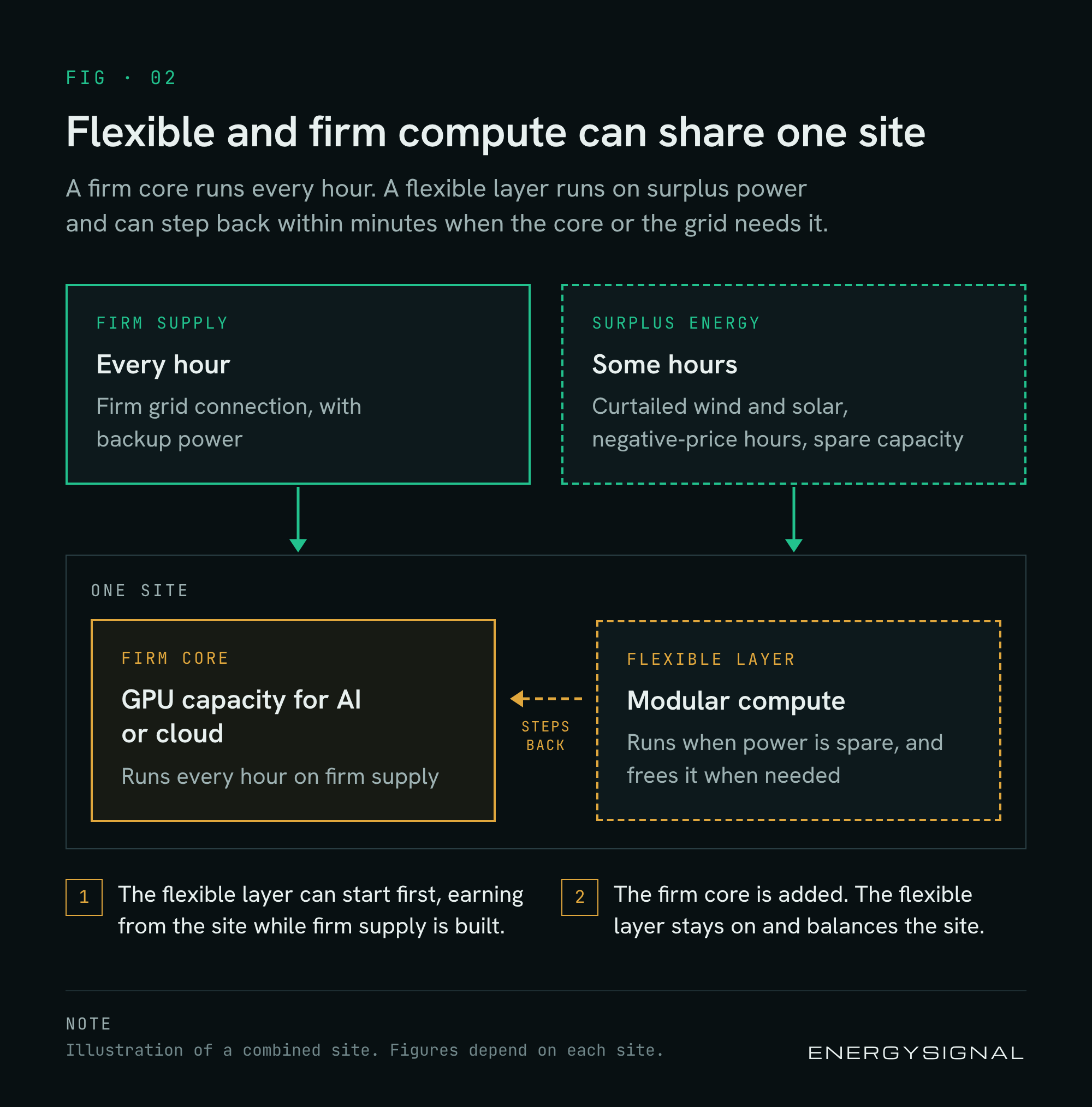
In Central Europe that order is how we would approach it. The plants with their own stations, the networks leaving coal and the coal sites with connections to spare are all places where a flexible layer can start on what exists, earn from the surplus and the heat, and build the evidence a firm core needs before it commits. The firm core then arrives at a proven site in a region with room, rather than at the back of a queue in a hub without it.
We would like to help hosts in the region see what their sites are worth, whether that is a flexible layer starting now on spare hours and heat, or a firm core arriving later on a connection that stays. Have a look at your site with our calculators at energysignal.io/calculators, or write to us at info@energysignal.io and we can talk it through with you and help you understand what it could do.
Also in this series
- The Connection That Stays: post-coal sites, land, grid capacity and a heat duty to meet
Sources
- Forbes Česko, Datacentra místo oceláren. Jak svatyně AI dopadají na českou energetiku, 16 September 2026
- BusinessInfo.cz, Projekt AI Gigafactory CZ dostal od vlády zelenou, 12 November 2025
- EuroHPC Joint Undertaking, The EuroHPC JU selects six additional AI Factories, 10 October 2025
- Polish Data Center Association via PAIH, Poland: A cool place for data centre development 2025
- Gramwzielone.pl, Prawdziwych chętnych na centra danych w Polsce jest kilkanaście, nie setki, 24 August 2026, citing PSE
- Warsaw Business Journal, EU funds AI factory in Poland, 13 March 2025
- DC Byte, Vienna's Data Centre Market: Navigating Growth, Challenges, and the Path Ahead, 8 September 2025
- Google, Unser erstes Rechenzentrum in Österreich, 23 April 2026
- ParTec AG, letter of intent for a modular hyperscale AI data center in Hungary, 8 July 2025
- Data Center Dynamics, Slovak Academy of Sciences completes integration of Perun national supercomputer, 5 May 2026, and EuroHPC JU signs hosting agreement with Hungarian government for Levente supercomputer, 11 July 2025
- Eurostat, Electricity prices for non-household consumers, bi-annual data (nrg_pc_205), band IE, second half of 2025, excluding taxes and levies
- Teplárenské sdružení České republiky, Bilance topné sezony 2025/2026, 27 April 2026
- Forum Energii, Transformacja ciepłownictwa w Polsce, edycja 2025, September 2025
- TASR via Teraz.sk, Slovenský zväz výrobcov tepla oslavuje 25. výročie, 18 December 2023
- Statistik Austria, Wohnungsmieten im 3. Quartal nahezu konstant, 5 December 2025
- Eurostat, Energy consumption in households, 2024 data
- Úřad vlády ČR, Programové prohlášení vlády (coal exit by 2033)
- Ekonomický deník, Rychle a zběsile. ČEZ nejspíš zavře uhelné elektrárny a doly již v tomto desetiletí, 27 March 2024
- SFŽP ČR, Operational Programme Just Transition
- European Commission, €3.85 billion for a just transition in five Polish regions, 5 December 2022, and The Just Transition Mechanism
- Beyond.pl, Connectivity
- JLL, EMEA data centre mid-year 2026 report, 3 August 2026
- The compute draw and heat return figures are those of EnergySignal's site calculators and site model: energysignal.io/calculators
Information only, as of the date shown. Not an offer, and not legal, tax, regulatory or investment advice. Any arrangement is agreed only in signed agreements.