Articles · 17
Flare Gas Is Power Without a Grid: Associated Gas, the Routine Flaring Ban, and Compute at the Wellsite
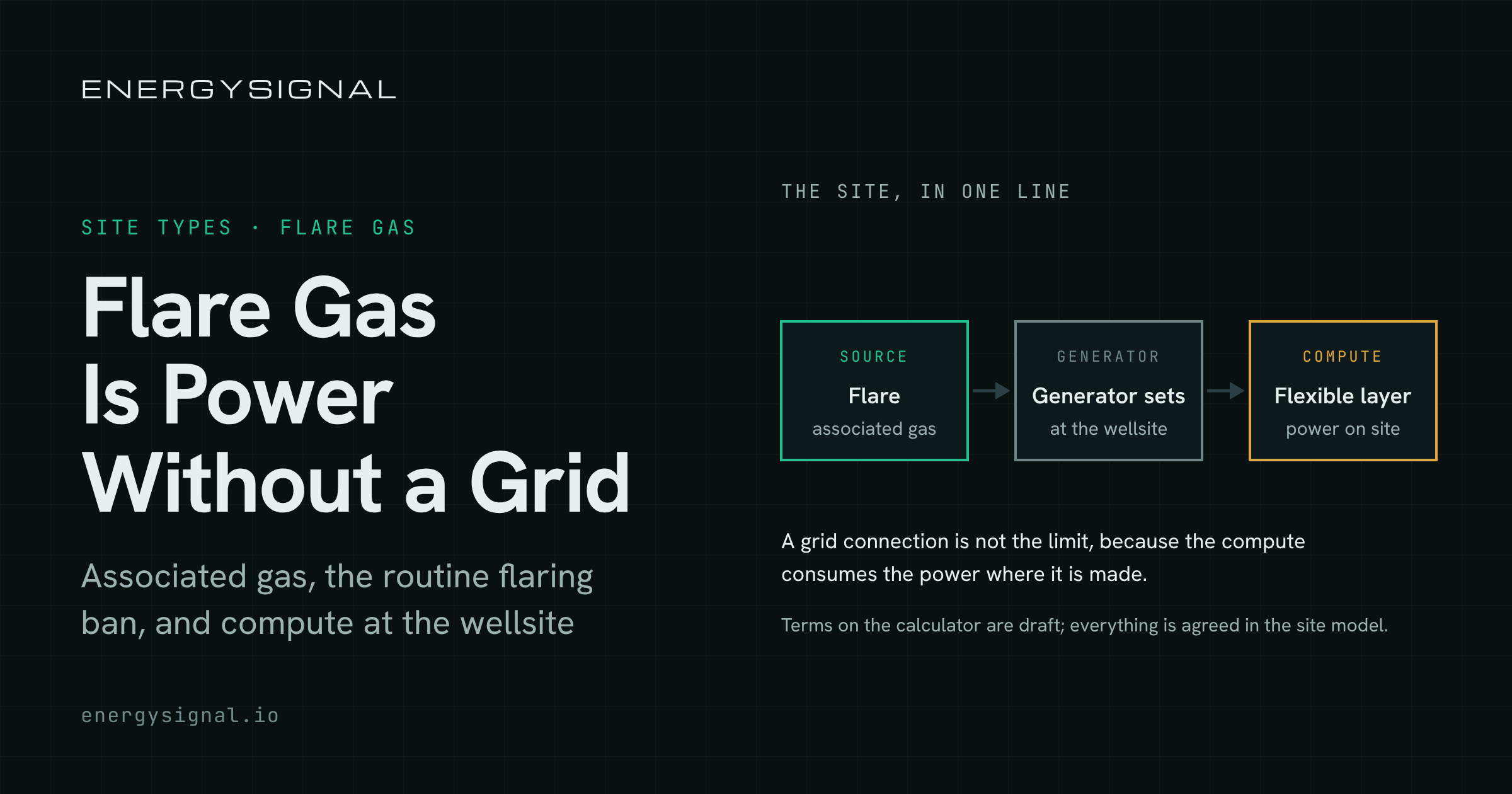
Oil fields burn gas they cannot sell, and the world flared more of it in 2025 than in any year since 2019. In the EU routine flaring is now banned, and what follows is our view of what a producer with gas and no pipeline can do instead, which is to put a generator set and a flexible layer of compute at the wellsite and use the power where it is made, without a grid connection setting the limit.
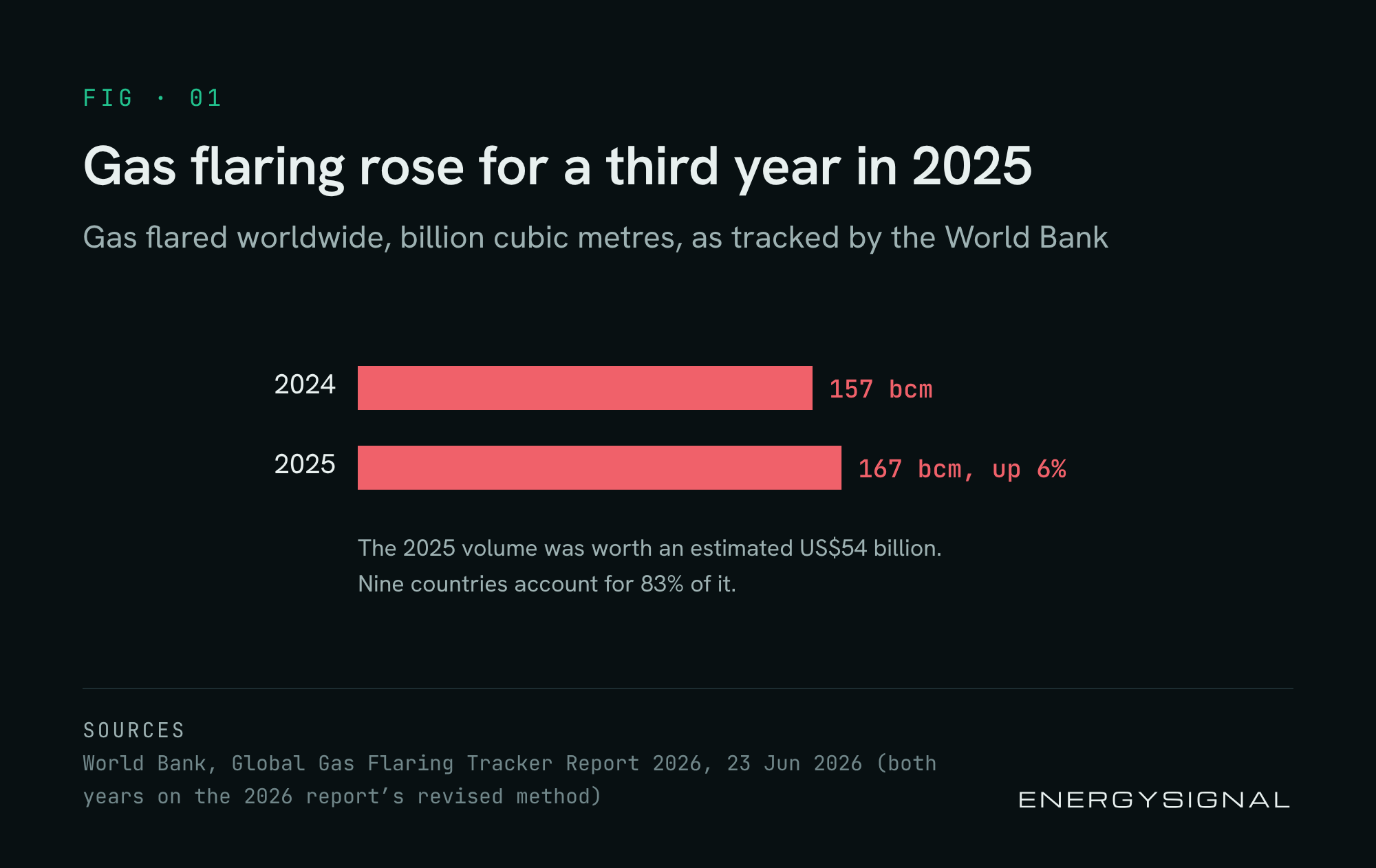
Associated gas comes up with the oil whether or not there is a pipeline to take it away. Where there is none, the gas is flared. The World Bank's Global Gas Flaring Tracker reports that "global gas flaring rose for the third consecutive year in 2025, reaching 167 billion cubic meters (bcm)", "the highest recorded level since 2019", and that "The gas wasted in 2025 was worth an estimated US$54 billion." Nine countries, Russia, Iran, Iraq, Venezuela, Mexico, Libya, Algeria, Nigeria and the United States, account for 83% of it between them.
Europe flares comparatively little, but it has regulated first. The EU Methane Regulation prohibits routine flaring at oil and gas sites. Existing sites had to comply by 5 February 2026, and the import rules begin to reach the supply chain from 2027. So a producer with gas and no pipeline now has to decide what to do with it, and for many wellsites the practical answer is to make power and use it on the spot.
The numbers, and the rule
The World Bank's 2026 report, which revises its earlier figures on a new method, puts global flaring at 157 bcm in 2024 and 167 bcm in 2025. That is a rise of 6% in a year, while oil production grew by 3.3%, so flaring rose faster than output. For a sense of the energy involved, the report notes that 1 bcm of gas can generate around 4 billion kWh of electricity. Associated gas is richer than pipeline gas. We use roughly 10 to 11 kWh per cubic metre in our model, and a gas engine turns that into power at 30 to 40% electrical efficiency depending on its size.
The rule in the EU is Article 15 of Regulation (EU) 2024/1787, which reads: "Venting shall be prohibited except in the circumstances provided for in this Article. Routine flaring shall be prohibited." Venting or flaring is allowed only in an emergency or malfunction, or where it is unavoidable, and operators "shall comply with this Article without delay and, in any case, not later than 5 February 2026 for existing sites and not later than 12 months from the date of start of operations for new sites". A new flare must have an auto-igniter or continuous pilot and a destruction efficiency of at least 99%. Outside the EU the rules that bind a producer are national ones, which in practice means flaring limits, the royalty treatment of gas used by a third party, and the approvals a power plant on the lease needs. Our flare gas calculator names those gates. It does not name the EU import rules, because those bind EU importers and not the producer.
Why a flare site suits compute
The gas has no route to market. That is the whole reason it is flared. Re-injection, a pipeline, compression to liquids or a chemical plant all need capital and a market, and a flare needs neither. So the first thing the site model asks is whether the gas is sold today or could be piped to market. If it can, it carries its full market value and the flare calculator will tell you it is not a flare case. If it cannot, the gas is fuel with no better use, and that is what the case rests on.
Generators make power where the gas is. Gas generator sets at the wellsite turn the gas into electricity at 30 to 40% efficiency depending on size. Lean-burn engines sit at the top of that range and rich-burn wellsite skids at the bottom. Our calculator picks the band from the flow and shows the installed capacity in kW or MW, counted at 90% load so there is room to ride through dips.
Compute uses the power on site. Most flare sites have no grid connection, or only a weak one. That does not hold the case back, because the compute uses the power where it is made. Where export is possible, the site model compares export at the tariff with compute on site, hour by hour. The containers stand on a yard next to the generator sets, with a data link and road access, and when the well declines they move on.
The flare stays as the backstop. Nothing about the arrangement removes the flare. It stays for emergencies and malfunctions, as the regulation requires, and the compute runs on the gas that would otherwise have gone through it. The carbon dioxide is the same whether the gas is flared or burned in an engine. What changes is that the energy gets used, the methane slip from a weak flare stops, and the site complies.
There is a fair amount the calculator does not attempt. Gas composition and conditioning, flow variability and well decline, emissions permits and noise, who owns the generator sets and how the gas is priced are all site-model items, and once the gas analysis and the engine quote are in hand they replace the calculator's figures.
What the calculator asks, and what to have ready
Our flare gas calculator asks where the site is, what kind of gas it is (associated gas, natural or process gas, biogas), whether the gas is sold today or could be piped to market, the flow in cubic metres a day, how many hours it flows, and whether a grid export is possible. From that it shows the electrical output, the compute in kW or MW, the gas no longer flared, and a return a year in a range, as a draft term per MWh of power made. If you are a producer, it helps to have the following ready:
- The gas flow by day for a year, and the gas analysis: methane, heavier hydrocarbons, carbon dioxide, hydrogen sulphide and water
- Whether the gas is saleable, and at what price, and whether a pipeline or re-injection is planned
- The permits the site holds for a power plant on the lease, and the flaring rules that apply
- The yard available for generator sets and containers, road access, and the data link
- The well's expected decline, so the compute can be sized to the years it has
The value per MWh on the page is a draft term and is marked as open. Everything, including who supplies the generator sets, gets agreed in the site model. The calculator is at energysignal.io/calculator/flare-gas.
Start light, at the wellsite
The shape we keep coming back to is a firm core with a flexible layer beside it. The core of AI or cloud capacity runs on firm supply. The flexible layer uses surplus or curtailed energy and can step back within minutes when the core or the grid needs power, and it can start first, earning from the site while firm supply and grid upgrades are built.
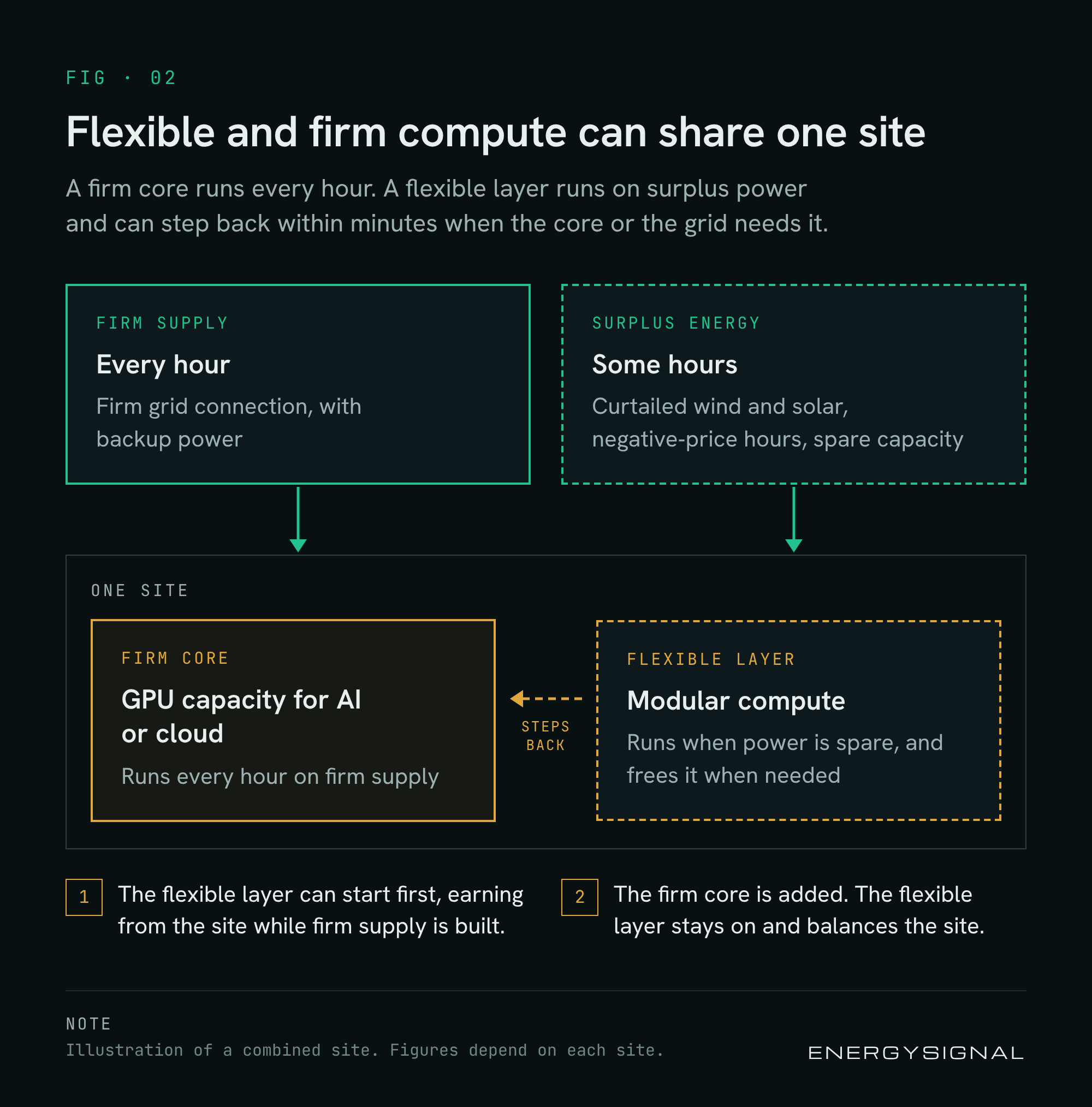
A flare site is the purest case of the flexible layer. There is no grid, the fuel is finite, and the equipment arrives on a truck and leaves the same way. Where a field is large and steady and sits near a service town, a firm core becomes possible on the same generation, and running the flexible layer first is how a producer finds out whether the gas, the site and the operating arrangements can carry it.
If you have a flare and no pipeline, we would like to help you see what the site is worth. For a wellsite the flare gas calculator at energysignal.io/calculator/flare-gas is the place to start, and the rest of our calculators are at energysignal.io/calculators. Or write to us at info@energysignal.io and we can talk your site through with you, the flexible layer first and the firm core if the field can carry it.
Also in this series
- Methane You Drain Is Power You Can Use: coal mine methane, the EU deadline and compute on the surface
Sources
- World Bank, 2026 Global Gas Flaring Tracker Report and the report PDF, 23 June 2026
- Regulation (EU) 2024/1787 on the reduction of methane emissions in the energy sector, Article 15
- European Commission, Methane emissions
- The gas energy values, generator efficiency bands, saleability gate and price treatment are those of EnergySignal's flare gas calculator and site model; all are draft and the value is marked as open: energysignal.io/calculators
Information only, as of the date shown. Not an offer, and not legal, tax, regulatory or investment advice. Any arrangement is agreed only in signed agreements.