Articles · 05
What Is Your Site's Energy Worth? A Host's Guide to the First Conversation
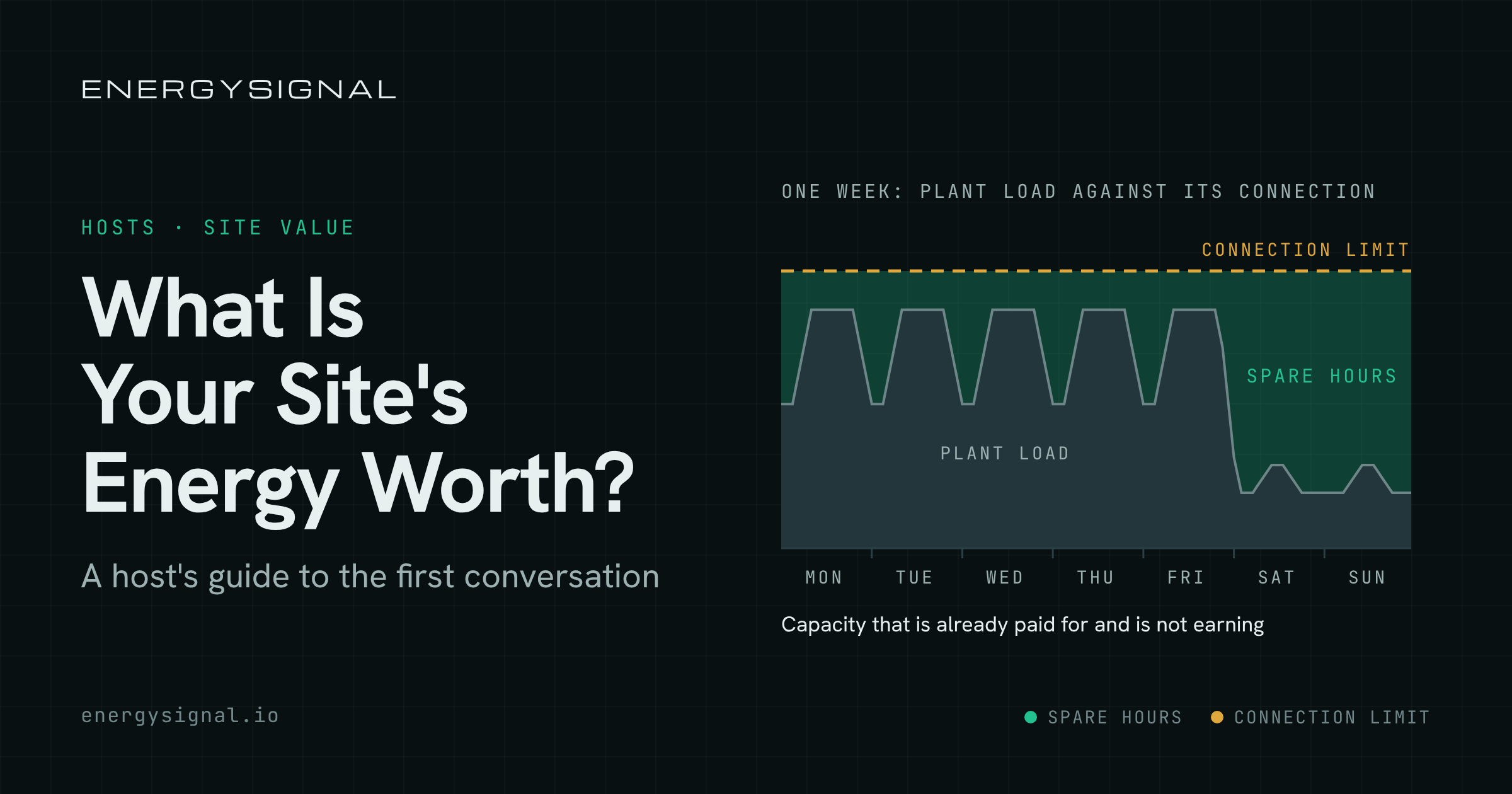
Most sites are worth more than their owners think, because nobody has counted the hours. If you own or run a site and want to know what yours would be worth to a compute partner, this guide tells you what to have ready, what we do with it, and what happens after that.
A grid connection is valued by its size, a power station by its output, a boiler by its fuel bill. The value of a site to a compute partner sits between those numbers. It is in the hours when a connection is not used, in the energy that is sold cheaply or curtailed, and in the heat that leaves through a cooling tower. None of it shows up on an invoice, so it tends to get missed.
The evidence is usually sitting in your files already, though. A year of metered data, a connection agreement, a fuel bill and a site plan are enough for a first reading. Gathering them takes about an hour, and below we say what to look for.
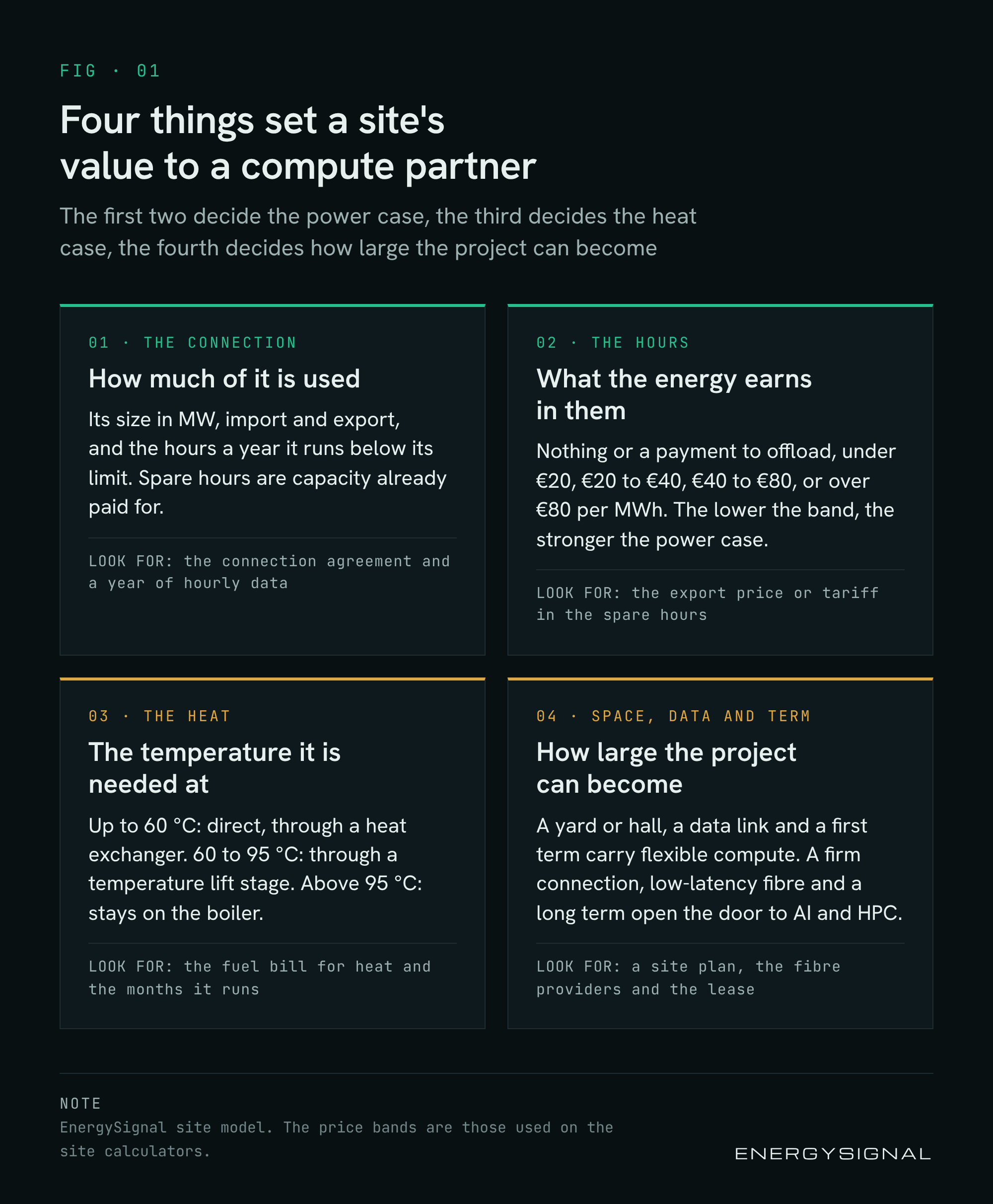
Four things set a site's value
1. The connection, and how much of it is used. A compute partner looks at the connection first, at its size in MW, whether it can import, export or both, and how many hours a year it runs below its limit. A plant that uses its connection fully on weekdays and lightly at weekends has thousands of spare hours a year. That capacity is already paid for, and it is not earning anything.
2. The hours, and what the energy earns in them. The second question is what the power is worth today in the hours it is spare. A site that sells its surplus at a tariff above €80 per MWh has little to gain from a flexible load on the power side. A site that pays to offload, or sells for under €20 per MWh, has a lot. Our calculators ask this as a band rather than a price, because most hosts, from what we see, know the situation well and the marginal price less well.
3. Heat, and the temperature it is needed at. Nearly all the electricity that compute uses leaves it as heat. In our site model, per MW of connection, compute draws about 0.93 MW and returns about 0.8 MW of heat to a water loop at about 55 °C. Up to about 60 °C that heat can pass through a heat exchanger straight into a plant network. From 60 to 95 °C a temperature lift stage raises it into the band, using some electricity. Above 95 °C, steam stays on the boiler. So what we ask is the temperature the heat is needed at, and in which months.
4. Space, a data link and a term. Flexible compute typically needs a yard for containers or a hall, a data link, and the permits any new electrical installation needs. Firm compute for AI and HPC asks for more. It wants a firm connection, a fibre route with low latency to a hub, and a term long enough to justify a large investment per MW. A site can offer one, the other, or both.
The first two tell you whether the power side has a case. The third tells you whether heat can carry the case where the power does not, and the fourth how large the project can grow.
What to gather before the first conversation
You do not need all of this to start. The calculators work from a handful of answers, and we build the site model from the rest. But the more of it you have to hand, the sooner the numbers become yours rather than ours.
The connection
- The connection agreement, or the reserved capacity in MW, for import and for export
- The voltage level and the metering point
- Whether the connection is firm or carries curtailment conditions
- Any upgrade that is planned or applied for, and its timing
A year of metered data
- Hourly or half-hourly import and export for the last 12 months, usually downloadable from the network operator's portal or held by your energy manager
- The shift pattern and the planned shutdowns, so the spare hours can be explained rather than guessed
Generation on site
- Any CHP, engines, solar, hydro or biogas: capacity in MW, run hours, and what the exported power earns in the hours it is spare
- The support scheme it runs under, and the date that support ends
Heat
- The fuel used for heat in a year, in MWh of gas or the equivalent, and its price per MWh
- The temperature the process or the network needs, and the months it needs it
- The age of the boilers or the CHP, and any replacement already planned
Space, data and term
- A site plan showing free yard or hall space, and its distance from the connection point
- The fibre providers at the site, and any dark fibre
- How long the site expects to operate, and any lease, licence or heat supply duty that shapes the term
Country
- Where the site is, because support schemes, methane rules and carbon pricing differ, and the calculators adjust for them
If one of these is missing, just say so. A missing number goes into the site model as an open question. It is no reason to hold off.
What a site model covers, and what it leaves out
A site model turns a year of hourly data into an hourly picture of the site with compute on it. It shows which hours the compute runs in and which it steps back in, what it pays for the energy in those hours, how much heat it returns and which months the network can take it, and what the site earns a year as a result. It also sets the terms, which means the term length, the heat price, who supplies what, and the flexibility the compute offers the site and the grid.
The web calculators are the quick version of the same engine. They use draft terms, labelled as such on every page, and they work from the bands you pick rather than from your data. The site model swaps the draft terms for numbers agreed for your site, and the bands for your metered hours. That is why the calculators end with "Send my numbers". What you send is where the site model starts, and the conversation goes on from there.
A site model also stops short in three places. It does not commit either side. It gives both sides the basis for a term sheet, which is a separate step. It does not price your own works. The site works, the connection point and the heat tie-in are priced in the model once the layout is known, and the return it shows is before that investment. And it does not replace the engineering. The gas analysis, the engine quote, the network return temperature and the connection study each replace a model figure as they arrive.
Reading the results
The calculators show a return a year, in a range, before your own investment. The low end of the range assumes the compute pays the bottom of the draft band for power and that you carry the electricity the temperature lift stage uses. The high end assumes the top of the band and heat taken without a lift. Your site sits somewhere between the two, and the site model says where.
We would ask three questions of any result.
Which hours carry it? A return that rests on a few thousand spare hours a year usually depends on the power in those hours being near free, or on the heat. A return that rests on 6,000 hours or more is a power case in its own right. The hours are the first thing the site model checks against your data.
Is the heat real? The heat figure depends on the share of the compute's heat your plant or network can actually use, in the months it needs it. A plant that heats all year can take far more than one that heats from October to April. If you are not sure of the share, pick a low one. The site model can raise it once the network's data is in.
What does the power earn today? The gain on the power side is the difference between what compute pays and what the energy earns now. Where the site sells at a tariff above €80 per MWh, the power side usually does not carry the case, and the result says so. The case is then the heat, and for a larger site the firm connection, which AI and HPC operators value for its firmness rather than its price.
What happens next
Send your numbers through the calculator, or send us what you have gathered. We come back to you with a first reading, usually within a couple of weeks: which shape your site fits, what the numbers suggest, and what we need to build the site model. From there the sequence is the one we would recommend for any site today.
- Assess. A year of metered data, the connection agreement and a site visit become the site model. The model says which hours carry the case, what the heat is worth, and how large the first step can be.
- Pilot flexible compute. Modular compute in containers on the existing connection, sized to the surplus, with a first term agreed in the site model. This step typically needs no new building and no new grid connection, because it runs behind the meter on power the site already has.
- Scale what works. The flexible layer grows step by step, and each step is tested against the site model before the next one goes in.
- Add firm compute alongside. Once firm power, a data link and an operator are secured, a core of AI or HPC capacity can take a reserved share of the connection on a long term. This is the larger commitment, and by then the flexible layer has proved the site.
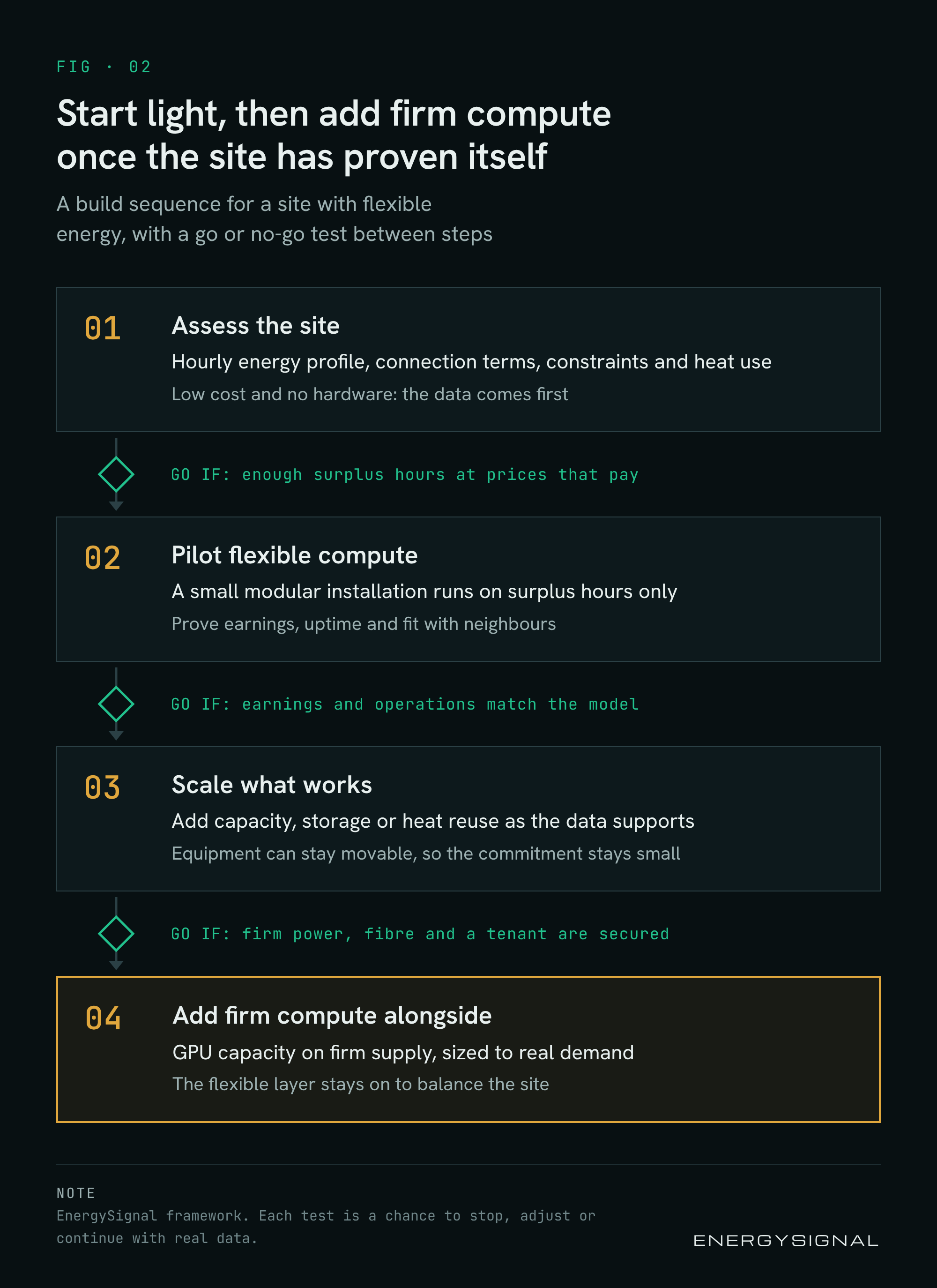
We put the steps in that order for a reason. The flexible layer is quick to install and easy to scale, and it can step back when it has to. The firm layer is a large investment that needs the site proven first. Starting light keeps the site in the game while the larger case is built.
Start light, and let the site prove itself
The shape we work towards is a core of AI or cloud capacity on firm supply, with a flexible layer beside it that uses surplus or curtailed energy and can step back within minutes when the core or the grid needs the power. The flexible layer can also go in first, and earn from the site while firm supply and grid upgrades are being built.
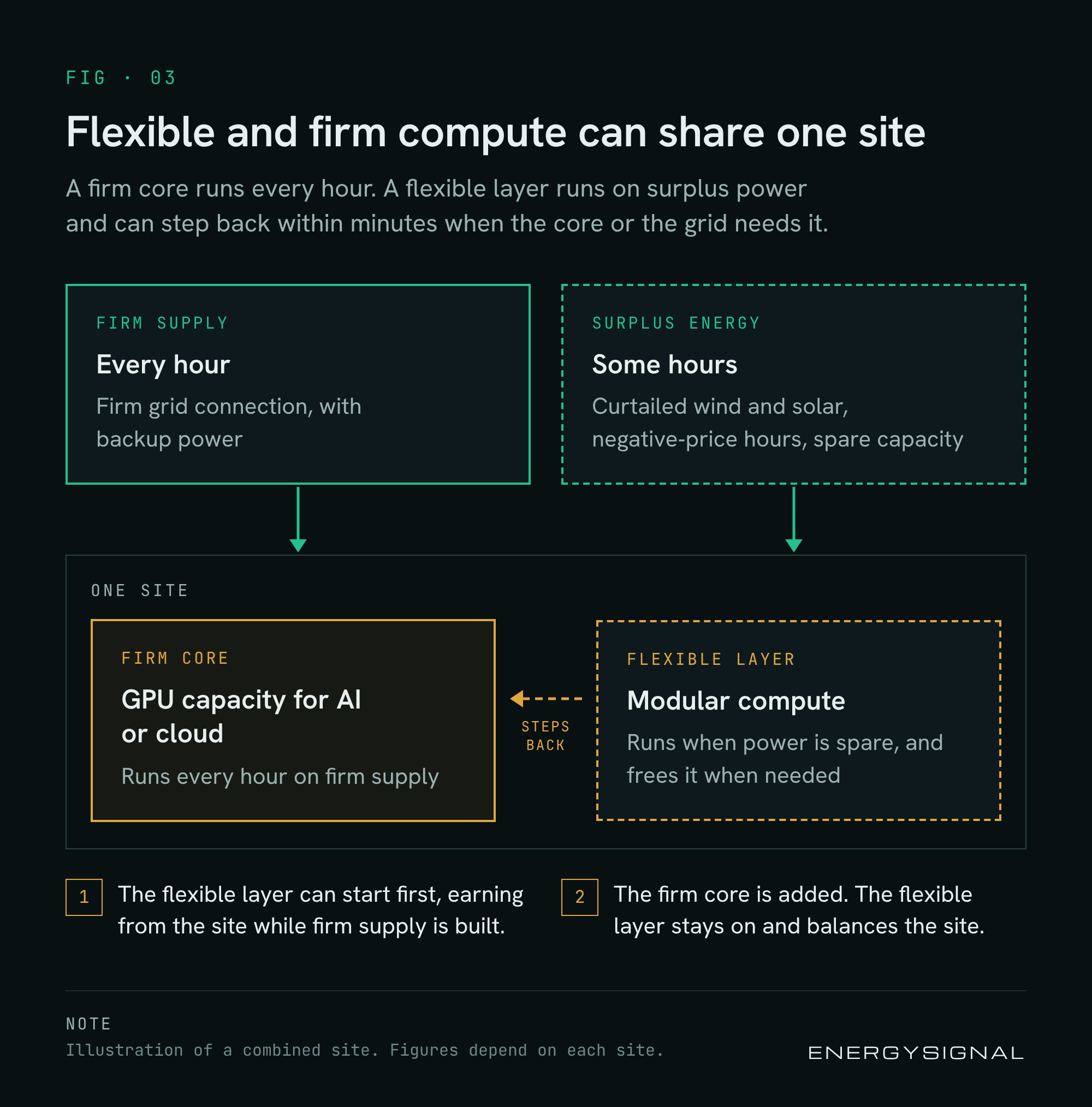
A firm core on firm supply and a flexible layer on the surplus, with the flexible layer going in first, is the shape most sites end up with, and it is why the first conversation is worth having even where the firm case is years away. The flexible layer earns from the hours the site already has, and the firm layer is about what the site can become. We are here to help hosts see what their site is worth. Try your site on our calculators at energysignal.io/calculators, or write to us at info@energysignal.io and we can sit down with your numbers and talk through what the site could do.
Sources
- The figures for compute draw, heat return, the temperature bands and the price bands are those used on EnergySignal's site calculators and in its site model. Commercial terms on the calculator pages are draft terms and are labelled as such: energysignal.io/calculators
- On the share of electricity that IT equipment turns into heat (about 97%): Oak Ridge National Laboratory authors, District Heating Utilizing Waste Heat of a Data Center: High-Temperature Heat Pumps, Energy and Buildings, 2024
Information only, as of the date shown. Not an offer, and not legal, tax, regulatory or investment advice. Any arrangement is agreed only in signed agreements.