Articles · 10
Pricing Flexibility: What a Load That Can Step Back Is Worth
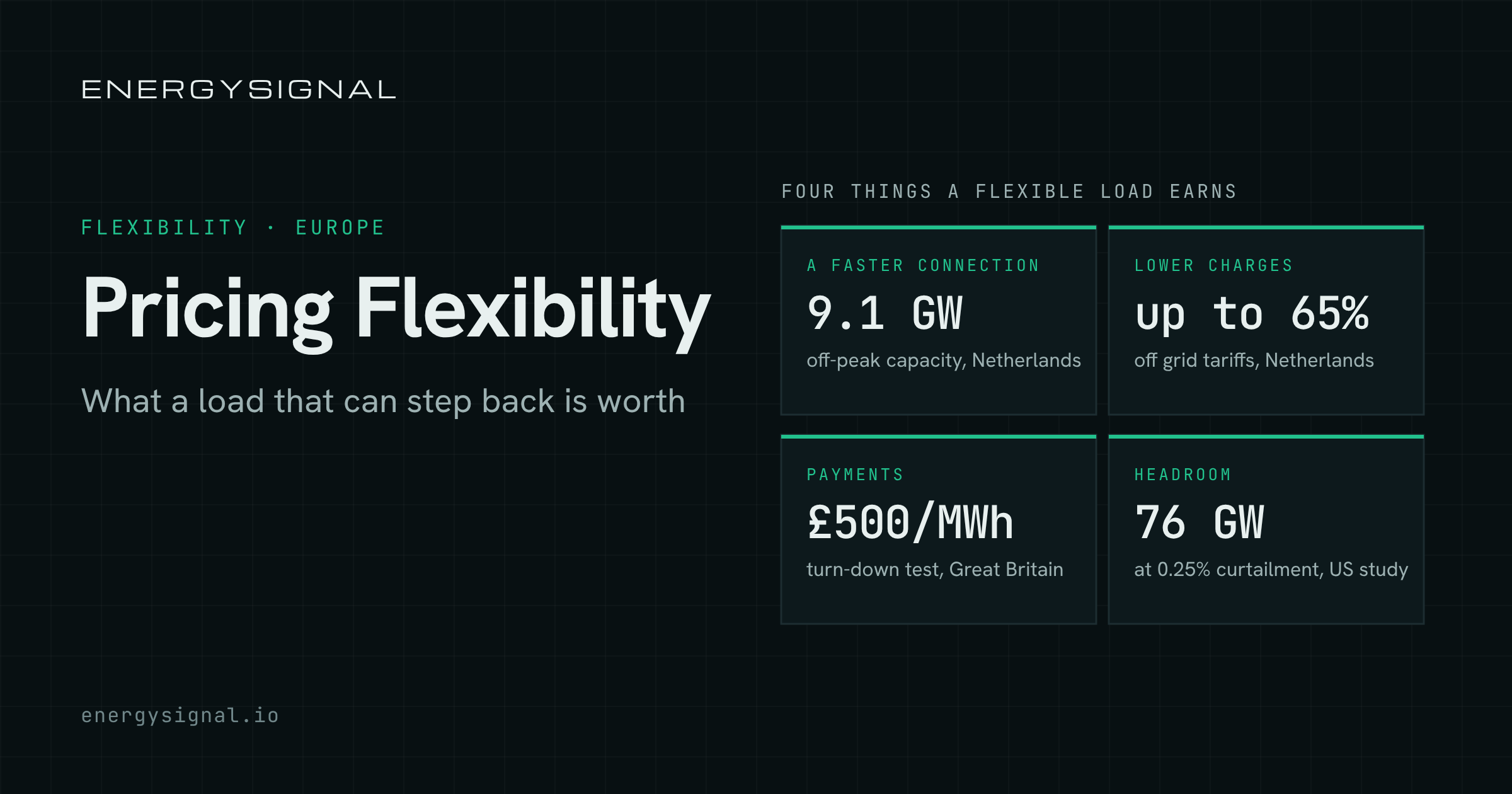
A load that can step back when the grid is tight used to be a courtesy, and it is turning into a priced product with four separate sources of value. Below we go through the four with the numbers regulators have published, and show what they add up to for a site that can offer them.
Every grid in Europe is short of capacity at peak and has plenty of it the rest of the time. A load that uses the long hours and leaves the peaks is cheap for the system to connect and useful for it to have, and regulators have started to pay for that in four different currencies: a faster connection, lower network charges, direct payments for stepping back, and headroom that lets more load connect than the wires would otherwise allow.
We take the four in turn, with the numbers regulators and system operators have published, and then set them next to the two values this series has already covered, cheap surplus power and heat, to see how the whole thing stacks at a single site. For a host, the thing to hold onto is that flexibility is a property of the compute, but it is the site's connection that earns it, and a flexible layer is the easiest way to put that on the table.
Value one: a faster connection
The first thing flexibility buys is time. A grid that cannot offer a firm connection for years can often offer a conditional one now.
The Netherlands has made it a product. Since 2025, under rules set by the regulator ACM, Dutch grid operators can offer contracts in which large users "are not allowed to use their connections at all during certain busy hours (in exchange for lower tariffs)" and, on the high-voltage grid, duration-bound contracts under which a user can draw power "for at least 85 percent of the time". TenneT found that "up to 9.1 gigawatts of power is available on the grid at off-peak times" for customers on its waiting list, and that "During the remaining 15% of the time, TenneT can (partially) limit the purchase or feed-in of electricity". A load that can live with that gets a connection, in a country where more than 15,000 businesses are waiting for one.
Great Britain is opening the same door for demand. Ofgem reported in November 2025 that the demand connection queue had grown from 41 GW to 125 GW in seven months, which is a lot, that "data centres account for a significant share of growth in the demand queue", and that it would work with NESO and the network companies "to understand the barriers to greater use of non-firm, ramped, or self-supply" connection agreements. A non-firm connection is, in practice, a connection for a load that can step back.
Ireland asks for it in kind. The CRU's December 2025 policy requires new data centres of 10 MVA and above to provide dispatchable on-site or proximate generation or storage matching their import capacity. There is no blanket flexibility obligation, but the system operators "can require demand flexibility provisions from data centres on the local system as deemed necessary on a case-by-case basis". A load that brings its own flexibility has a shorter conversation with them.
The EU would make it the default. The Commission's Grids Package proposal of December 2025 would require system operators, where there is insufficient grid capacity, to "propose, where technically possible, a flexible connection agreement". And its July 2026 proposal on electricity bills would let regulators prioritise grid users "with flexible consumption patterns".
Value two: lower network charges
The second thing flexibility buys is a smaller bill for the wires.
In the Netherlands the discount is explicit. TenneT expects that "flexible grid users can save up to 65% on grid tariffs" through a combination of time-dependent transport rights and time-dependent tariffs, and under the time-dependent rights customers pay no tariff for their contracted transport capacity.
In Germany the direction is set and the date is 2029. The Bundesnetzagentur's orientation points on industrial network charges, updated in April 2026, keep a successor to the baseload privilege, the discount that energy-intensive users have earned for a flat load, but tie it to flexibility instead. The flexing "nicht grundsätzlich täglich erfolgen" soll, it need not be daily, since "nur besonders angespannte und kritische Situationen im System maßgeblich sein", only particularly tight and critical system situations count. "Die Regelung soll mit dem Jahr 2029 in Kraft treten", with a transition to the end of 2031, and the regulator expects general network charges at high voltage to fall by 20% to 80% as a result. For a large user in Germany, the discount for being flat is on its way out and a discount for being flexible is taking its place.
For a site, the arithmetic works in the host's favour. The network charge is paid on the connection the host already holds, and a flexible layer that uses the off-peak hours and leaves the peaks brings the cost of that connection down per MWh that flows through it, whether or not the compute pays the charge directly.
Value three: payments for stepping back
The third currency is cash, paid by the system operator for a load that reduces on request. The clearest public prices are British.
NESO's Demand Flexibility Service pays large consumers and aggregators to turn demand down, or up, when asked. For the test events it has scheduled for August and September 2026, NESO's market information report set guaranteed acceptance prices of £180 per MWh for demand turn-up and £500 per MWh for demand turn-down. In live events over the fourth quarter of 2025, according to Drax's quarterly review, NESO accepted 1,721 MWh of flexibility at an average of £152 per MWh and a maximum of £350. The volumes are small, because the events are short. But the price per MWh is several times what the energy itself costs.
The capacity market pays for the promise rather than the event. Great Britain's T-4 auction for delivery in 2029/30, held in March 2026, "cleared at £27.10/kW/year, and 40,108.608 MW of capacity has been secured", according to RWE, and demand-side response and batteries took 3.8 GW of it. A load that can reliably step back can sell that same promise, alongside the generators.
On the continent the balancing markets do the same job under different names, and the prices vary by country and by year. What a given site could earn, and in which market, is something we work out in the site model rather than here. What matters for now is that each of these markets pays a flexible load something, and pays a flat load nothing.
Value four: the headroom itself
The fourth value is the largest and the least visible. A flexible load lets a grid connect far more than its peak capacity would suggest, because the peaks are rare.
The reference study is from Duke University's Nicholas Institute, Rethinking Load Growth, published in February 2025. Looking at the US grid, it finds that "76 GW of new load" could be integrated "with an average annual load curtailment rate of 0.25%", that 98 GW could be integrated at 0.5%, and 126 GW at 1.0%. So a load that is willing to step back for one hour in four hundred can connect where a firm load would wait years, on a grid that looked full.
The operators have begun to act on it. In August 2025 Google announced demand response agreements with Indiana Michigan Power and the Tennessee Valley Authority, describing demand response as something that "allows large electricity loads like data centers to be interconnected more quickly" and "helps reduce the need to build new transmission and power plants", and noting that "These agreements represent the first time we're delivering data center demand response by targeting machine learning (ML) workloads." If one of the world's largest operators of firm compute is making those workloads flexible in order to connect faster, we take that as a fair measure of what flexibility is worth.
For a host, this is the value that unlocks the other three. A site with a firm connection that it uses for two shifts has headroom. A flexible layer can use that headroom without raising the site's peak, and a firm core that follows later can be sized to the connection, with the flexible layer as its buffer.
Stacking the four at a site
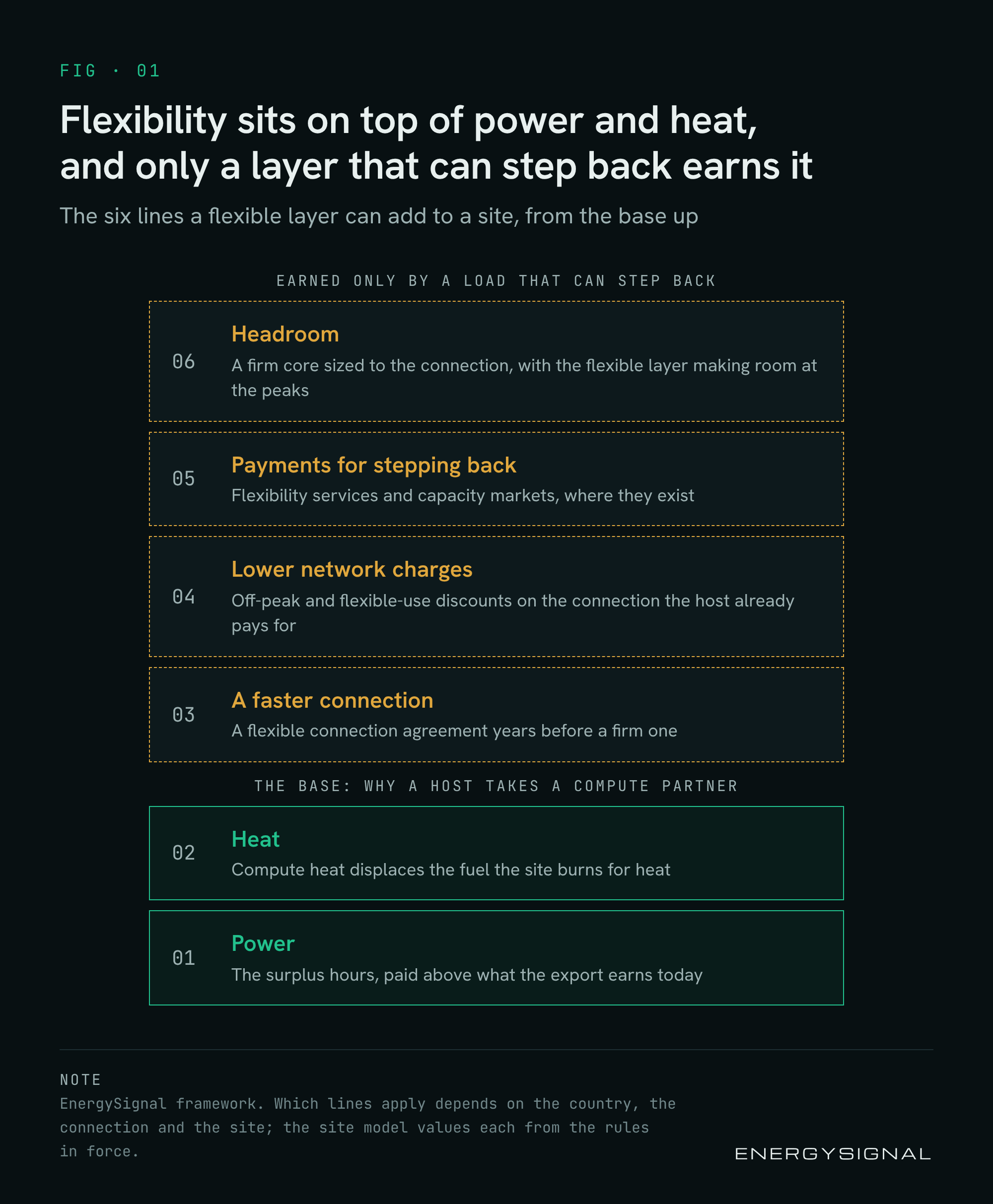
None of the four values is large on its own, and none of them is the reason a host takes a compute partner. The reason is still the two values this series began with, a buyer for surplus power in the hours it earns least and a buyer for heat. Flexibility sits on top of those, and at a single site the stack reads like this.
- Power. The flexible layer pays for the surplus hours, above what the export earns today. This is the base of the stack, and the line our calculators show.
- Heat. The compute's heat displaces fuel the site burns for heat, at a discount to that fuel. The second line, and often the larger one.
- A faster connection. Where the site or the compute needs capacity it does not yet have, a flexible connection agreement arrives years before a firm one. What the host gets is a date rather than a payment, and dates have a price too.
- Lower network charges. Where the rules offer a discount for off-peak use or for flexing in tight hours, the connection the host already pays for gets cheaper per MWh.
- Payments for stepping back. Where a flexibility service or a capacity market exists, a load that can reduce on request can sell that service.
- Headroom. A firm core can be sized to the connection, with the flexible layer stepping back to make room at the peaks. This is what lets a site host more compute than its peak would suggest, without a new connection.
Which lines apply depends on the country, the connection and the site, and the site model values each one from the rules in force. The order does not vary, though. The flexible layer is what makes the last four lines available, because it is the part of the site that can step back, and a firm core on its own has none of them.
Start light, and let flexibility pay for the firm core
The arrangement we keep coming back to has a core of AI or cloud capacity running on firm supply, with a flexible layer beside it that uses surplus or curtailed energy and can step back within minutes when the core or the grid needs power. And the flexible layer can start first, earning from the site while firm supply and grid upgrades are built.
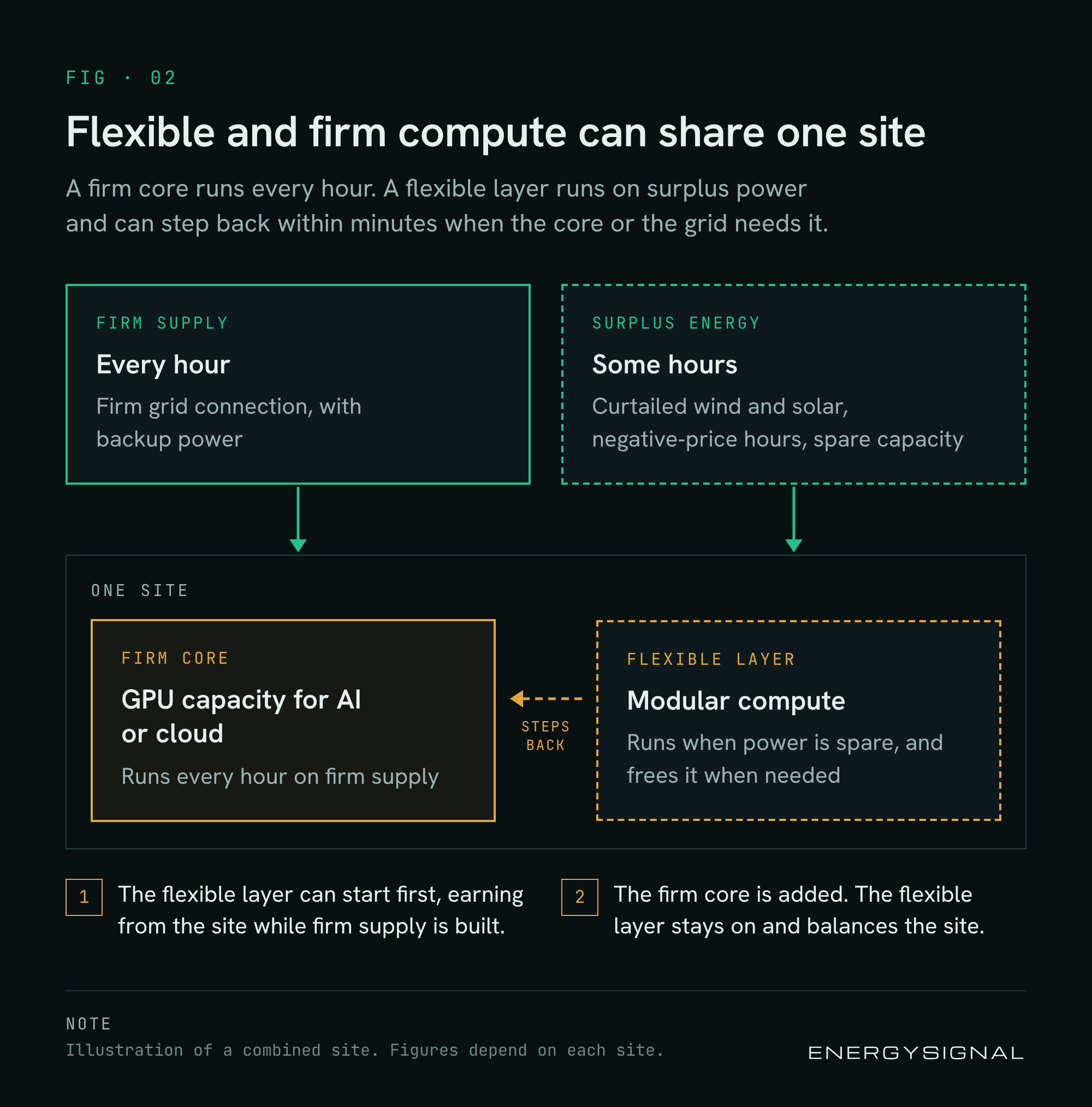
The four values in this article are the reason the combination works. The flexible layer is the part of the site that connects faster, pays less for the wires, earns from stepping back and frees the headroom, and the firm core is the part that needs all of that most and cannot provide it for itself. So a host that starts with the flexible layer is building the credentials, the connection terms and the operating record that make the larger project financeable.
If you have a site and want to know what it is worth, we would like to help. Our calculators at energysignal.io/calculators give a first view of what your site could earn, and for what. Or write to us at info@energysignal.io and we can go through your site with you properly.
Sources
- ACM, ACM has established measures against grid congestion and published basic principles for future tariff changes, 19 July 2024
- TenneT, TenneT provides 9 gigawatts of capacity on the high-voltage grid for customers on the waiting list, 7 April 2025
- Ofgem, Our response to the recent surge in demand connection applications, 6 November 2025
- CRU, Large Energy Users Connection Policy, Decision Paper, CRU/2025236, 12 December 2025
- European Commission, Proposal for a Directive as regards acceleration of permit-granting procedures, COM(2025) 1007, 10 December 2025, and Proposal for a Regulation as regards future-proofing electricity bills in the Union, COM(2026) 600, 17 July 2026
- Bundesnetzagentur, Industrienetzentgelte: Orientierungspunkte der BNetzA, 22 April 2026
- NESO, Demand Flexibility Service market information report, 11 August 2026
- Drax, Flexibility Focus Q4 2025, February 2026, and Capacity Market auction results, 23 March 2026
- RWE, Great Britain's T-4 capacity auction for delivery in 2029/30 has concluded, 10 March 2026
- Duke University Nicholas Institute, Rethinking Load Growth: Assessing the Potential for Integration of Large Flexible Loads in US Power Systems, February 2025
- Google, How we're making data centers more flexible to benefit power grids, 4 August 2025
Information only, as of the date shown. Not an offer, and not legal, tax, regulatory or investment advice. Any arrangement is agreed only in signed agreements.