Articles · 01
Power Comes First: What Is Changing Around Data Centres
What changed this year
Large new data centres can no longer assume the grid will take them. In 2026 the first question for any project became where the power will come from. Where to connect comes after that.
On 14 July, New York became the first US state to pause large data centres. The order halts state environmental permits for projects of 50 megawatts or more, for up to a year (Route Fifty).
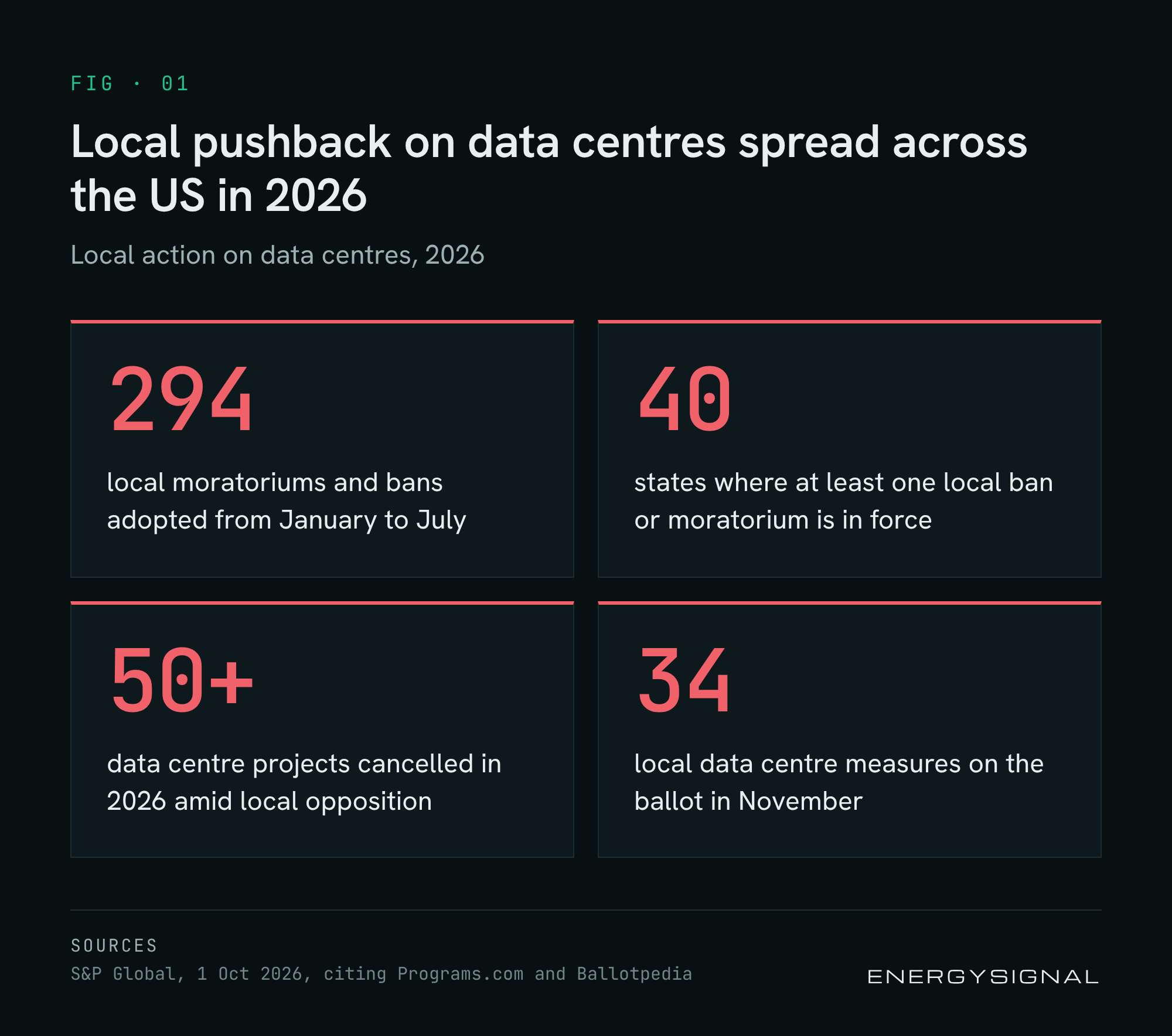
Local governments adopted 294 moratoriums and bans between January and July, and 40 states now have at least one in force. More than 50 projects have been cancelled this year in the face of community opposition. And on 3 November, voters will decide 34 local data centre measures, 20 of them in Ohio (S&P Global).
Why it is happening
Voters fear higher power bills, and politicians of both parties now expect data centres to pay for their own power. Demand for compute keeps rising regardless. What holds a project back now is getting hold of the energy.
The scale explains the pressure. As of the second quarter, S&P Global's 451 Research counted 3,173 operating US data centres with about 56.6 gigawatts of IT power, and another 1,140 planned (S&P Global). New York alone had nearly 12 gigawatts of data centre load sitting in its grid queue in May, more than 8 gigawatts of it added in 2025, which is a lot for one state (DLA Piper).
The backlash crosses party lines. On 18 August, Pennsylvania's Democratic governor ordered that developers fund their own electricity use, and on 21 September Texas's Republican governor paused environmental permit reviews. In Texas, 57% of voters polled opposed data centres in their communities (S&P Global).
Spending has not slowed. Moody's expects six hyperscalers, including Microsoft, Amazon and Alphabet, to spend $785 billion on capital investment in 2026 and close to $1 trillion in 2027, and cites compute shortages and growing backlogs as the reason (Data Center Dynamics). So the money is there. What is scarce is power that can be connected quickly without pushing up household bills.
For compute operators: power strategy is now site strategy
The projects moving fastest arrive with their power arranged and local support in hand, and with a load that can flex. Grid-only plans now run into long queues, permit pauses and local votes. A Norton Rose Fulbright partner told S&P Global that community engagement used to be optional and is now part of initial site selection (S&P Global).
Regulators are writing this into the connection rules. In Ireland, a new data centre of 10 MVA or more must bring dispatchable generation or storage, on site or nearby, covering its full grid import capacity (A&L Goodbody). In the US, Ohio and Texas opened routes in 2025 to self-supply or to connect directly to existing generation (MultiState).
But the rules are still moving. PJM runs the grid with the largest cluster of US data centres, and on 9 October the federal regulator FERC rejected its plan to make new large loads bring their own capacity or be curtailed first. What survived was a 50 MW large-load definition and a registry (Troutman Pepper Locke).
Flexibility is the common thread. Ireland's government expects large users to accept non-firm connections and to cut demand when the grid is constrained (A&L Goodbody). As far as we can tell, compute that can follow whatever power is available is the load grids find easiest to accept.
For energy owners and hosts: unused power now has buyers
Energy that cannot reach the grid is becoming one of the most sought-after inputs in computing. Owners of curtailed or stranded power have what compute operators need most, megawatts that can be used soon.
And the waste is large and growing. Great Britain curtailed over 10 TWh of renewable power in 2025 and paid £363 million in curtailment payments, while the island of Ireland curtailed 2.1 TWh (Montel). In 2025 the day-ahead price fell below zero for about 570 hours in Germany, nearly 600 in the Netherlands and 322 in the Czech Republic (oEnergetice).
The rules are opening up to direct supply as well. Ohio's 2025 energy law lets large users self-generate, directly or through a third party, and dropped the requirement that the generation sit on the customer's premises (MultiState). Ireland's action plan promotes Green Energy Parks next to renewable generation and commits to legislation that would allow private wires (A&L Goodbody).
In practice, a flexible compute load can turn those wasted hours into a contracted customer, one that ramps down whenever the grid or the site needs the power.
For investors: the risk has moved from demand to delivery
Demand for compute is a given. What an investor has to judge now is whether a project can be powered and permitted on time, and value is moving toward the projects that already control their energy, can flex their load and have local support.
Permitting risk is now real. New York's pause offers no grandfathering based on construction, and only applications deemed complete before 14 July escape it (DLA Piper). In Ireland, an environmental group has taken the new connection rules to court (A&L Goodbody).
Financing pressure is building too. Moody's notes that hyperscaler capital spending is eating into operating cash flow while debt and lease liabilities rise (Data Center Dynamics). And behind-the-meter power is no free pass. The AI Now Institute urges local governments to ban it, with a possible exemption for data centres that bring their own renewable power (AI Now Institute).
The questions we would ask of any compute or energy deal:
- Is the power contracted, and on what terms if the grid connection is delayed?
- Can the load ramp down when the grid is stressed, and is that written into the contract?
- Does the project lower or raise local power bills?
- Which approvals are complete, and which depend on rules still being written?
What to watch next
The rules will keep moving through mid-2027, and three decision points are already on the calendar.
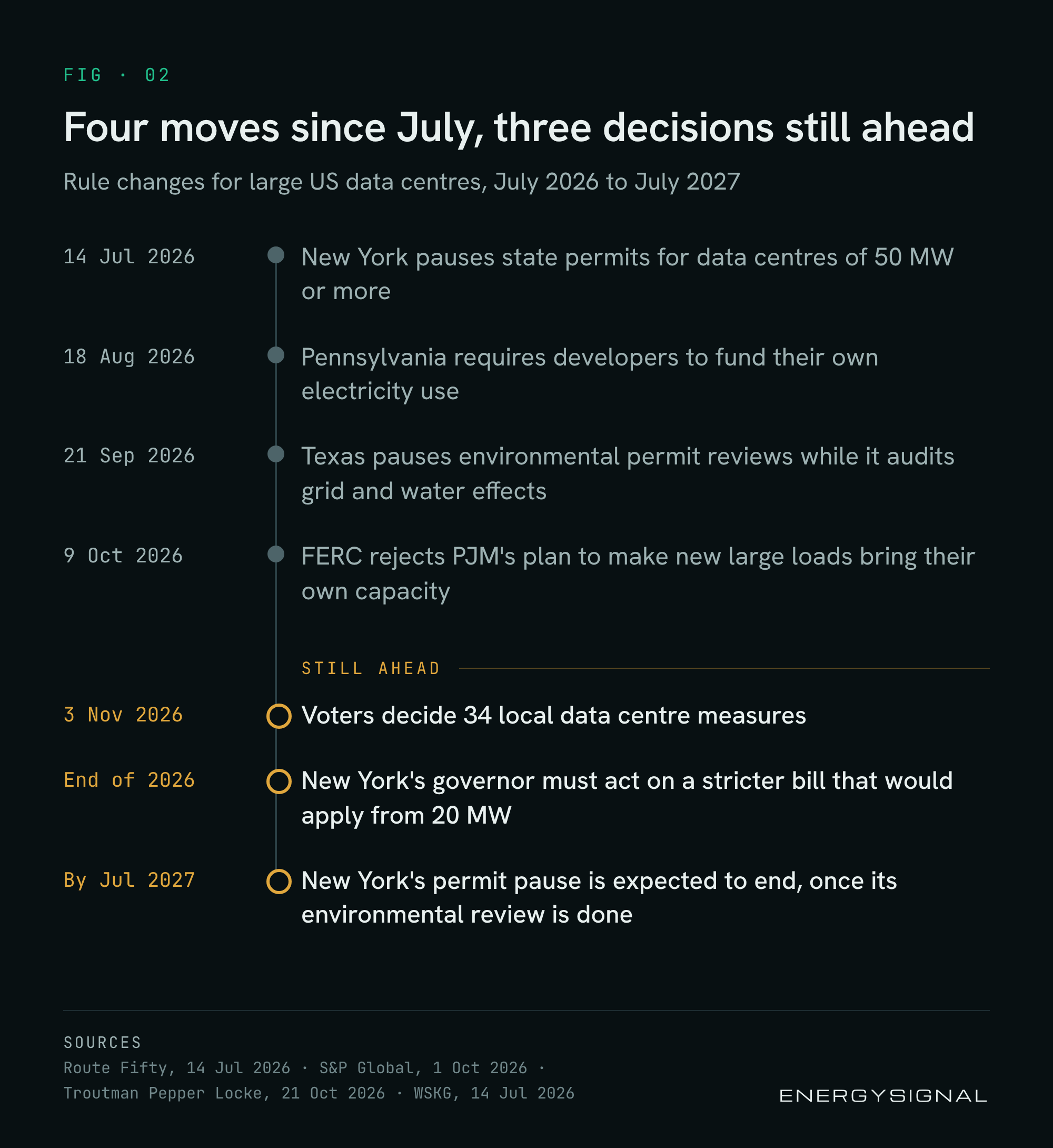
On 3 November, the local votes will show whether the backlash holds up at the ballot box. By the end of the year, New York's governor has to sign, veto or seek changes to the stricter bill, the one that would apply from 20 MW (WSKG).
New York's pause is expected to run for up to a year, until the state finishes its environmental review (Route Fifty). In PJM's territory, the question of who has to bring their own capacity is still open, and FERC has offered guidance should PJM refile (Troutman Pepper Locke).
Where EnergySignal fits
The direction looks clear enough to us. Compute will go where power is available, where it can flex and where it is welcome. EnergySignal connects owners of curtailed or stranded power with operators of flexible, modular compute, and we model the economics for both sides before anyone commits.
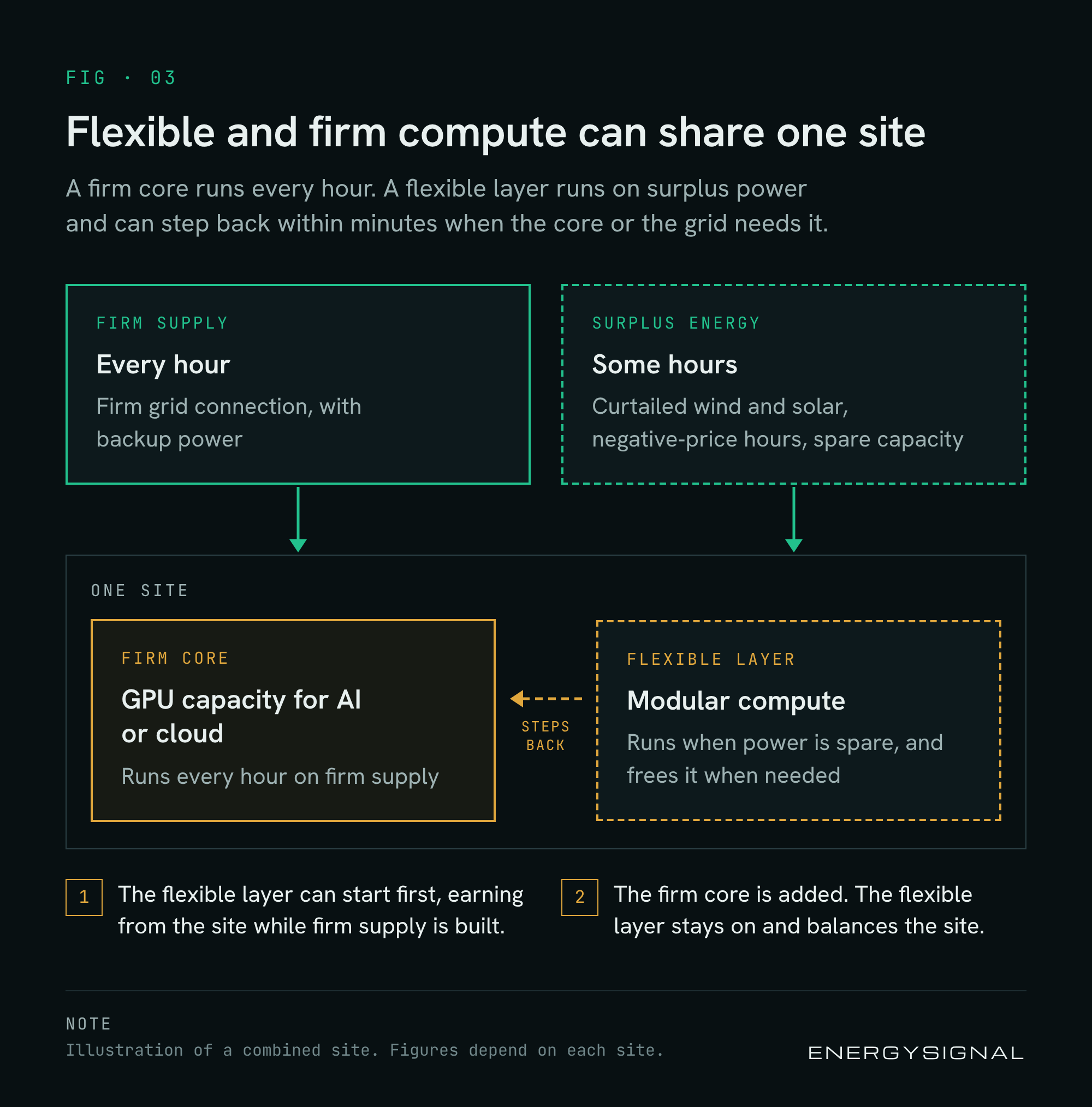
Flexible compute and the large projects that need stable, round-the-clock power can share a site, and in our view the flexible part can make the large project easier to build and to pay for.
The way we picture it, a core of AI or cloud capacity runs on firm supply, and a flexible layer of modular compute runs beside it on surplus or curtailed energy, stepping back within minutes when the core or the grid needs the power. The flexible layer can also go first and start earning from the site while the firm supply and grid upgrades are still being built.
If you are a compute operator or an investor looking for powered, flexible sites, write to us at info@energysignal.io.
And if you own a site, we would like to help you see what it is worth. That might be a wind or solar farm that is being curtailed, or an industrial site with spare grid capacity or heat demand. The calculators at energysignal.io/calculators let you explore your site and what it could be valuable for. Or write to us at info@energysignal.io and we can talk through your site with you and help you understand its potential.
Also in this series
- Not All Megawatts Are Equal: flexible energy, the firm power GPUs need, and how to sequence a project
Sources
- S&P Global: Data center backlash shapes midterm ballots, campaigns across US (1 Oct 2026)
- Route Fifty: New York governor signs nation's first moratorium on large data centers (14 Jul 2026)
- WSKG: Hochul draws cheers, jeers over statewide data center moratorium (14 Jul 2026)
- DLA Piper: Executive Order pauses DEC permits for data centers in New York (23 Jul 2026)
- Data Center Dynamics: Moody's hyperscaler capex forecasts marked up by $85bn
- MultiState: State lawmakers look to behind-the-meter policies for data centers (13 Oct 2026)
- Troutman Pepper Locke: FERC accepts PJM's Large Load definition but rejects Interim Resource Adequacy Service (21 Oct 2026)
- A&L Goodbody: Data centres and the grid, how recent Irish policy will shape the sector (15 Apr 2026)
- Montel: Curtailed renewables in GB and Ireland 2025
- oEnergetice: 2025 marked by negative electricity prices, new records set in Czechia and beyond (24 Jan 2026)
- AI Now Institute: Prohibit off-grid and behind-the-meter power generation (Mar 2026)
Information only, as of the date shown. Not an offer, and not legal, tax, regulatory or investment advice. Any arrangement is agreed only in signed agreements.