Articles · 03
Not All Megawatts Are Equal: Flexible Energy and the Firm Power GPUs Need
The short answer
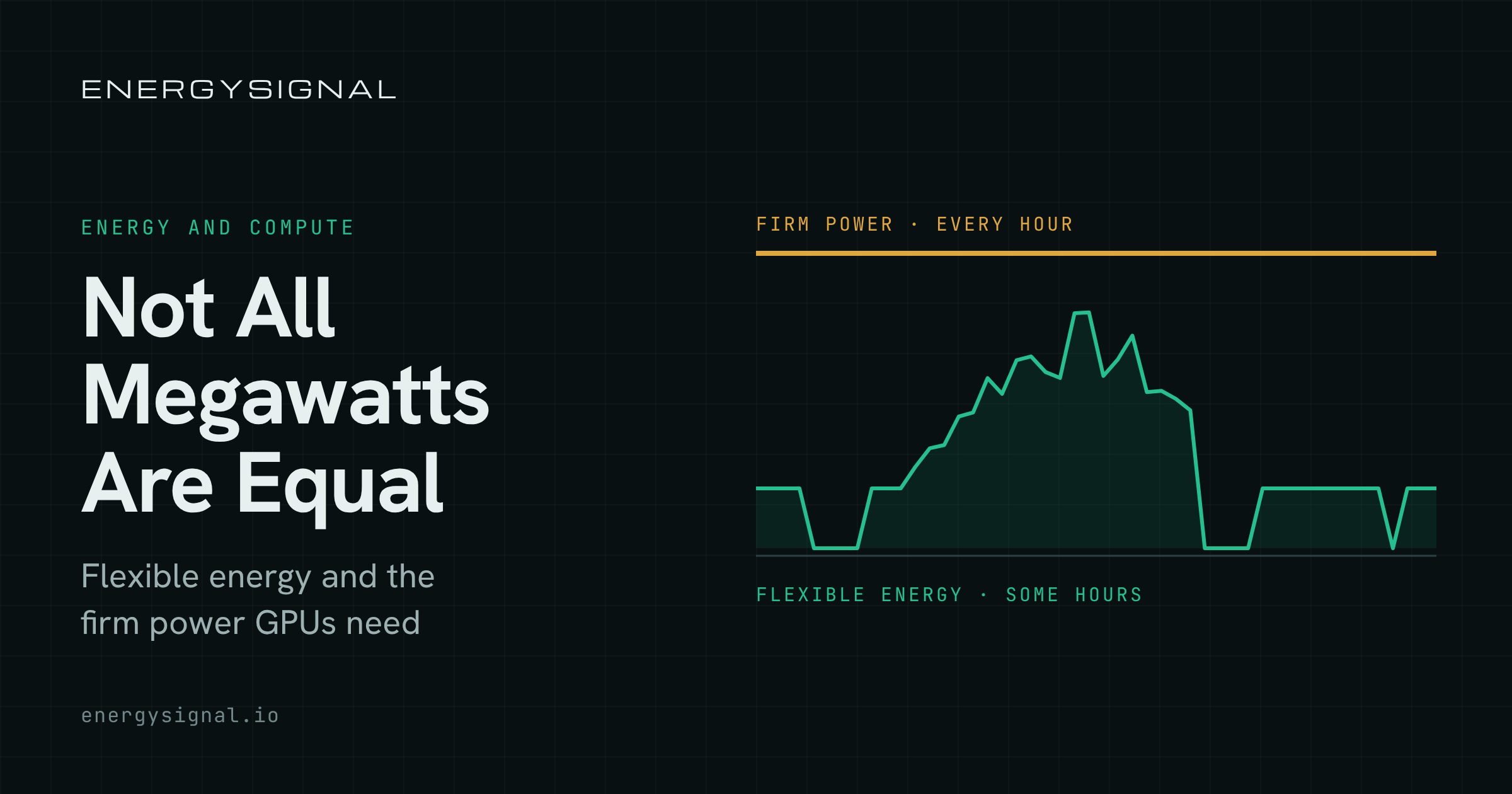
Not every megawatt is worth the same. Some power is only there some of the time, or only in some places, and when it is there it is cheap or even free. Other power is there every second of every day, at a steady voltage and frequency, and it costs far more to secure.
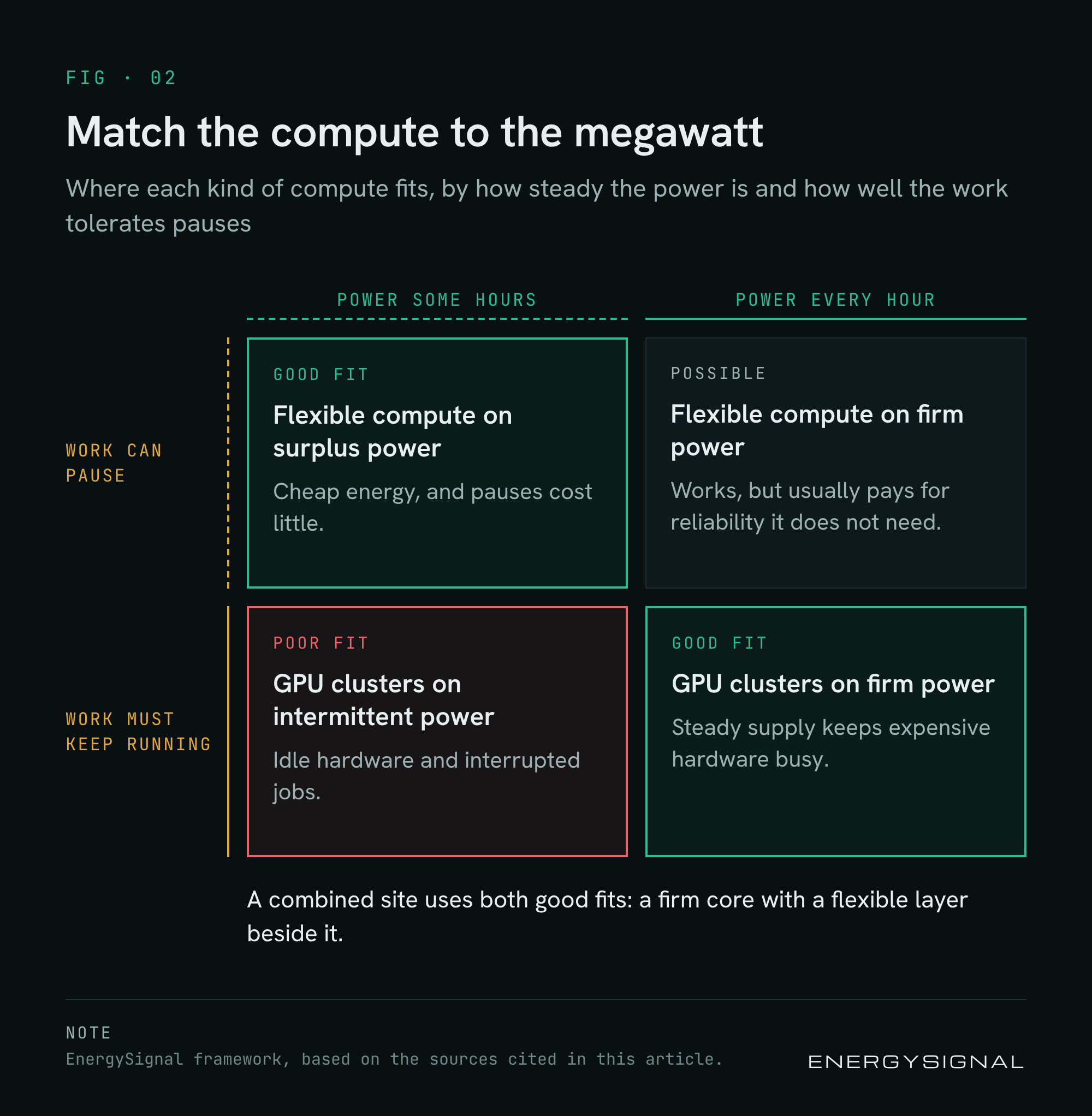
Compute splits the same way. Flexible compute can pause, slow down or step back when power is short, which means it can live on flexible energy. Large GPU clusters for AI mostly cannot. They need firm power, and every idle hour is very expensive hardware doing nothing.
The projects we think are strongest today match each kind of compute to the energy it suits. They start light, prove the site and then grow as the evidence comes in.
Flexible energy: real power that cannot be relied on every hour
Flexible energy is power that exists but cannot be called on whenever it is wanted. It is often cheap because the grid has no use for it at the moment it is produced. It turns up in several forms:
- Curtailed wind and solar. Generators get told to switch off when the grid cannot take what they produce. In Northern Ireland, 24% of all available wind energy was curtailed in 2025 (Montel).
- Negative-price hours. Sometimes there is so much power on the system that the price drops below zero. Spain had 247 such hours in 2024 and 590 in 2025 (oEnergetice).
- Stranded generation. Power gets produced a long way from the demand, behind a transmission bottleneck. Hydropower in northern Sweden is a clear European case, unable to reach the populated south (oEnergetice).
- Non-firm grid connections. The grid can interrupt these when it is constrained, and in return the site connects sooner. Ireland now expects large energy users to accept them (A&L Goodbody).
- Spare capacity at industrial sites. A factory or plant may be sitting on a grid connection it no longer fully uses, often with a demand for heat on site as well.
What these have in common is that the power is real but it comes and goes. So it suits a load that can wait.
Firm power: what GPU clusters need
GPU clusters for AI need power that is there every hour, at steady quality, with backup behind it. Three things set them apart from other loads.
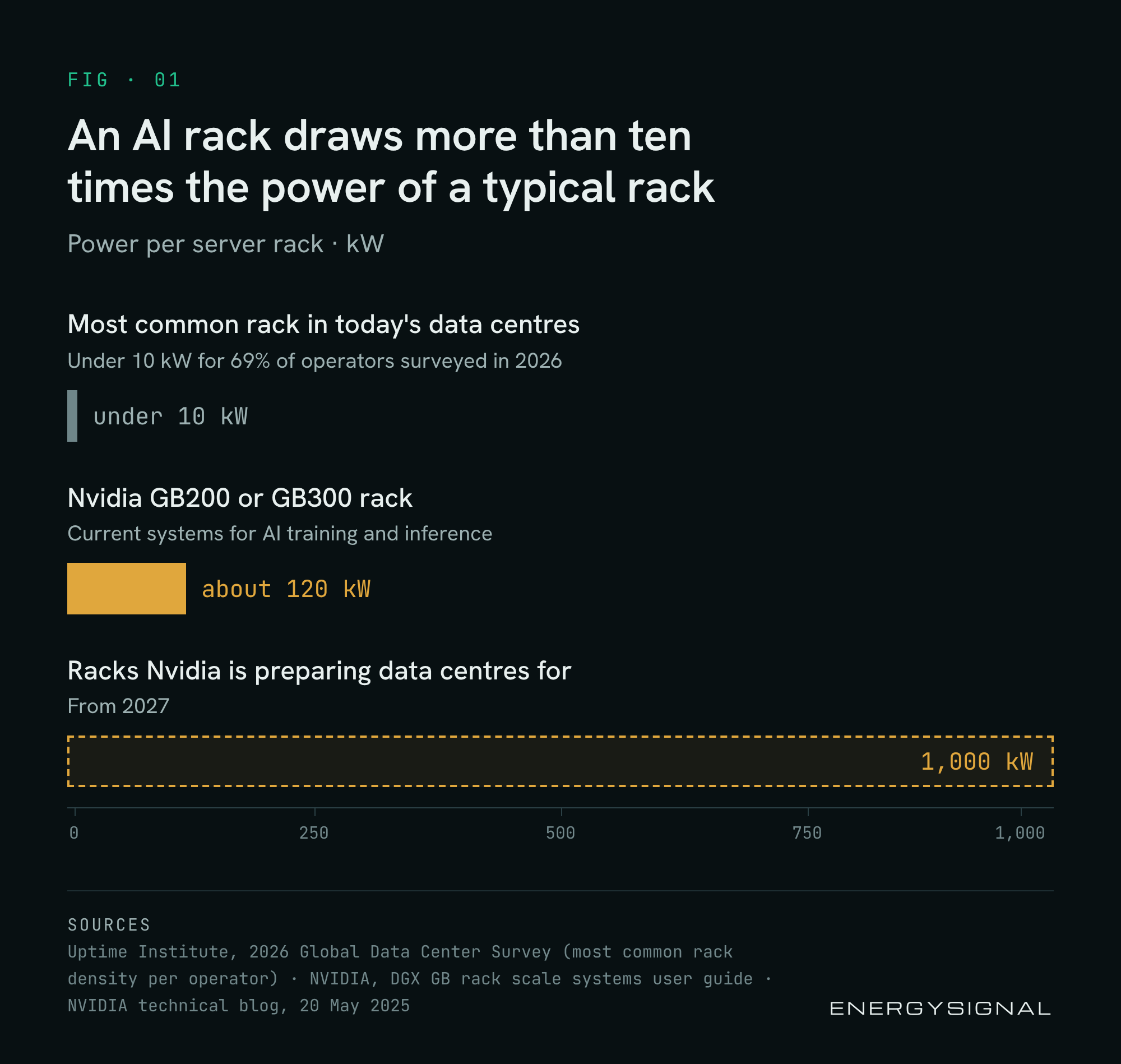
Density. A current Nvidia GB200 or GB300 rack draws about 120 kW (NVIDIA). For comparison, in Uptime Institute's 2026 survey, 69% of operators said their most common rack runs below 10 kW (Uptime Institute).
Reliability. Nvidia recommends that sites for its largest systems meet Uptime Tier III design standards or better, with no single point of failure (NVIDIA). Training runs are fragile. While training Llama 3, Meta found that a single GPU failure could force a restart of the whole job, and it logged 466 interruptions in 54 days (Meta).
Grid impact. GPUs in a training job move in lockstep, so the draw of a whole cluster can swing by tens or hundreds of megawatts (Microsoft, OpenAI and NVIDIA authors). In July 2024, a line fault in the eastern US grid knocked about 1,500 MW of data centre load off at once, as sites switched to backup power (NERC). And in July 2026, the US regulator FERC ordered mandatory reliability standards for these large computational loads (Willkie Farr & Gallagher).
In practice, firm power means a firm grid connection with backup behind it. Even Microsoft's new AI site in Atlanta, which it describes as capable of 99.99% availability, gets there by securing highly available grid power rather than by running on anything less (Microsoft).
Side by side
Put the two next to each other and they differ on almost every requirement, which is why they suit different energy.
| Flexible compute | GPU compute for AI | |
|---|---|---|
| Power it needs | Surplus, curtailed or non-firm power, in the hours it is there | Firm power every hour, at steady quality |
| Reliability built in | Little: the load is designed to pause | Tier III-class design, usually with 2N or N+1 power |
| When the grid is stressed | Ramps down on request | Limited and still in trials: 25% for three hours in a US test, up to 40% in a UK test |
| Cost to build | Modular equipment, no data hall | $17.6 million per MW for a modern US building before chips, plus up to $25 million per MW of AI fit-out |
| Time to power | Can use power already at the site | 7 to 10 years for a grid connection in Europe's main hubs |
| Commitment | Equipment can be moved or resized | Long contracts, and hardware that needs high use to pay back |
Sources: NVIDIA, Uptime Institute, NVIDIA on the Phoenix test, National Grid, Cushman & Wakefield, JLL, Ember.
Where each fits, and where it does not
The energy at a site decides what kind of compute belongs there. We would rather start from that than from the hardware.
Flexible compute fits where power is plentiful at some hours and wasted at others. In practice that means next to wind, solar or hydro facing curtailment, behind a congested grid node, on a non-firm connection, or at an industrial site with spare capacity and a use for heat. It also works as a first tenant while firm supply is being arranged.
It does not fit where power is short in every hour, where homes sit close enough for the equipment noise to matter, or where a customer needs a service that runs without interruption.
GPU compute fits where firm power, fibre, cooling and skilled staff all come together, usually with a long-term contract from a creditworthy tenant behind it. Training clusters can sit further from cities than inference, which often has to stay close to its users.
It does not fit on power that comes and goes, on sites without fibre, or in projects that cannot fund the hardware or cannot wait years for a connection.
The challenges on each side
Flexible compute earns only in the hours it runs. So its income depends on how many surplus hours a site really has, and on what compute pays at the time. Rules for power used on site, behind the meter, are still being written, and some advocates want it restricted (AI Now Institute).
Noise and heat need a plan as well, ideally before the neighbours raise them.
GPU compute carries far more weight. Building costs keep climbing, and Cushman & Wakefield's latest guide shows a 21% rise per MW since its previous edition (Cushman & Wakefield). That is before the chips, which JLL puts at up to $25 million per MW for an AI fit-out (JLL).
Time is the other constraint. Ember found that grid connections take about three years in Italy, which is quick compared with the main hubs (Ember). Even so, AWS says securing power for a new European data centre can take up to seven years (The Register).
How to evaluate a project
Look at the site before the hardware. These are the questions we ask first, because they decide whether a project works:
- Energy profile. How many megawatts are firm, and how many hours a year is power surplus, curtailed or priced below zero? Ask for at least a full year of hourly data.
- Connection. What grid connection exists today, is it firm or non-firm, and when could it realistically be upgraded?
- Site. Are land, permits, noise limits and cooling in place, and is there a use for the heat?
- Connectivity. Is there fibre, and does the planned workload need low latency?
- Economics. What would compute earn per megawatt hour, compared with what the power earns today? How much capital is at risk, and how fast does it pay back?
- Commitment. How long are the contracts, and can equipment be moved or resized if conditions change?
- Upgrade path. Could the site add firm compute later, and what would that take?
The sequence for building now
Build in steps, and put a clear test in front of each one.
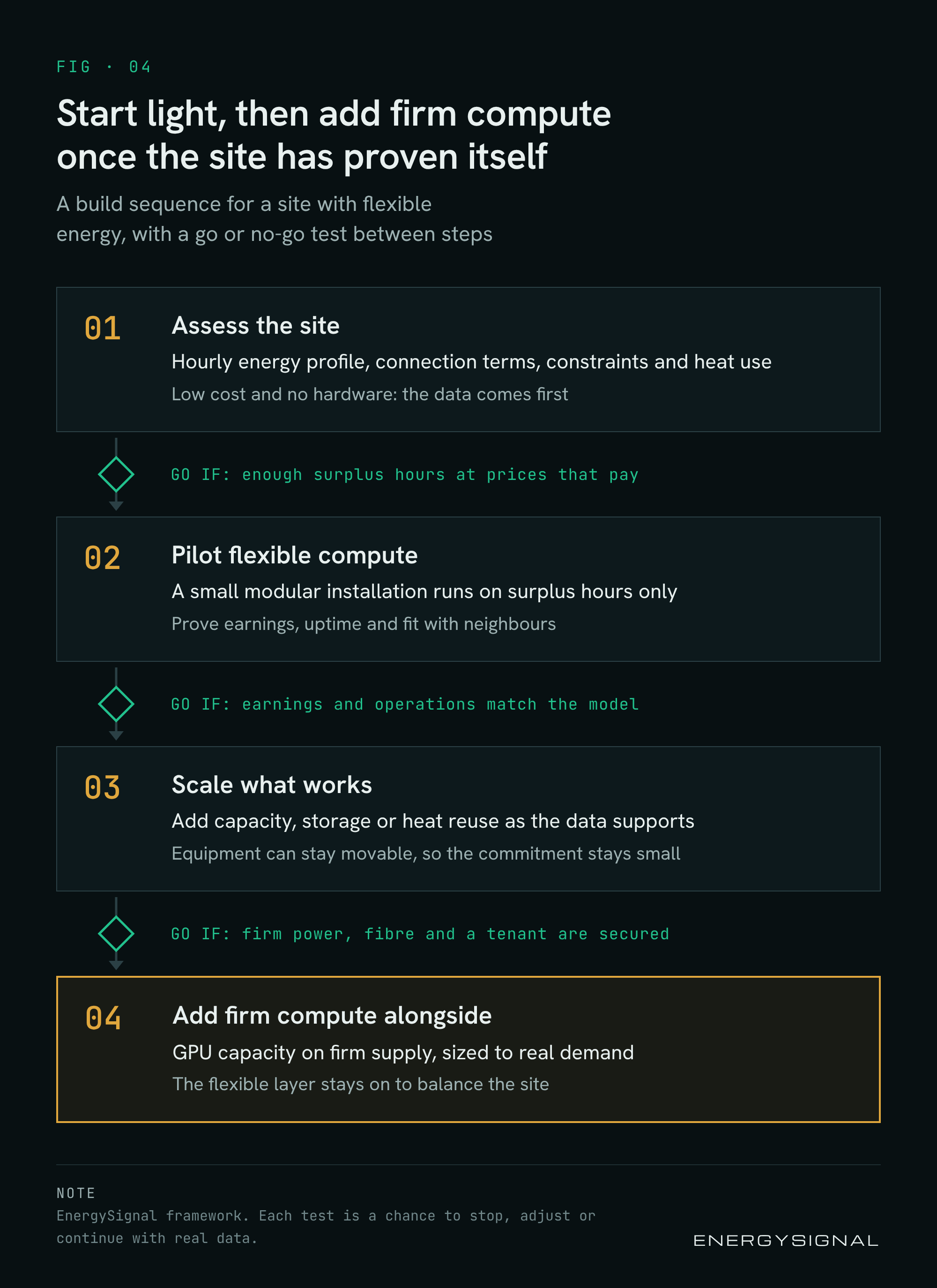
Each test is a chance to stop, adjust or carry on with real data in hand. The largest commitment comes last, once the site has shown what it can do.
The order matters because the hardware is the most expensive and least patient part of the project. The site, the power and the permits can be assembled over time and at low cost. The GPUs cannot wait. Every idle month of a cluster that cost tens of millions of dollars per megawatt is money lost. So the power and the site come first, and the GPUs follow, sized to what the site has proven it can deliver.
Start light, scale with evidence
Staying light and flexible is often the stronger position today, in our view. A large early commitment ties up capital for years against power, permits and demand that are all still moving. Modular, flexible compute lets a site test its economics with a small first step and scale only as the evidence comes in.
Flexible compute is no rival to the large projects that need stable, round-the-clock power. If anything it can make them easier to build and to pay for, and a single site can host both.
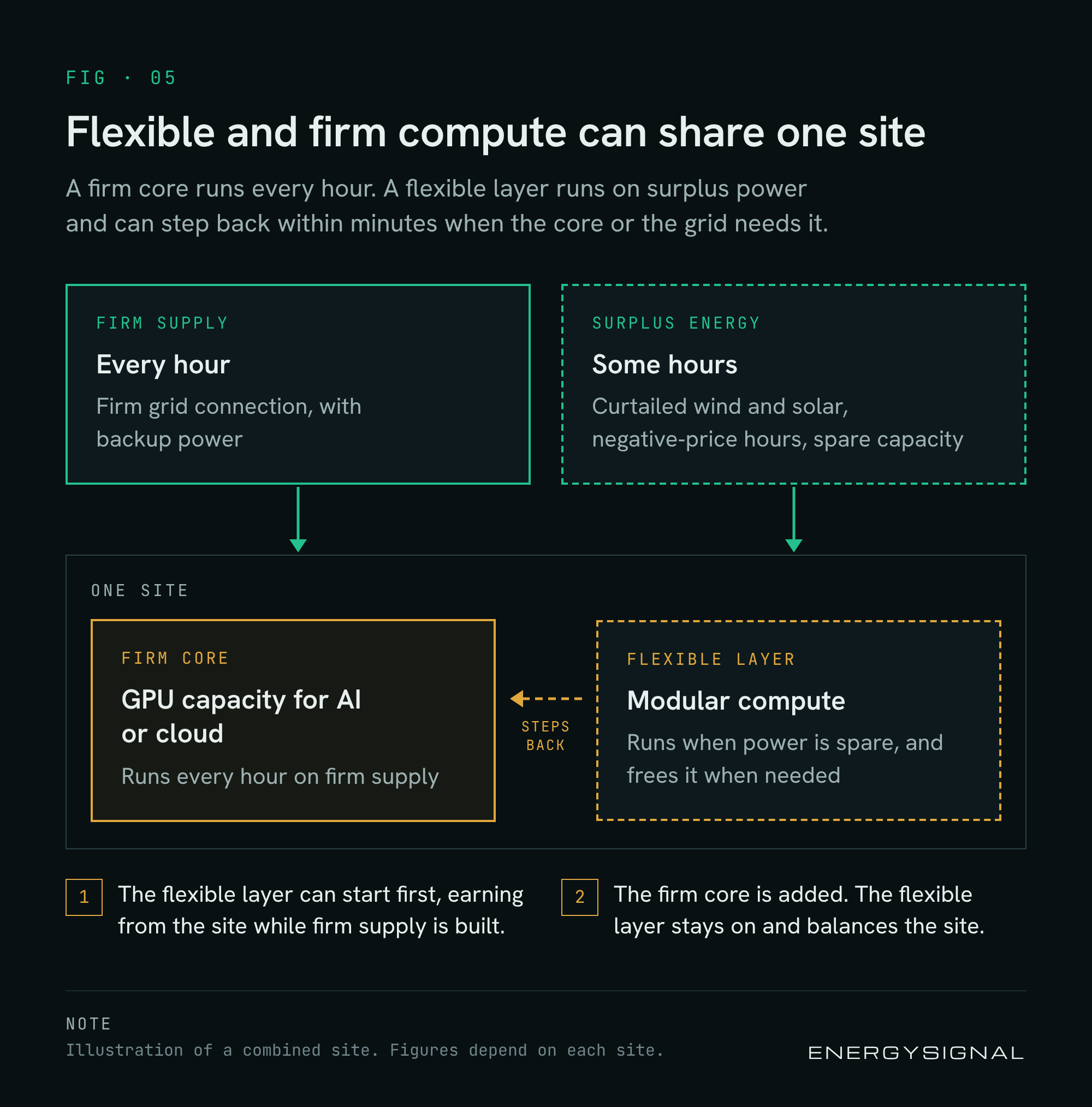
The firm supply feeds a core of AI or cloud capacity. A flexible layer of compute sits next to that core, uses the surplus or curtailed energy, and can step back within minutes when the core or the grid needs the power. And the flexible layer can go first, earning from the site while the firm supply and grid upgrades are still being built.
EnergySignal connects owners of curtailed or stranded power with operators of flexible, modular compute, and we model the economics for both sides. Compute operators and investors looking for powered, flexible sites can reach us at info@energysignal.io.
If you own a site, we would like to help you see what it is worth, whether that is a wind or solar farm facing curtailment or an industrial site with spare grid capacity or a demand for heat.
A good first step is to run your own numbers through our calculators at energysignal.io/calculators. Or write to us at info@energysignal.io and we can talk the site through with you and help you see what it could do.
Also in this series
- Pricing Flexibility: what a load that can step back is worth
- What Is Your Site's Energy Worth?: four things that set a site's value, and how to prepare the first conversation
Sources
- Montel: Curtailed renewables in GB and Ireland 2025
- oEnergetice: 2025 marked by negative electricity prices, new records set in Czechia and beyond (24 Jan 2026)
- A&L Goodbody: Data centres and the grid, how recent Irish policy will shape the sector (15 Apr 2026)
- NVIDIA: DGX GB rack scale systems user guide, hardware
- NVIDIA: DGX SuperPOD reference architecture featuring DGX GB200
- Uptime Institute: Findings from the 2026 Global Data Center Survey (Aug 2026)
- Meta: The Llama 3 Herd of Models
- Power Stabilization for AI Training Datacenters (Aug 2025)
- NERC: Incident review, considering simultaneous voltage-sensitive load reductions (Jan 2025)
- Willkie Farr & Gallagher: FERC orders new reliability standards for data centers and other computational loads (30 Jul 2026)
- Microsoft: Infinite scale, the architecture behind the Azure AI superfactory (12 Nov 2025)
- NVIDIA: How AI factories can help relieve grid stress (1 Jul 2025)
- National Grid: UK-first trial of AI grid technology (2 Mar 2026)
- Cushman & Wakefield: 2026 Data Center Development Cost Guide release (3 Sep 2026)
- JLL: 2026 Global Data Center Outlook (5 Jan 2026)
- Ember: Grids set to block or unlock economic opportunities in Europe's AI race (19 Jun 2025)
- The Register: Amazon says seven-year wait for EU grid connections is holding up data centres (3 Feb 2026)
- AI Now Institute: Prohibit off-grid and behind-the-meter power generation (Mar 2026)
Information only, as of the date shown. Not an offer, and not legal, tax, regulatory or investment advice. Any arrangement is agreed only in signed agreements.