Articles · 07
Heat as a Second Income: What Compute Heat Is Worth to a Site
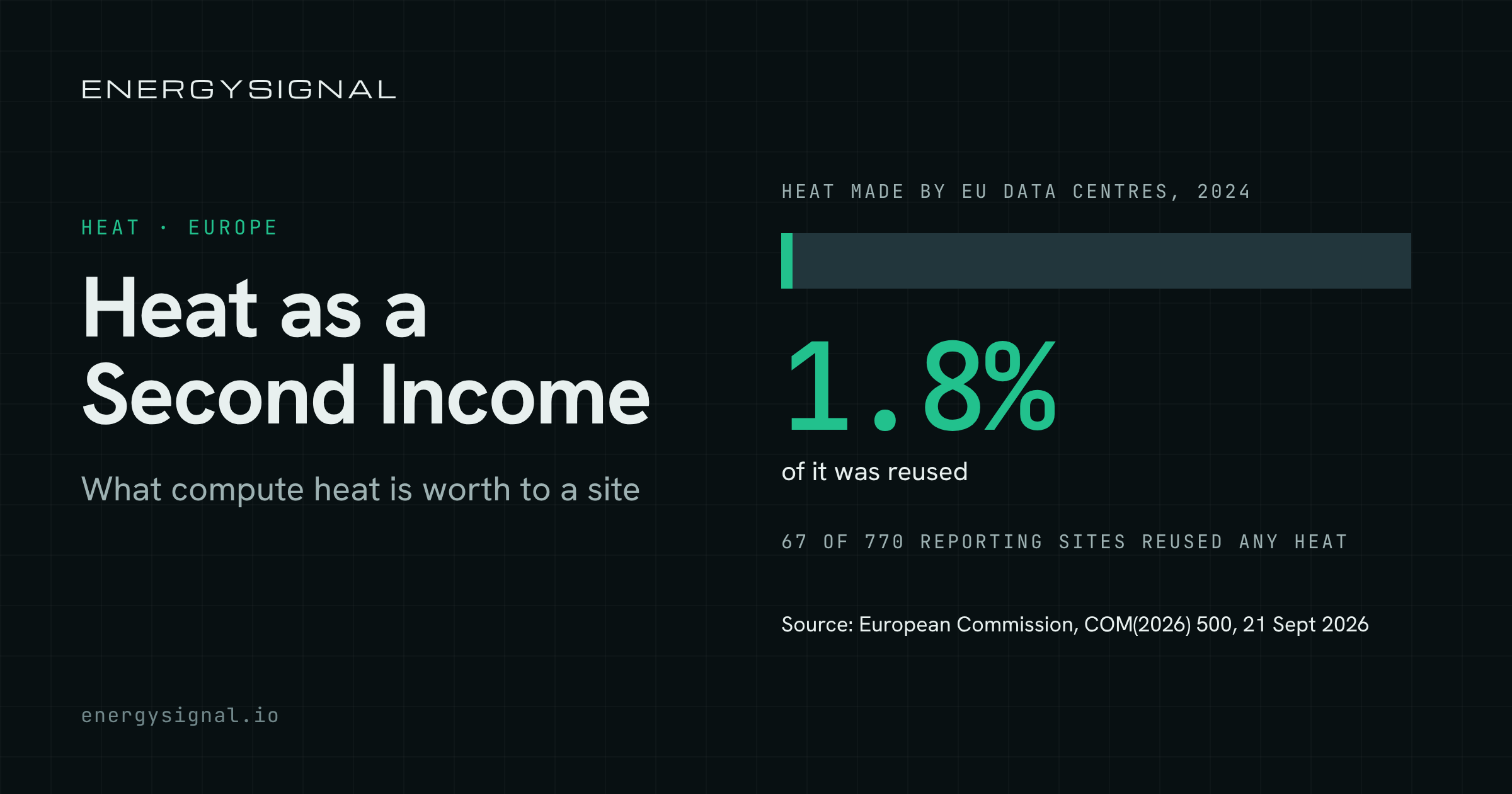
Nearly all the electricity that goes into compute comes back out as heat, and across Europe almost none of it gets used. If your site has a use for warm water, that heat can be a second income, and what follows is how we count it.
IT equipment turns about 97% of the electricity it uses into heat, according to a 2024 study by Oak Ridge National Laboratory researchers on district heating from data centres. In most data centres that heat goes out to the air through cooling towers and chillers, which costs money to run, while the buildings next door buy their own fuel to keep warm. The European Commission's first report on the energy efficiency of data centres, published on 21 September 2026, found that of the 770 data centres that reported for 2024, "only 67 data centres reported some waste heat reuse", and that "approximately 1.8% of the total heat generated by data centres is being reused in the EU".
That is the gap. For a host with a heat network, a process that runs on warm water, a greenhouse or a digester, compute heat is something the compute partner has to get rid of and the host is already paying for. The rest of this piece goes through what the heat is, what it is worth, why the rules are starting to reward it, and how the heat account works at a site.
What the heat is, and what it is worth
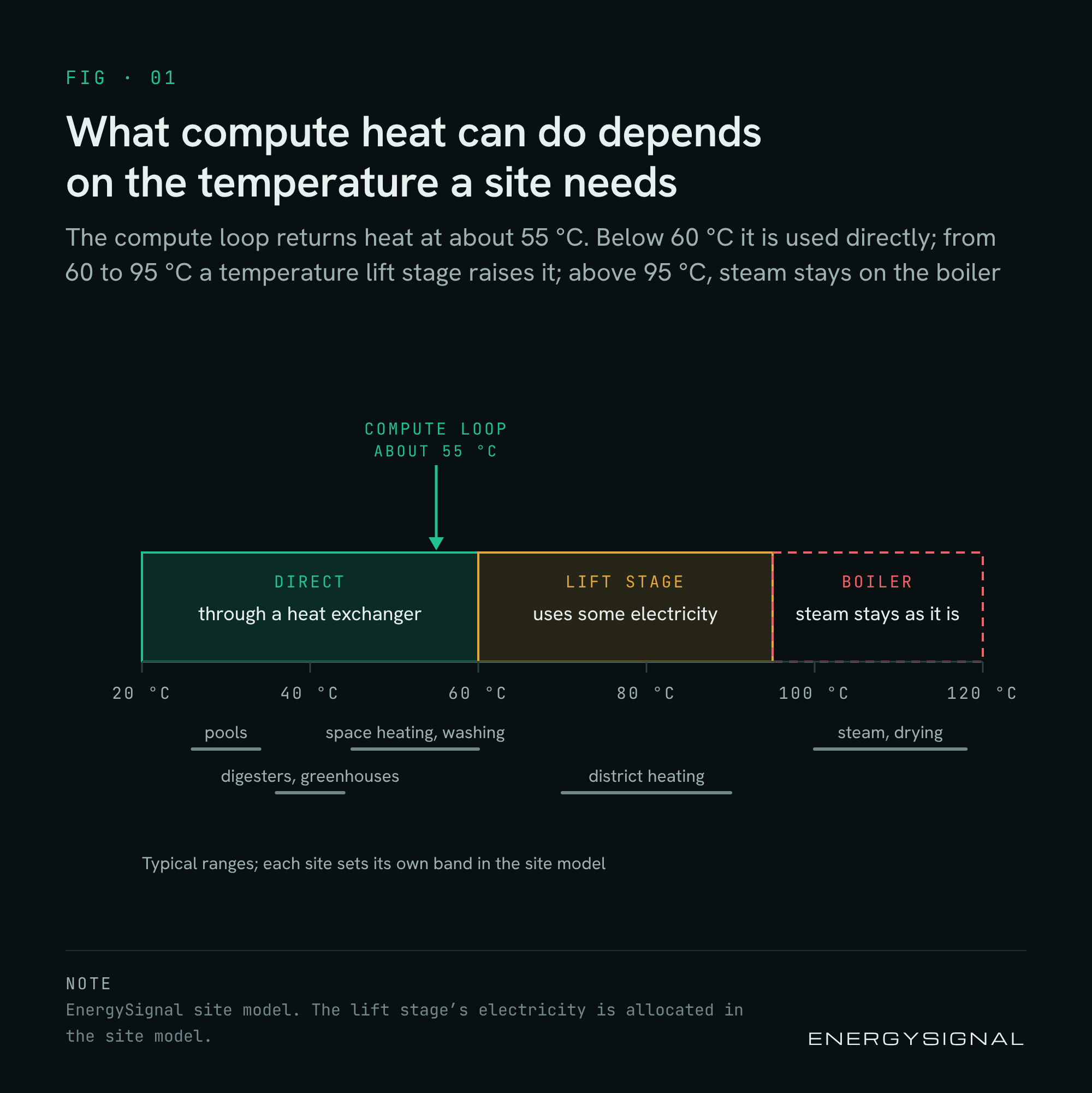
Compute heat is warm rather than hot. The Oak Ridge study puts typical data centre waste heat at 25 to 35 °C for air-cooled systems, 50 to 60 °C for water-cooled systems and up to 90 °C for two-phase refrigerant cooling, against district heating networks that run at up to 100 °C in today's third-generation systems and at 50 to 60 °C in the fourth generation now being built. The modular compute we work with is liquid cooled, and per MW of connection it draws about 0.93 MW and returns about 0.8 MW of heat to a water loop at about 55 °C.
What a site can do with 55 °C depends on the temperature it needs. Up to about 60 °C the heat goes through a heat exchanger straight into the process or the network, which covers washing and process water, space heating, pools, greenhouses and the digesters of a biogas plant. From 60 to 95 °C a temperature lift stage raises it into the band, and that stage uses some electricity, which the site model allocates. Above 95 °C, steam and drying stay on the boiler.
What is it worth? The clearest public price we know of comes from Stockholm, where the district heating company buys recovered heat from data centres, supermarkets and industry. Stockholm Exergi says it "pays for delivered heat capacity based on what the equivalent heat would have cost to produce in our plants", and its example is "approximately two million SEK annually for heat deliveries of 1MW", which is roughly €180,000 a year per MW at current rates, with payments varying with the outdoor temperature. It heats 11,000 apartments with excess heat today. Every heat account works on that logic, ours included. The heat is worth what the fuel it replaces would have cost, less a discount that makes it worth the taker's while to connect.
The projects running today are big ones. In Odense, the recovery plant at Meta's data centre recovers 215,000 MWh of energy at about 45 MW, lifted to 70 to 75 °C for the city network, and in 2023 it heated more than 12,000 homes, according to Ramboll, which designed it. In Espoo and Kirkkonummi, Fortum started heat production at its plants on Microsoft's two data centre sites in May 2026. Once fully implemented, data centre waste heat "is expected to cover approximately 40 per cent of the total yearly 2 terawatt hour district heat demand of the 250,000 heat users in the area", with 72 water-to-water units producing up to 180 MW of district heating. In Hamina, Google's recovered heat "represents an estimated 80% of Hamina's district-heating needs" and goes to the local utility free of charge, according to Business Finland. And in Dublin, Ireland's first data centre heat network in Tallaght has run since 2023 on heat from a nearby Amazon data centre, and distributed 3,770 MWh in its first year to council buildings and a university campus, according to Codema.
The rules now reward it
Three layers of rules are turning heat reuse from a nice idea into a condition of operating, and each of them makes a site with a heat user worth more to a compute partner.
The EU directive. Article 26(6) of the recast Energy Efficiency Directive reads: "Member States shall ensure that data centres with a total rated energy input exceeding 1 MW utilise the waste heat or other waste heat recovery applications unless they can show that it is not technically or economically feasible in accordance with the assessment referred to in paragraph 7." Article 12 of the same directive makes data centres with at least 500 kW of installed IT power report their energy data every year. If a site can take the heat, the operator has an easy way to show feasibility and no need to argue against it.
Germany's law. Section 11 of the Energieeffizienzgesetz requires data centres that start operating from 1 July 2026 to reach a PUE of 1.2 or better and a share of reused energy of at least 10%, rising to 15% for those starting from 1 July 2027 and 20% from 1 July 2028, within two years of commissioning. Existing data centres must reach a PUE of 1.5 from July 2027 and 1.3 from July 2030. A government bill now before the Bundestag (first reading on 24 September 2026, committee hearing on 5 October) would stretch the compliance window from two to four years and make the heat duty conditional. In the Bundestag's summary, "Abwärme muss nur dann genutzt werden, wenn ein passendes Wärmenetz in der Nähe vorhanden ist", that is, waste heat only has to be used where a suitable heat network is nearby. The bill is not yet law. But either way, a site next to a network is where the German rules point.
The EU label. On 21 September 2026 the Commission adopted a delegated regulation establishing a common Union rating scheme for data centres. From 15 August 2027, and every year after, an electronic label will be generated automatically for every data centre that reports, and the label states "whether the data centre is 'waste heat reuse ready' or not" alongside its energy reuse factor, which is the share of its energy that is reused outside the data centre boundary. The same day the Commission opened a call for evidence on minimum performance standards that would cover "energy efficiency, water use, waste-heat reuse, services to the grid and other selected sustainability criteria". So heat reuse is becoming something an operator gets rated on, and a host that can take the heat is part of how an operator earns that rating.
Which sites can take it
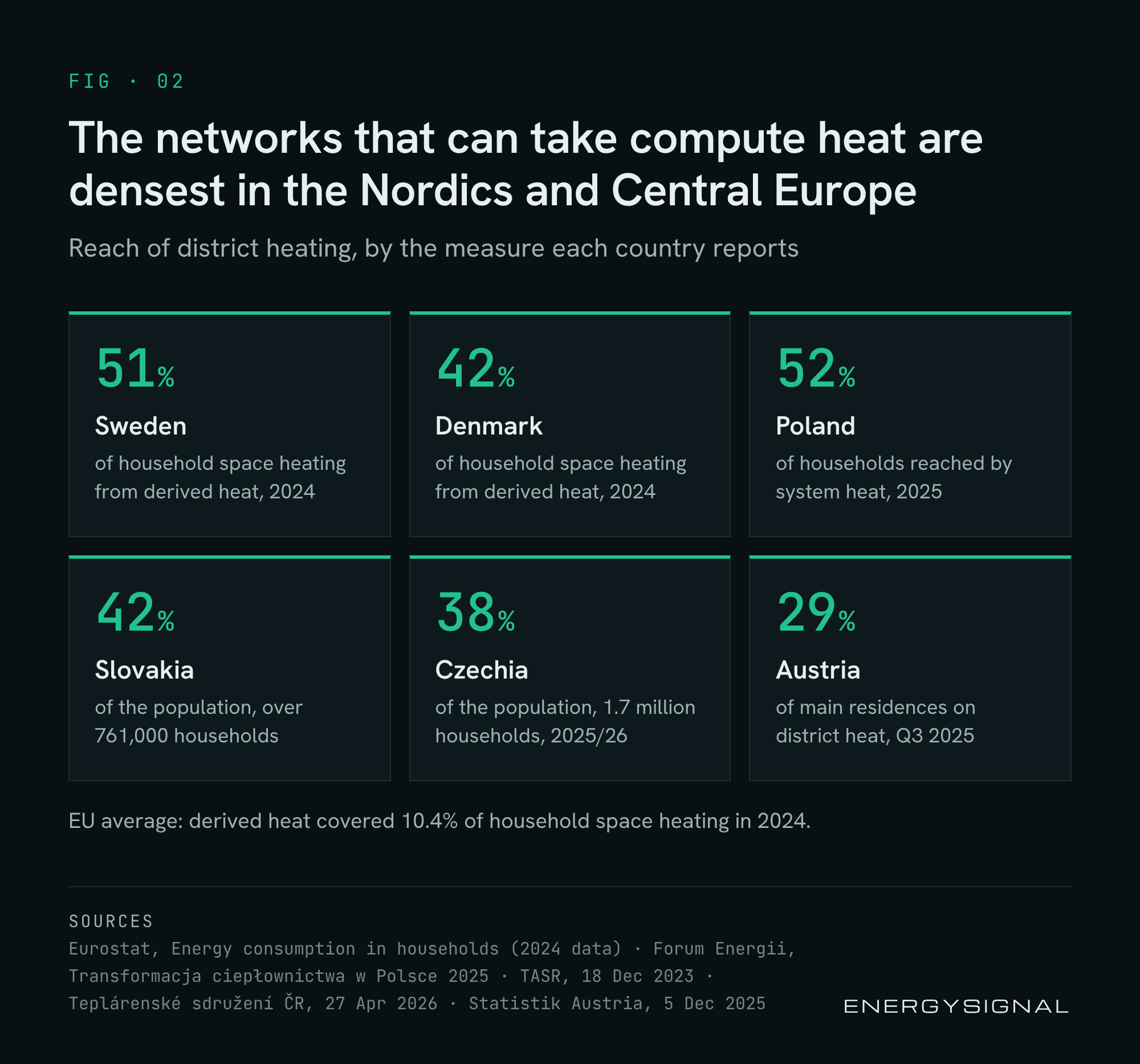
District heating is the largest taker, and Central Europe and the Nordics have the most of it. Across the EU, derived heat covered 10.4% of household space heating in 2024, according to Eurostat. In Sweden it was 51.0% and in Denmark 42.2%. In Czechia, district heating supplies 1.7 million households, 38% of the population, according to the Czech district heating association, and coal still provided 47.6% of that heat in 2025, so the networks are looking for new sources. In Poland, system heat reaches about 52% of households through 22,700 km of networks, according to Forum Energii. Slovakia's networks serve over 761,000 households, 42% of the population, according to the Slovak heat producers' association, and 28.9% of Austria's main residences are on district heat, according to Statistik Austria.
The temperature a network needs decides the route. Older networks supplying 70 to 90 °C take compute heat through a temperature lift stage, as Odense does. Newer low-temperature networks, and the return lines of older ones, can take 55 °C water directly. The return line is often the best entry point, because it needs the least lift and it is where the network's own plant is least efficient.
Industry is the second taker, and for most sites it is nearer at hand. Any process that runs on water below 60 °C can use the loop directly. That covers washing and rinsing in food and drink plants, preheating of boiler feed water, space heating of halls, pools and leisure centres, greenhouses, fish farms, low-temperature drying, and the digesters of biogas plants, which run near 40 °C. A plant that already has a heat network of its own, as many vehicle and chemical plants do, is the simplest case of all, because the loop ties into pipework that is already there.
The other thing that matters, in every case, is the months. A network or a process that needs heat all year can take most of what the compute makes. One that only heats from October to April takes less, and the calculators and the site model count only the share the site can actually use.
How the heat account works for a host
The heat account in our site model has four lines, and a host can put a rough figure on each of them before we ever talk.
The price. Heat is priced per MWh at a discount to the fuel it replaces. The calculators ask for "the fuel cost you avoid, per MWh of gas", so that a plant on gas, a CHP burning its own fuel and a network buying heat each enter the right basis. The discount is what makes the connection worth the host's while. The exact figure is a draft term on the calculator pages and gets agreed in the site model. From 2028 the EU's second emissions trading system is due to add a carbon cost to heating fuels, which raises the value of every MWh the compute displaces.
The lift electricity. Up to 60 °C there is none. In the 60 to 95 °C band the temperature lift stage uses electricity, and the site model shows two cases. In the high case the heat price is the host's only cost. In the low case the host also pays the lift electricity at its own power price. Which case applies is settled in the site model, and in practice a host should expect the answer to land somewhere between the two.
The share. Only the heat the site can use, in the months it needs it, counts. The calculators start from a cautious share and let the host change it, and the site model reads it from the network's or the process's monthly data. A year-round process is worth far more than a winter network on the same loop.
The tie-in. The loop needs a heat exchanger at the site boundary and a short run of pipework to the point where the heat enters the process or the network. That tie-in is part of the minimal investment on the host's side, and it is priced in the site model once the layout is known.
Before the conversation, it helps if a host has measured a few things. The fuel used for heat in a year, in MWh, and what it costs. The temperature the process or network needs, and its return temperature. The monthly profile. And the distance from where the compute would probably sit to the point of use.
Start light, and let the heat carry the case
The shape we work towards is a firm core of AI or cloud capacity on firm supply, with a flexible layer of compute beside it that uses surplus or curtailed energy and can step back within minutes when the core or the grid needs the power. The flexible layer does not have to wait for the core. It can start first and earn from the site while firm supply and grid upgrades are built.
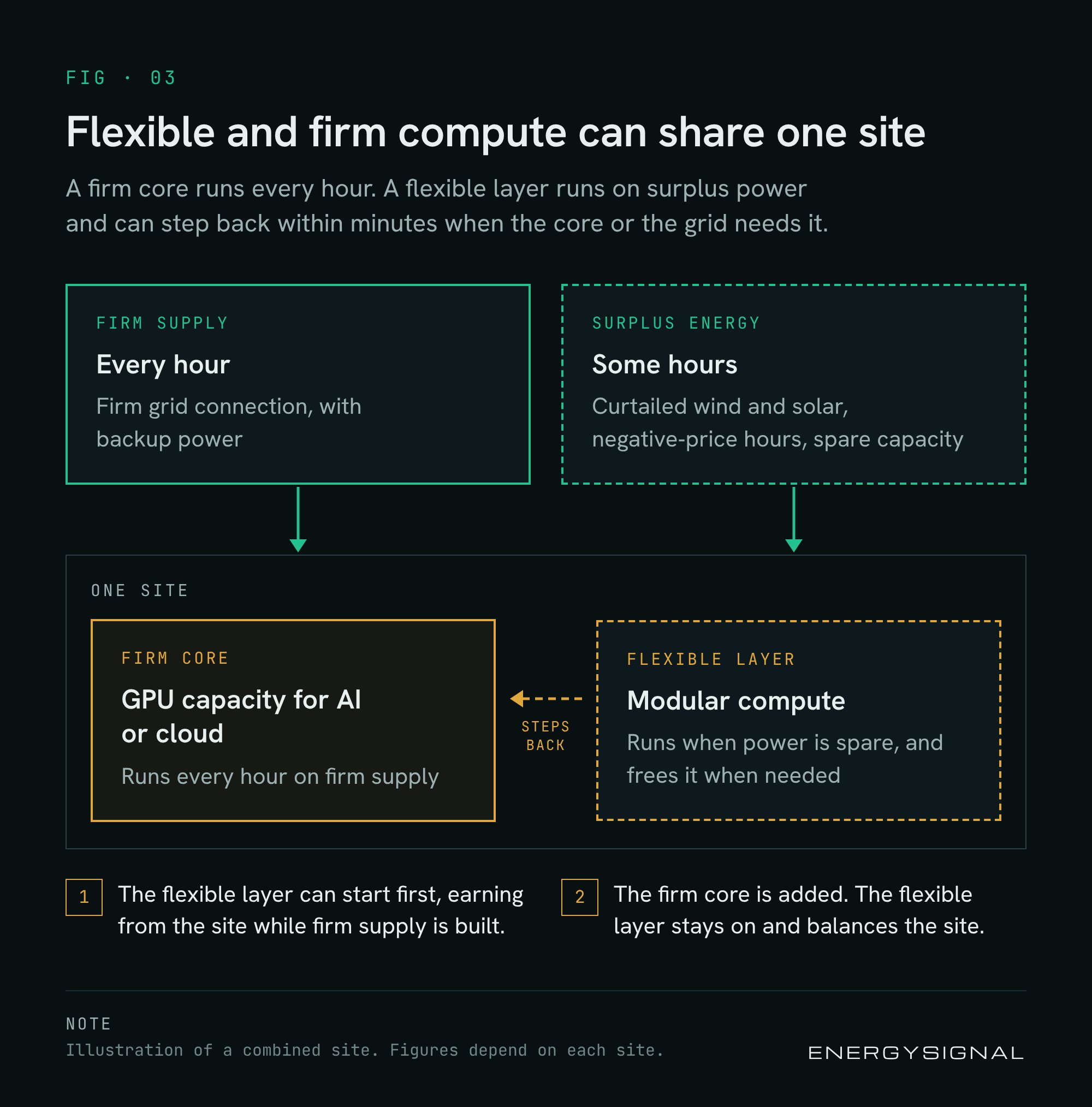
Heat is what joins the two. The flexible layer proves the heat loop on a few MW, so the tie-in, the temperatures and the share the site can take through the year all get tested before anything larger arrives. A firm core that follows runs every hour and makes heat every hour, which is exactly what a network wants, and it arrives at a site where the loop already works. And for many hosts the heat account is the reason the first step pays even where the power side is thin.
If your site has a use for warm water, we would like to help you see what it is worth. Try your own numbers in the calculators at energysignal.io/calculators, and if heat is your case, go straight to the heat calculator at energysignal.io/calculator/heat. Or write to us at info@energysignal.io and we can go through your site with you and what it could do.
Also in this series
- Why Central Europe: industrial power, district heat and room to grow
Sources
- Oak Ridge National Laboratory authors, District Heating Utilizing Waste Heat of a Data Center: High-Temperature Heat Pumps, Energy and Buildings, 2024
- European Commission, Report on the energy efficiency of data centres in the EU, COM(2026) 500, 21 September 2026
- European Commission, Delegated Regulation on a common Union rating scheme for data centres, C(2026) 3472 and its annexes, 21 September 2026
- European Commission, Call for evidence: Data centres in the EU, minimum performance standards, September 2026
- Directive (EU) 2023/1791 on energy efficiency, Articles 12 and 26(6)
- Section 11 of the Energieeffizienzgesetz and the Bundestag's summary of the 2026 amendment bill, 5 October 2026
- Stockholm Exergi, Heat recovery
- Ramboll, Meta: surplus heat to district heating
- Fortum, Fortum has started heat production at two large data centre sites in Finland, 6 May 2026
- Business Finland, Google announced an expansion of its Hamina data center and a new heat recovery project, 20 May 2024
- Codema, Tallaght District Heating Scheme
- Eurostat, Energy consumption in households, 2024 data
- Teplárenské sdružení České republiky, Bilance topné sezony 2025/2026, 27 April 2026
- Forum Energii, Transformacja ciepłownictwa w Polsce, edycja 2025, September 2025
- TASR via Teraz.sk, Slovenský zväz výrobcov tepla oslavuje 25. výročie, 18 December 2023
- Statistik Austria, Wohnungsmieten im 3. Quartal nahezu konstant, 5 December 2025
- The compute draw, heat return and temperature bands are those of EnergySignal's site calculators and site model; commercial terms on the calculator pages are draft terms: energysignal.io/calculators
Information only, as of the date shown. Not an offer, and not legal, tax, regulatory or investment advice. Any arrangement is agreed only in signed agreements.