Articles · 11
The EU's New Data Centre Label, and What It Rewards
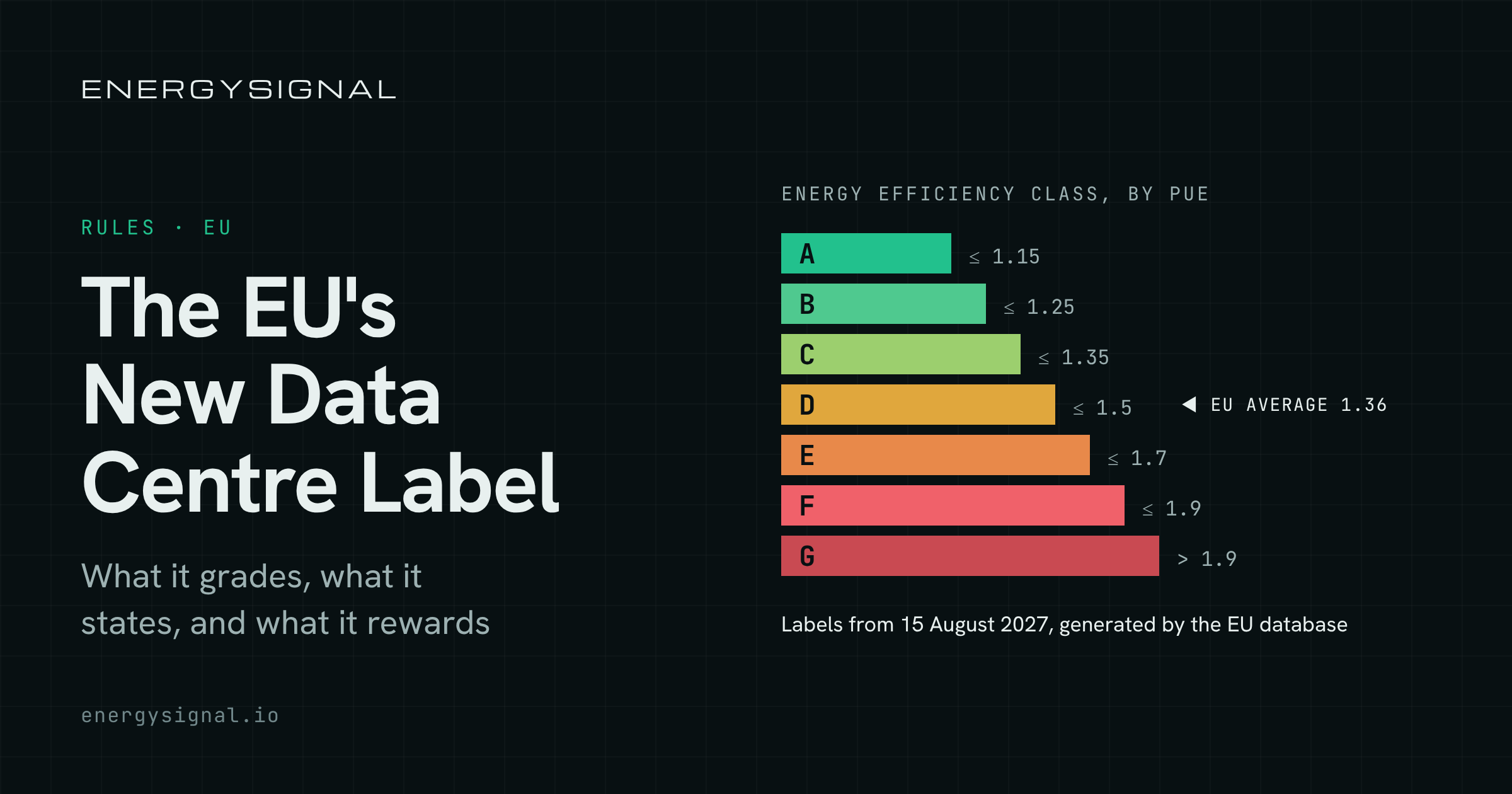
From August 2027 every large data centre in the EU gets a label. It grades efficiency and water use from A to G and states whether the site reuses its heat and offers flexibility to the grid, and those last two lines depend on the site rather than the equipment, which is why we think site owners should read this one.
On 21 September 2026 the European Commission adopted a delegated regulation establishing a common Union rating scheme for data centres. It builds on the reporting that data centres with at least 500 kW of installed IT power have had to make since 2024, and it turns that reporting into a label. The regulation says that "By 15 August 2027 and every year thereafter, an electronic label in the format set out in Annex II shall be automatically generated by the European database" for every data centre that reports. The Commission's strategic roadmap of June 2026 had set the timing in advance: "rating scheme adopted in 2026; first labels in 2027; minimum EU energy performance standards needs assessment by 2027."
For operators, the label becomes a new line in every tender and every planning application. For hosts it is simpler than that. It gives an operator a reason to pay for a site that can take heat and for a load that can step back. Below we go through what the label shows, what the first reporting rounds found, where the scheme goes next, and what we think it means for hosts, operators and investors.
What the label shows
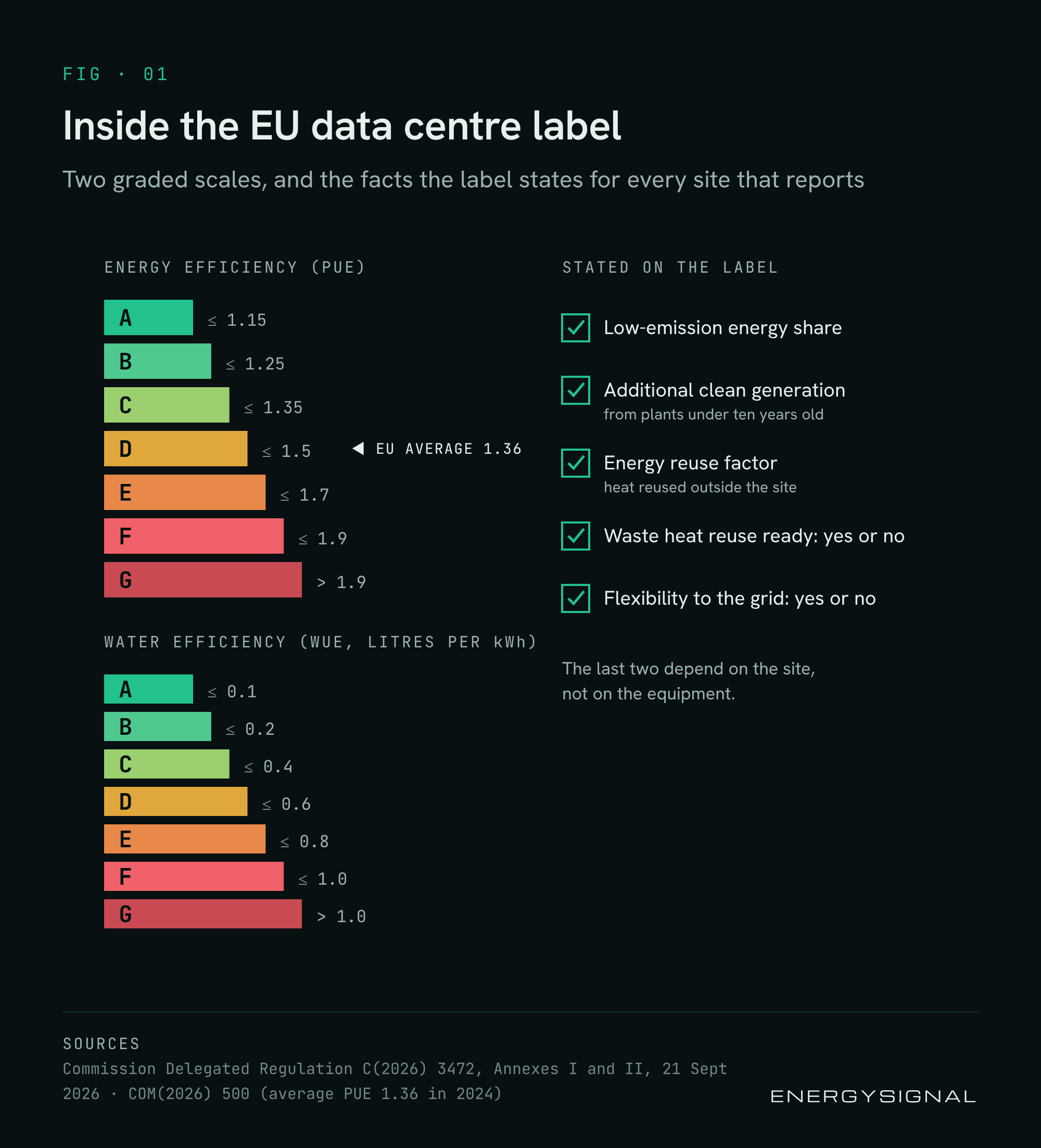
The label has two graded scales and a set of stated facts. The Commission's own Q&A lists three rated dimensions, "power use efficiency, water use efficiency, use of low-emission sources", and a set of other indicators, "grid functions, waste heat reuse readiness".
Energy efficiency, A to G. The grade comes from the power usage effectiveness, which is all the energy the data centre uses divided by the energy its IT equipment uses. The annexes set the classes: A for a PUE of 1.15 or below, B up to 1.25, C up to 1.35, D up to 1.5, E up to 1.7, F up to 1.9, and G above 1.9.
Water efficiency, A to G. The same ladder applies to water usage effectiveness, measured in litres per kWh of IT energy. A is 0.1 or below, B up to 0.2, C up to 0.4, D up to 0.6, E up to 0.8, F up to 1.0, and G above 1.0.
Low-emission energy. The label reports the share of the data centre's energy that comes from low-emission sources, and it shows whether the operator "contributes to the creation of new, additional clean energy generation", for instance through power purchase agreements with plants "which are not older than ten years or which have been substantially refurbished over the last ten years". Buying certificates from an old hydro plant does not count as additional. A new plant next to the site does.
Two facts a host can supply. Annex II lists, among the items the label states, the "provision of flexibility functions to the grid or not" and "whether the data centre is 'waste heat reuse ready' or not", next to the energy reuse factor, which is the share of the data centre's energy that is reused outside its boundary. Flexibility, in the amended definition, covers "peak demand shifting, flexibility of any type, firm frequency response". Neither item is graded yet. But both are printed on every label, and the regulation's review clause asks the Commission to reassess the scheme by 31 December 2028.
The EU database generates the label from data the operator has already reported, so there is no application to make and no fee to pay. The only thing an operator can change is the data, and two of those lines depend on the site it chooses.
What the first reporting rounds found
The label arrives with a baseline. The Commission's report on the energy efficiency of data centres, published on the same day as the regulation, summarises the first round of reporting, which covered 2024.
- 770 data centres reported, "representing around 36% of the estimated total of data centres in the EU falling under the reporting requirement". The second round brought in more.
- The average reported PUE was 1.36, against a global average of 1.58 in 2023. On the new ladder, 1.36 is a D.
- The EU-wide weighted average renewable energy factor was 0.86.
- "Only 67 data centres reported some waste heat reuse in the first reporting period", and "approximately 1.8% of the total heat generated by data centres is being reused in the EU".
- The Commission's estimate is that data centres in the EU used 68 TWh of electricity in 2024.
Two of those lines are where we expect the label to move first. The average site sits in class D, one hundredth of a point from C. And heat reuse is at 1.8%, which is low, so almost every operator that wants "waste heat reuse ready" on its label will need a site where that is actually true.
Where it came from, and where it goes
The scheme is the second step in a sequence that was written into EU law in 2023, and the steps after it already have dates.
The directive. Article 12 of the Energy Efficiency Directive required member states, "By 15 May 2024 and every year thereafter", to make data centres with at least 500 kW of installed IT power publish their energy data. It also asked the Commission to assess that data by 15 May 2025 and, where appropriate, propose further measures "including establishing minimum performance standards". Article 26(6) of the same directive separately requires data centres above 1 MW to use their waste heat unless they can show it is not technically or economically feasible.
The reporting regulation. Delegated Regulation (EU) 2024/1364 set out what had to be reported and when. The first submission was due by 15 September 2024, then by 15 May each year, covering the four key ratios (PUE, water usage effectiveness, the energy reuse factor and the renewable energy factor) and a yes or no on "functions that support the stability, reliability, and resilience of the electrical grid". The September 2026 regulation amends it and adds the label.
The Cloud and AI Development Act. The Commission's proposal of 3 June 2026 would let member states designate data centre acceleration zones with faster permitting. Its recitals say the sustainability requirements for those zones should use the key performance indicators of the reporting regulation, and that member states should "facilitate clear and efficient procedures for grid connection and flexible connection agreements". The rating regulation's explanatory memorandum says the scheme "will be used to assess the sustainability of data centres in other EU legislation, including in the Cloud and AI Development Act". So the label is also the measuring stick that other rules will use.
Minimum performance standards. Alongside the label, the Commission opened a call for evidence on minimum performance standards for data centres. Its stated aim is "to ensure that all new or retrofitted data centres meet a minimum performance level for energy efficiency, water use, waste-heat reuse, services to the grid and other selected sustainability criteria". The roadmap's timing is a needs assessment by 2027. If standards follow, heat reuse and grid services turn into conditions of building.
National rules run ahead. Germany's Energy Efficiency Act already requires data centres starting from 1 July 2026 to reach a PUE of 1.2 or better, which is class B on the EU ladder, and to reuse at least 10% of their energy, rising to 20% for those starting from July 2028. To be fair, a bill now before the Bundestag would soften the timing and make the heat duty conditional on a suitable network nearby.
What it means for hosts, operators and investors
For hosts. Two lines on the label are decided by the site rather than by the equipment. One is whether the data centre is waste heat reuse ready, the other is whether it provides flexibility functions to the grid. A plant with a heat network, a process that runs on warm water or a district heating connection makes the first true. A connection with spare hours, behind which a flexible layer can step back on request, makes the second true. Neither costs the operator anything it would not have paid for anyway, and both now get printed on a document that regulators, customers and lenders will read. Our article "Heat as a Second Income" sets out what the heat is worth (energysignal.io/insights/heat-as-a-second-income). The point here is that the same heat is also worth a line on the label.
For operators. The label grades PUE from the operator's own data, and liquid-cooled modular compute with a water loop sits at the efficient end of the ladder because the cooling overhead is small. The additionality rule rewards new clean generation near the site rather than certificates. And the flexibility line is easiest to earn with a layer of compute that is built to step back, which is what a flexible layer next to a firm core does. On a site that has both, the operator gets the heat line and the flexibility line from the site itself.
For investors. The label joins a set of rules that are all starting to price the same things. The grid queue reforms rank requests by readiness and flexibility, the directive and German law carry heat duties, and minimum performance standards are now being scoped. Each of them raises the value of a site that already has a heat user and a flexible load, and lowers the value of one that has neither. In our view the label is the most visible of the lot, because it is public, it comes out every year and it can be compared across sites.
Start light, and earn the label on the way
The shape we keep coming back to is a core of AI or cloud capacity on firm supply, with a flexible layer of modular compute next to it that uses surplus or curtailed energy and can step back within minutes when the core or the grid needs the power. The flexible layer can also go in first, earning from the site while the firm supply and the grid upgrades are still being built.
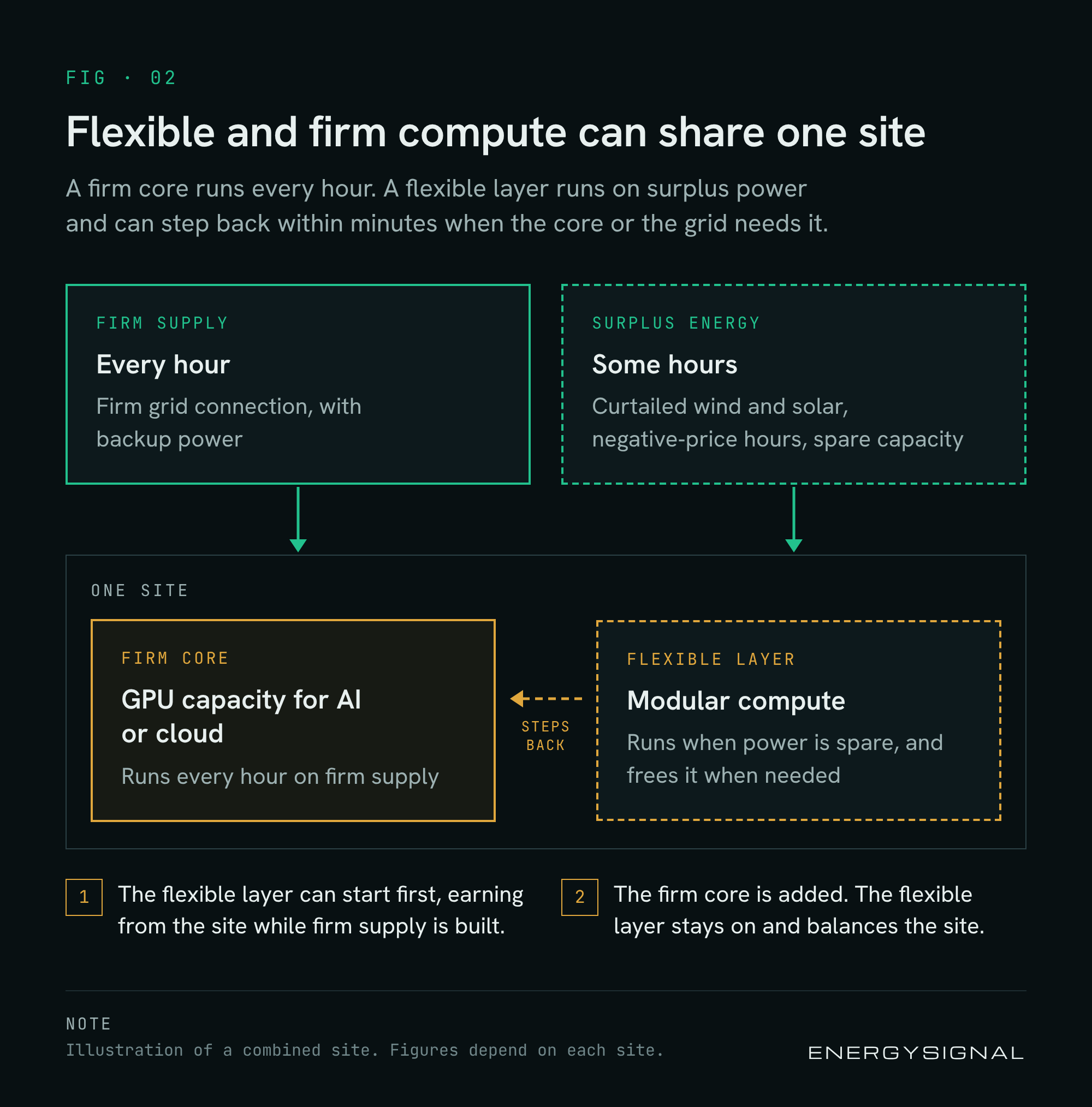
It is also the shape the label rewards. The flexible layer provides the flexibility functions and proves the heat loop in practice, and the firm core that follows inherits a site that is already waste heat reuse ready and already known to the grid as a load that can step back. So for a host, the first conversation about a flexible layer is also the first step toward the two lines every operator will soon want on its label.
If you own or run a site and want to know what it could be worth to an operator, we would be glad to help you work that out. Our calculators at energysignal.io/calculators let you try your own numbers and see what your site could be valuable for. And if you would rather talk it through, write to us at info@energysignal.io and we can go through your site with you.
Also in this series
- Heat as a Second Income: what compute heat is worth to a site
- Pricing Flexibility: what a load that can step back is worth
Sources
- European Commission, Delegated Regulation supplementing Directive (EU) 2023/1791 and amending Delegated Regulation (EU) 2024/1364 as regards the establishment of a common Union rating scheme for data centres, C(2026) 3472 and its annexes, 21 September 2026
- European Commission, Questions and answers on the data centre energy efficiency package, 21 September 2026
- European Commission, Report on the energy efficiency of data centres in the EU, COM(2026) 500, 21 September 2026
- European Commission, Call for evidence: Data centres in the EU, minimum performance standards, September 2026
- European Commission, Strategic Roadmap for Digitalisation and AI in the Energy Sector, COM(2026) 501, 3 June 2026
- European Commission, Proposal for a Regulation establishing a framework of measures for strengthening Europe's cloud and AI ecosystem (Cloud and AI Development Act), COM(2026) 502, 3 June 2026
- Directive (EU) 2023/1791 on energy efficiency, Articles 12 and 26
- Commission Delegated Regulation (EU) 2024/1364 on the first phase of the rating scheme, 14 March 2024
- Section 11 of the Energieeffizienzgesetz and the Bundestag's summary of the 2026 amendment bill, 5 October 2026
Information only, as of the date shown. Not an offer, and not legal, tax, regulatory or investment advice. Any arrangement is agreed only in signed agreements.